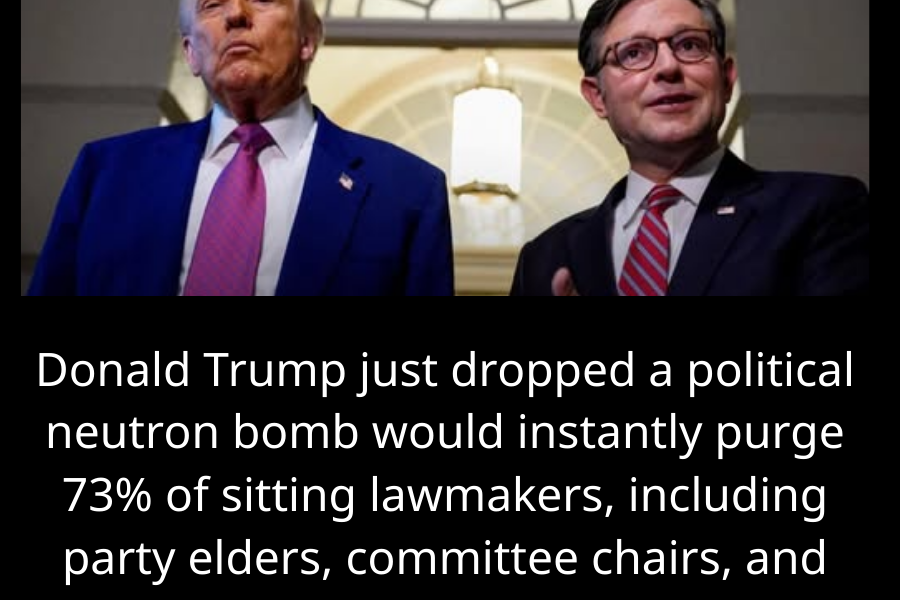
The 73% Purge: Trump’s Term Limit Gambit and the Dangerous Allure of Political Amnesia
WASHINGTON — Let’s start with the number, because that’s the grenade tossed into the cloakroom: 73%. According to a Congressional Research Service analysis of the current membership, a hard 12-year cap for Senators and a 6-year limit for House members would forcibly retire nearly three-quarters of sitting lawmakers. Not through election. Through administrative extinction.
Donald Trump’s proposal—resurrected from his 2016 playbook and framed as a cure for “corrupt career politicians”—isn’t just policy. It’s political theater of the highest order. It speaks directly to a profound, bipartisan public rage: the feeling that Washington is a remote, self-perpetuating aristocracy. But the question isn’t whether the sentiment is popular. It’s whether this particular surgery would cure the patient—or simply remove its memory, leaving the body politic lobotomized and easier to manipulate.
The Allure of the Guillotine: Why “Drain the Swamp” Still Resonates
The appeal is visceral, almost primal. Term limits promise a mechanical solution to a moral problem. If corruption and complacency grow with tenure, then cap the tenure. Simple. Elegant. Satisfying.
Trump’s framing is perfect culture war alchemy:
-
It targets a universally despised class: “Career politicians.” (Never mind that the presidency itself is a political career.)
-
It uses a populist, anti-elitist lever: The outsider forcing the insiders to clock out.
-
It offers a numerical “reset”: 73%! A clean sweep! The ultimate expression of disruptive politics.
Polls consistently show broad public support for congressional term limits, often near 80%. The frustration is real. The feeling that members spend more time dialing for dollars from lobbyists than listening to constituents is real. The proposal taps into a deep, justified anger about a system that seems rigged for incumbency.
But here’s the brutal, unsentimental truth: Term limits primarily don’t limit power. They relocate it.
The Unintended Consequences: Where Power Flees When Politicians Leave
Imagine the 73% purge happens. What fills the vacuum?
1. The Permanent Bureaucracy & Lobbyist Class Strengthens.
A junior Senator in their first term, facing a hard 12-year clock, is no match for a Deputy Assistant Secretary who’s been in the same office for 25 years, or a K Street lobbyist who wrote the last reauthorization bill. Institutional memory and expertise shift from elected, accountable officials to unelected, unaccountable staff and influencers. The learning curve for complex policy (budgets, defense, healthcare) is steep. Term limits ensure lawmakers are perpetually on that curve, forever reliant on the “permanent Washington” they were meant to disrupt.
2. The Fundraising Frenzy Intensifies.
If you only have 6 years in the House, you start running for re-election on day one. The pressure to raise money from Day 1 becomes apocalyptic. There’s no time to build a reputation on legislative work; your metric for survival becomes quarterly fundraising reports. This doesn’t reduce the power of money in politics; it supercharges it.
3. Accountability? Or Less Accountability?
Proponents argue term limits increase accountability by ensuring politicians can’t get “too comfortable.” But what’s more accountable: a politician who knows they must face voters every 2 or 6 years to keep their job, or a lame-duck politician in their final term who is completely insulated from electoral consequences? A member on their way out can vote for wildly unpopular but donor-friendly bills with zero fear of reprisal. They are, in essence, unaccountable.
“Term limits are a placebo for political pain,” argues Dr. Eleanor Vance, a political scientist who studies legislative institutions. “They address the symptom—long tenure—while ignoring the disease: the structural incentives around money, gerrymandering, and partisan primaries that create the ‘safe seat’ careerist in the first place. It’s like trying to fix a leaky roof by mandating you can only own a house for six years. The roof still leaks; you just have a parade of inexperienced owners who can’t fix it.”
The 73%: What Would We Actually Lose?
Beyond the mechanics, consider the human capital. That 73% includes:
-
The chairs of every major committee, who (for all their faults) understand the arcana of tax law or defense procurement.
-
The legislators who built relationships across the aisle over decades, who know how to craft a compromise that can pass.
-
The institutionalists who, at critical moments, have acted as a brake on executive overreach or party extremism.
You would replace them with a constant churn of newcomers, many of whom would see Congress not as a calling, but as a stepping stone. Their eye would be on their next job—often in the influence industry their term limits were supposed to curb. The incentive shifts from long-term legacy to short-term, headline-grabbing, partisan combat that builds a personal brand for a post-Congress career on cable news or as a lobbyist.
The Real Disease vs. The Seductive Quick Fix
The ailments of Washington are real: the corrupting influence of money, hyper-partisan gerrymandering that creates uncompetitive seats, a primary system that rewards extremism. These are systemic, structural problems. Fixing them is boring, complex, and lacks a catchy number like “73%.”
Term limits are the opposite. They are a simple, sweeping, symbolic solution. They feel like action. They sound like revolution. But they would likely make the core problems worse while creating new ones, all while giving the public the cathartic, but false, impression that the “swamp” has been drained.
Trump’s proposal isn’t a governance plan. It’s a polemic. It’s a weaponized expression of disgust. It’s effective politics because it confirms what people already feel: the system is broken. Whether it’s effective policy is an entirely different question—one that the 73%, unsurprisingly, and perhaps even rightly, would fight to the death to prevent, not out of mere self-interest, but out of a belief (however self-serving) that experience still matters in the craft of legislation.
The debate over term limits, then, is a proxy war. It’s a fight between the desire for clean-slate disruption and the faith in evolved, messy stability. And in that fight, the number “73%” will always be a more powerful rallying cry than a 50-page plan to reform campaign finance. That’s the tragedy, and the genius, of the proposal.