(The air in the room just changed. It’s no longer about policy or polling. It’s about the sound of a car slowing down outside your home, a window rolling down, and a word—that word—hanging in the air like a threat. This is where politics gets personal, and fear becomes a public record.)
The R-Word: When Political Rhetoric Crosses the Street and Parks in Your Driveway
Forget the deficit. Forget the fraud headlines. For a moment, strip away the “D” and the “R.”
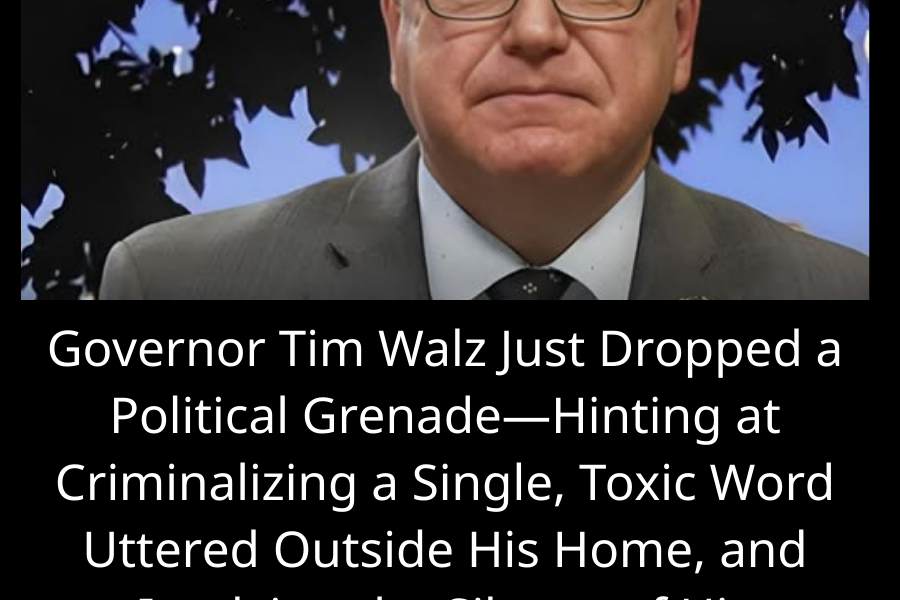
What we have here is a human being, who also happens to be a state governor, standing before cameras and describing what it feels like to be personally, domestically targeted. This isn’t about disagreeing with his budget. This is about someone shouting a slur—the slur for intellectual disability—at him and his family in their own neighborhood.
His message is a seismic shift in the political conversation. He is not arguing a point. He is sounding an alarm.
“We know how these things go. They start with taunts, they turn to violence.”
This is the core of his plea. He is drawing a direct, historical line from dehumanizing language to physical harm. He is invoking the darkest chapters of political violence, where figures are first mocked, then marginalized, then marked.
He is saying: The word is the first stone.
Part 1: The Power of the “R-Word” – Dehumanization as a Pre-Attack Protocol
Why that word? In the arsenal of insults, “retard” occupies a uniquely vile space. It is not just a critique of policy or intelligence. It is a medicalized slur that historically justified segregation, institutionalization, and abuse. To use it is to declare someone subhuman, unfit, worthy of ridicule and exclusion.
When hurled at a sitting governor, it performs a specific, corrosive function:
-
It Strips Authority: It attempts to reduce a chief executive to a caricature of incompetence, framing his governance not as wrong, but as pathological.
-
It Sanctions Contempt: It makes hatred socially acceptable within a certain in-group. If the governor is a “retard,” then why respect his office? Why obey his policies? Why treat his family with decency?
-
It Creates a Permission Structure: It is the verbal equivalent of throwing the first egg. It tests the boundaries. If this level of dehumanizing abuse is met with silence or even cheers, the next escalation—a threat, a brick, a bullet—feels less unthinkable.
Walz is pointing at the eggshells on his lawn and saying, “The next thing will be a rock.”
Part 2: The Deafening Silence – “I have yet to see an elected official… say, ‘You’re right.'”
This is perhaps the most damning part of his statement. It’s an indictment of cowardice and complicity.
He is not asking for Republicans to agree with his politics. He is asking for a basic, human, bipartisan condemnation of targeted bigotry and harassment. He is asking for someone—anyone—with an (R) next to their name to stand up and say, “No matter our differences, this is beyond the pale. This is shameful.”
The silence he describes is louder than the slur. It sends a message: This behavior is a valid tactic. This hatred is a permissible cost of doing political business. Your fear is not our concern.
That silence normalizes the abnormality. It tells the people in those cars, and everyone watching, that this new, vicious ruleset is now in play.
Part 3: The Strategic Vulnerability – A Governor Admitting Fear
Politicians, especially executives, are never supposed to show this card. The image of strength is everything. By saying “I’m worried” and “deeply concerned,” Walz is breaking a cardinal rule. He is revealing vulnerability.
But in doing so, he is making a critical, calculated exchange: he trades the image of impersonal strength for the power of personal witness.
He is no longer just Governor Walz, manager of the state. He is Tim Walz, husband and father, whose home is now a protest site. His authority now derives not from his office, but from his experience as a target. It is a profoundly emotional, and potentially powerful, repositioning. He is arguing that the threat isn’t to an institution, but to the very individuals who make democracy work.
The Verdict: A Canary in the Statehouse
Tim Walz is doing something rare. He is publicly documenting the radicalization of the American political climate at the micro level, using his own home as the data point.
This press conference isn’t about the next bill. It’s a forensic report on how national, fever-swamp rhetoric—the kind that labels opponents as “vermin,” “traitors,” or “human scum”—trickles down, metabolizes, and eventually manifests as a car idling outside a private residence, its occupants feeling empowered to scream slurs at the first family.
He is tracing the supply chain of hate, from the cable news chyron and the social media post all the way to his quiet street.
When he says, “This creates danger,” he is issuing a warning that transcends partisanship. He is saying the market for violent rhetoric is bullish, and the delivery is now door-to-door.
The “R-word” isn’t just an insult. It’s a metric. And Governor Walz is telling us the reading is in the red zone. 🚨