The Percentages and the Politics: Inside the Minnesota “Assault Weapons” Poll and the National Divide
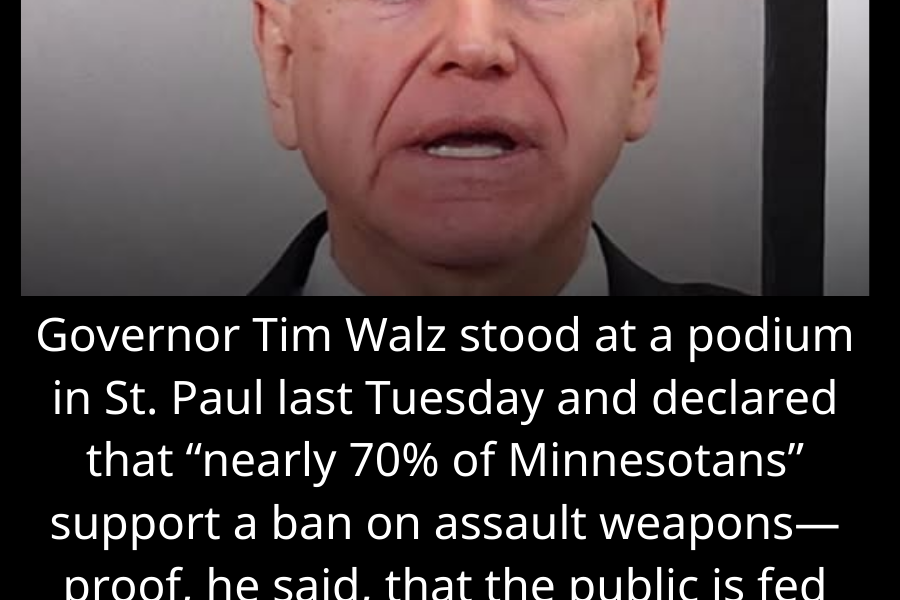
ST. PAUL, Minnesota — The number is politically potent: “Nearly 70% of Minnesotans support it.” When Governor Tim Walz cites this poll to argue that “most Americans want assault weapons banned,” he’s performing a delicate rhetorical dance. He’s using a strong, specific local data point to advance a national argument, banking on the idea that Minnesota’s sentiment is a proxy for the country’s.
But this isn’t just a debate about polling methodology. It’s a case study in how one of America’s most visceral cultural divides gets filtered through the lenses of local politics, national messaging, and raw emotional rhetoric.
Let’s dissect the move, the math, and the minefield.
The Poll: What It Actually Says and Doesn’t Say
First, the context, which is crucial. The poll is from Minnesota, not nationwide. This distinction is everything.
Minnesota is a purple state that has trended blue in recent statewide elections, but with a strong rural, pro-Second Amendment tradition. A 70% support level there for a ban on “assault weapons” is significant and likely reflects genuine urban-suburban concern, particularly after high-profile shootings. It gives Walz, a Democrat, a powerful home-state mandate to push for such legislation.
However, Governor Walz then extrapolates this to “most Americans.” This is a political inference, not a statistical one. National polling on this issue is more complex and less decisive. Support for an “assault weapons ban” often polls between 55% and 65% in national surveys, but that support can be highly sensitive to the specific wording of the question, the definition of “assault weapon,” and the political moment. It is a majoritarian, but not overwhelming or universal, national position.
Walz’s statement is a classic political “local mandate, national message” strategy. He’s saying: Look at this sensible, bipartisan consensus in my heartland state. This isn’t coastal elitism; this is what Americans everywhere want.
The Terminology Trap: “Assault Weapon” as Political Lexicon
The debate often founders on definition. The term “assault weapon” is a political and legal construct, not a precise technical classification used by the military or firearms manufacturers. It generally refers to semi-automatic firearms with certain cosmetic or functional features (like pistol grips, detachable magazines, etc.). For ban proponents, it describes a class of weapons designed for lethal efficiency in mass shootings. For opponents, it’s a frightening but nebulous label applied to commonly owned rifles to stigmatize them.
When a poll asks about banning “assault weapons,” respondents are reacting to this culturally loaded symbol, not a forensic specification. This is why polls can show high support for a ban while also showing strong opposition to banning “semi-automatic rifles”—terms describing much of the same hardware.
“The poll number is a Rorschach test of fear and principle,” explains Dr. Lena Kowalski, a sociologist who studies risk perception. “For those who see mass shootings as a unique and preventable horror, supporting a ban feels like a logical, moral response to an obvious weapon of choice for that horror. For those who see firearm ownership as a fundamental right and distrust government overreach, the same question sounds like: ‘Do you support banning a vaguely defined category of the most popular rifles in America based on their scary appearance?’ The 70% isn’t a consensus on policy mechanics; it’s a measure of the salience of terror versus the salience of liberty in the current moment.”
The “Morons” Insult: Dehumanization as Political Dead End
The comment “Minnesota voters are morons” is not an argument. It is emotional decompression. It represents the absolute failure of political discourse. It transforms 70% of a state’s electorate—neighbors, co-workers, family members—into a monolithic, stupid Other.
This reaction is instructive because it mirrors the existential anger felt on both sides of the debate.
-
From a gun rights perspective: It feels like 70% of people are willing to punish law-abiding citizens and infringe on a constitutional right based on media-driven panic and a misunderstanding of the tools themselves. The insult channels that frustration.
-
From a gun control perspective: It feels like opposition to a ban is so irrational and callous in the face of slaughtered children that it can only be explained by stupidity or malice.
Both sides, in their most heated moments, dehumanize the other. “Morons” vs. “baby killers.” This is where the debate lives online and in rallies. It is where governance goes to die.
The Political Reality: Why Walz’s Statement Matters
Walz’s move is savvy politics for his goals:
-
It localizes a national issue: He roots a contentious national debate in the specific will of his constituents.
-
It puts opponents on the defensive: He frames opposition as defying a clear supermajority, not just a policy disagreement.
-
It energizes his base: For Democratic voters, especially in the suburbs, gun violence is a top-tier motivator.
But it also ensures escalation. For the 30% opposed—and the millions nationally who agree with them—this isn’t a popular mandate; it’s the first step toward confiscation, proof that coastal liberal views have infected the heartland. It guarantees fierce legislative battles and lawsuits.
The Bottom Line
The 70% figure is real, powerful, and context-specific. Walz is using it as a lever. The insult “morons” is the sound of that lever meeting immovable resistance.
The tragedy of the American gun debate is that it has long ceased to be a policy discussion about homicide rates, suicide prevention, mental health resources, or specific firearm regulations. It is a values war fought with polls, labels, and insults, where every statistic is a weapon and every opponent is a caricature.
Governor Walz has fired a salvo in that war. The response—in the legislature, in the courts, and in the ugly comments sections—will simply prove that while 70% may agree on a poll question, the country is nowhere near agreement on what it means to be safe, free, or sane.