(The air crackles with the sound of a history book being slammed shut, and another one being opened to a fiercely contested page. This isn’t a comment on immigration. It’s a battle over foundational mythology.)
The Founders and The Foundry: The High-Stakes War Over Who “Built This”
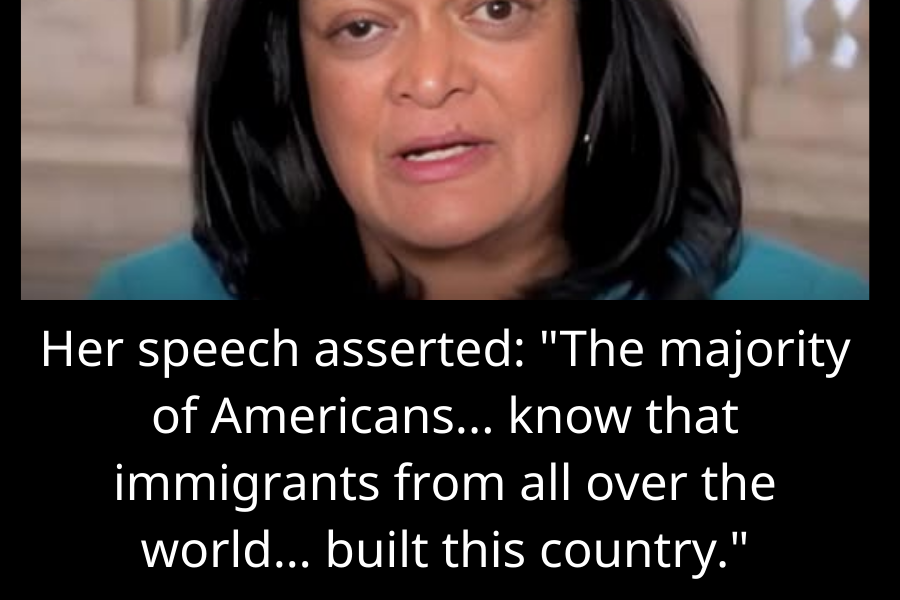
Representative Pramila Jayapal didn’t just praise immigrants. She performed a historical pivot. She shifted the weight of the American narrative from its 18th-century cornerstone to its 21st-century engine room.
Her statement is a direct, conscious reframing of the most sacred American question: Who built this?
By listing Somalia, India, Latin America, Africa, she is not merely adding to a list that includes England, Germany, and Italy. She is re-centering the story. She is declaring that the ongoing, daily labor of recent immigrants—the care work, the tech code, the farm harvest, the startup hustle—is not a supplement to the American project. It is the American project, here and now.
And the furious backlash—“she’s implying that people with European ancestry contributed nothing”—is the predictable, seismic reaction to that pivot. It’s the sound of a dominant historical narrative feeling displaced.
Part 1: Jayapal’s Calculus – From “Founding” to “Building”
Jayapal’s word choice is meticulously powerful: “built” and “make.”
-
“Built” (Past Tense): This claims a share in the historical foundation. It says the railroads, the cities, the agricultural empires were constructed by Chinese laborers, Irish navvies, enslaved Africans, and Mexican vaqueros alongside the plans of European-descended engineers and financiers. It’s a correction to the portrait gallery of history, insisting the frame includes the hands that laid the bricks.
-
“Make” (Present Continuous Tense): This is the real thrust. America is not a finished monument to be preserved. It is a verb. It is being made—today, tomorrow—by the nurse from Lagos, the engineer from Bangalore, the line cook from Guatemala, the entrepreneur from Somalia. Their labor, culture, and community are not happening in America; they are actively constituting America.
She is swapping a static, patrimonial inheritance model (“This is what our forefathers built for us”) for a dynamic, contributory creation model (“This is what we are all building, together, right now”).
Her list—Somalia, India, Latin America, Africa—isn’t an erasure. It’s an expansion of the “we.”
Part 2: The Backlash – The Panic of Displacement
The counter-claim—that she is “implying people with European ancestry contributed nothing”—is a classic, defensive rhetorical move. It’s the “Fallacy of the Excluded Middle,” weaponized.
The logic goes: If you celebrate Group B, you must be negating Group A. If you say “immigrants built this,” you must mean “non-immigrants (or earlier immigrants) did not.”
This misreads her intent but reveals a profound anxiety. For a segment of the population, American identity is still a zero-sum story. There is only so much credit in the national narrative. To highlight new builders feels, to them, like scratching the names of the original architects off the cornerstone.
It translates her inclusive vision into an exclusive threat. It hears: “You are no longer the protagonists of this story. Your chapter is over.”
Part 3: The Two Competing American Scriptures
This clash isn’t about policy. It’s about national scripture.
-
Scripture A (The Traditional Canon): America was founded by European Enlightenment thinkers and pioneers. Later immigrant waves assimilated into this pre-existing, superior culture and contributed to its growth. The narrative arc is one of grateful arrival and adoption. The foundational act is complete (1787). What follows is maintenance and expansion.
-
Scripture B (The New Testament Jayapal is Citing): America is perpetually being built by successive waves of newcomers. The “founding” was merely the first draft, written by one group of immigrants. The true, enduring American genius is continuous, pluralistic creation. The foundational act is ongoing, and the most relevant builders are often the most recent arrivals, who embody its renewing spirit.
One sees America as a finished house, where we argue over who gets credit for the original blueprints and who is tracking mud on the floor.
The other sees America as a permanent construction site, where the original framers were essential, but the plumbers, electricians, and drywallers who showed up this morning are just as vital to the fact that the lights turn on today.
The Verdict: A Fight Over the Soul’s Blueprint
Pramila Jayapal is not erasing history. She is expanding the definition of “builder” from a historical caste to an ongoing, democratic vocation.
The furious reaction is the sound of a paradigm being challenged. It is the fear that in this new, bustling, noisy construction site, the statues of the original architects will be moved to the side, surrounded by scaffolding and the vibrant chaos of new work.
She is saying the country is not a museum to be curated, but a workshop to be staffed. And in that workshop, the tools are being passed to new hands every single day.
The question isn’t “Who built it?” The real fight is over the tense of the verb. Is America something that was built, or something that is forever being built? The answer you choose determines who you see when you look at your neighbor, and what you think they owe the past—or what the past owes them. ⚒️🗽