The Medicaid Loophole: The Fact, The Frame, and The Fractured Trust
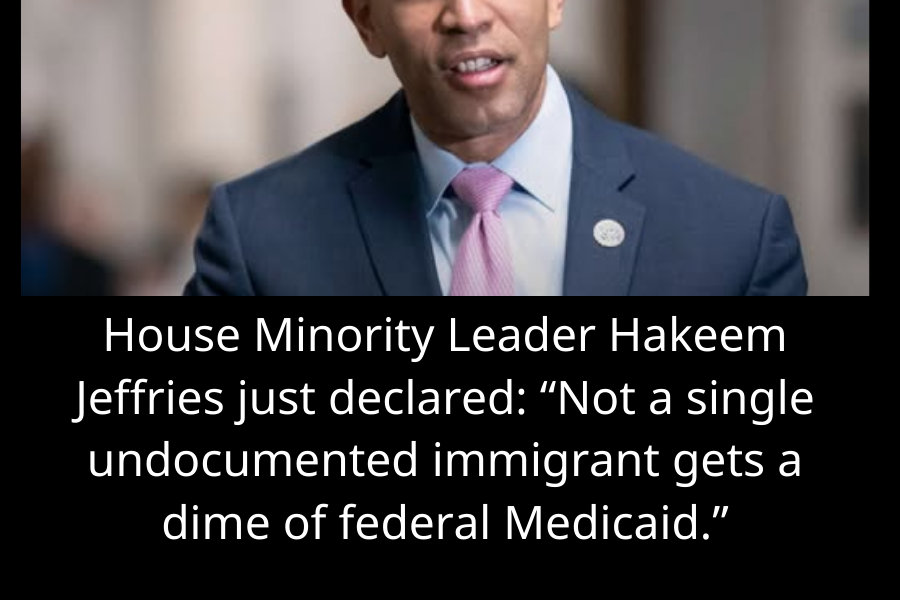
WASHINGTON — The statement from House Minority Leader Hakeem Jeffries is, in the strictest legal sense, a clean bullet point: Undocumented immigrants do not receive federal Medicaid dollars for comprehensive coverage. It’s a defensible fact, a retort to the sweeping claim that “illegals get all our benefits.”
But in American politics today, a fact is rarely just a fact. It is a rhetorical weapon, a truth claim, and a Rorschach test for the public’s decaying trust in institutions. Jeffries’ comment isn’t being debated on C-SPAN; it’s being dissected in the court of public perception, where legal technicalities collide with lived experience and visceral suspicion.
Let’s autopsy why this statement, while technically accurate, feels to so many like an act of political jujitsu rather than transparent clarity.
The Legal Reality: A Wall with Emergency Doors
Jeffries is correct on the statute. The 1996 Personal Responsibility and Work Opportunity Reconciliation Act explicitly bars undocumented immigrants from receiving “federal public benefits,” which include the comprehensive (non-emergency) coverage of Medicaid. The federal treasury does not cut checks for their routine doctor visits, prescriptions, or elective procedures.
However, the policy landscape is not a wall; it’s a wall with mandated, federally-funded doors.
-
Emergency Medicaid: Federal law requires states to provide Medicaid coverage for emergency medical services for anyone who meets other eligibility criteria (like income), regardless of immigration status. This includes labor & delivery, severe trauma, and acute life-threatening conditions. The federal government reimburses states for a significant portion of these costs. So while it’s not “comprehensive coverage,” it is a major, mandated federal expenditure on behalf of the undocumented population.
-
The State & Local Layer: States and counties, using their own tax revenues, can and do create programs that offer broader health services to undocumented residents. California’s Medi-Cal for all low-income residents regardless of status is the prime example. When a critic says “my taxes pay for their healthcare,” they are often (correctly) referring to state and local taxes funding these programs, not federal Medicaid. Jeffries’ statement sidesteps this entire layer of the issue.
-
The Community Cost Shift: When uninsured undocumented individuals (who are ineligible for ACA subsidies and most employer plans) receive non-emergency care, the costs don’t vanish. They are absorbed by hospitals as uncompensated care, which is partially offset by federal Disproportionate Share Hospital (DSH) payments and passed on in the form of higher charges for insured patients. This creates a de facto, indirect public subsidy that is financially real but bureaucratically invisible.
“Leader Jeffries has offered a statement that is legally precise but contextually anemic,” says Dr. Alicia Carter, a health policy ethicist at Georgetown. “It’s like saying ‘the library doesn’t give books to people without cards’ while ignoring that we fund a separate, expensive reading room for them next door that’s open 24/7 for emergencies, and the librarian often just hands them books from the back to avoid a scene. The technical truth remains, but it fails to describe the ecosystem of care and cost that actually exists.”
The Perception Chasm: Why The “Technically True” Feels Like a Lie
For millions of Americans, the lived experience is this:
-
They see crowded emergency rooms.
-
They hear about state programs expanding coverage.
-
They pay rising insurance premiums and hospital bills.
-
They are told, in absolutist political rhetoric, that “they” are getting benefits “we” pay for.
When a leader like Jeffries offers a narrow, technical correction, it doesn’t bridge that chasm—it highlights it. To the skeptical ear, it sounds like a politician using a loophole of definitions (“federal dollars,” “comprehensive coverage”) to dismiss a legitimate, broader concern about public resources and fairness.
It feels like wordplay. It feels like being told to ignore the elephant in the room because, technically, it’s standing in a section labeled “state jurisdiction” or “uncompensated care.”
The Credibility Crisis: Absolutes in a Gray World
This is the core of the modern distrust. The public is drowning in complexity—intertwined funding streams, federalism, hidden cost-shifting. They crave clarity. But when politicians offer clarity, it often comes in the form of over-simplified absolutes that serve a political narrative.
The Right says: “They’re stealing your benefits!” (An over-simplified absolute that ignores legal barriers).
Jeffries says: “They get zero federal Medicaid dollars.” (An over-simplified absolute that ignores the complex financial ecosystem).
The public is left in the middle, trusting neither, because both absolutes feel engineered to win an argument, not to explain a reality.
Do statements like this from elected officials have credibility anymore?
For their base, yes. They are effective rallying cries and defensive shields. For the broader, persuadable middle, their credibility is hemorrhaging. Each overly precise, context-stripped statement is seen as evidence that the speaker values “winning the point” over “explaining the problem.”
The Path Forward (If There Is One)
The solution isn’t for leaders to stop stating facts. It’s for them to start framing truths.
A more credible, transparent statement might have been:
“Federal law rightly prohibits undocumented immigrants from enrolling in standard Medicaid. However, we do provide and fund emergency care, and some states use their own funds for broader programs. This creates a complex, often inefficient system that impacts hospitals and local budgets. Our focus should be on comprehensive immigration reform to address the root cause, rather than pretending these intertwined health costs don’t exist.”
That’s harder. It’s nuanced. It concedes ground. It doesn’t fit on a bumper sticker. But it treats the public like adults capable of holding a complex thought.
Jeffries gave a legally correct answer to a politically loaded question. In today’s America, that’s often the most damaging kind of correct—a fact that fuels more suspicion than it dispels. Until leaders dare to speak in shades of gray about the issues people experience in color, the trust will continue to drain, one technically-true statement at a time.