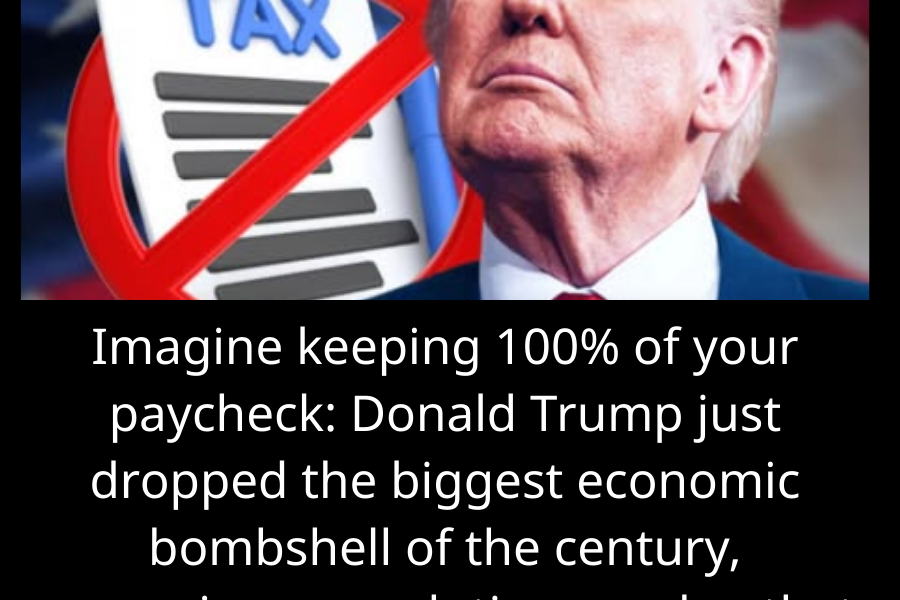
(The sound you just heard was 100 years of American fiscal policy exploding. The proposal isn’t a tax cut. It’s a cultural demolition. Let’s map the blast radius.)
The Tariff Gambit: How Ending the Income Tax Wouldn’t Just Change Your Paycheck—It Would Rewire America
Stop. Breathe. Let the headline sink in.
“ENDING the federal income tax.”
Not trimming it. Not flattening it. Not adjusting brackets. Ending it. Erasing the single largest source of federal revenue—the lifeblood of the modern U.S. government since the 16th Amendment in 1913. In its place: “massive tariffs.”
This isn’t a policy pivot. This is a philosophical revolution. It’s the economic equivalent of declaring the Earth flat and proposing to sail off the edge. The promise is visceral, emotional, and brilliant in its simplicity: You keep every single dollar you earn. The government funds itself by taxing “them”—foreigners, imports, the world.
Let’s dissect this “game-changer” before the confetti hits the floor.
Part 1: The All-American Paycheck – The Psychology of Taking Back “Your” Money
First, the raw, undeniable appeal. The psychological power of this idea is atomic.
For the average American, the federal income tax is an abstract, painful leak. It’s FICA, withholdings, a chunk gone before you ever feel it. It’s the complexity of filing, the dread of the IRS, the feeling of paying for a government that feels distant and dysfunctional.
Trump’s proposal attacks this at the root. It offers a pure, unmediated transaction between labor and reward. “Your full paycheck.” The imagery is potent: a worker looking at a stub and seeing their number, whole and untouched. It’s a restoration of what feels like a fundamental property right. It’s the ultimate “Take Back Control” for the individual earner.
It promises a psychological liberation from the most tangible symbol of federal overreach. This isn’t about economics for most people at first blush; it’s about sovereignty over one’s own labor.
Part 2: The “Massive Tariff” Swap – The World Pays, Right?
Here’s where the simple promise meets brutal, global complexity. The proposal swaps an invisible, broad-based tax on income for a highly visible, targeted tax on trade.
The Theory (The “Trump Doctrine” of Public Finance):
-
Tariffs are taxes paid by foreign companies and countries when they sell goods to Americans.
-
By slapping “massive” tariffs on imports, you force China, Mexico, Europe, etc., to fund the U.S. government.
-
Result: Americans get a tax cut, the treasury gets revenue, and we punish “bad actors” who’ve “ripped us off.”
The Reality (What Every Econ 101 Textbook Screams):
-
Consumers Pay, Always: Tariffs are a tax on the importer, who immediately passes the cost onto the American consumer and business. That “massive” tariff on Chinese steel raises the price of every car, appliance, and construction project in the U.S. The tariff on components raises costs for American manufacturers. You don’t see it on your paycheck, but you pay it at the Walmart register, the car dealership, and the hardware store. It’s a consumption tax by another name, and it’s deeply regressive—it hits low and middle-income families hardest, as they spend a larger share of their income on goods.
-
Retaliation is Guaranteed: Trading partners don’t just fund the U.S. Treasury and say “thank you, sir.” They retaliate with tariffs on American exports—soybeans from Iowa, whiskey from Kentucky, software from California. Farmers and export-driven industries get annihilated. Jobs are lost.
-
The Math is Staggering: The federal income tax brought in about $2.6 trillion in 2023. To replace that with tariffs, the average tariff rate on all imports would have to soar from roughly 2-3% today to something astronomically high—experts estimate well over 40-50% on virtually everything coming into the country. This isn’t a tweak. It’s a trade nuclear winter. It would instantly make thousands of everyday goods vastly more expensive, trigger massive inflation, and risk a global trade collapse.
Part 3: The “Game-Changer” – A Radical Reshuffling of Power and Society
Beyond the economics, the implications are even more profound:
-
The Death of the IRS as We Know It: The symbolic victory is complete. The agency most hated by a segment of America is dismantled. But the enforcement apparatus simply shifts to ports, borders, and customs—a different kind of bureaucracy with the power to inspect, delay, and levy at the dock.
-
A Fortress America Economy: This policy completes the shift from a globalized, interconnected economy to a fortressed, protectionist one. It is the ultimate economic expression of “America First.” It tells the world: our prosperity is no longer tied to yours; in fact, we will fund ourselves by penalizing you for interacting with us.
-
The End of Progressive Taxation: The income tax is progressive (the more you make, the higher your rate). A tariff-based system is inherently regressive (the poor pay a larger share of their income on taxed goods). This would represent one of the largest wealth transfers upward in American history, dressed in the populist clothing of “keeping your paycheck.”
-
A Constitutional Earthquake: The 16th Amendment, which authorized the federal income tax, would become a relic. The power of the federal government would be fundamentally altered, its revenue hostage to the volatility of global trade flows and geopolitical spats.
The Verdict: Freedom or Fortress?
President Trump’s proposal is a masterstroke of political framing. It takes a complex, painful system and offers a seemingly clean, patriotic alternative: Your money stays with you. The world pays our bills.
But the devil isn’t in the details; it’s in the dazzling, dangerous illusion.
It swaps a visible, paycheck deduction for an invisible, embedded cost in the price of everything. It trades the certainty of a broad-based revenue stream for the volatility of a weaponized trade policy. It replaces a progressive (if flawed) system with a regressive one that hits the working class hardest at the cash register.
Is it a “game-changer”? Absolutely. It would change the game from Monopoly—a complex, rule-based, domestic economy—to Risk—a zero-sum, conquest-driven, global confrontation.
The promise is freedom: the unviolated paycheck.
The price is the fortress: a more expensive, isolated, and economically volatile America.
The real question isn’t whether we want to keep our full paycheck. It’s whether we understand what that “free” money will actually cost us at every turn, in every store, for the rest of our lives.
The proposal is on the table. The dice are in the air. The game, indeed, may be about to change forever. 🎲🇺🇸💰