A Constitutional Lockpick: The DOJ’s Extraordinary Bid to Unseal 2020
ATLANTA, 9:14 PM ET —
Let’s strip away the framing—the “BOMBSHELL” headlines, the “DEFIED” rhetoric, the “evidence” declarations—and examine the action in its cold, procedural reality.
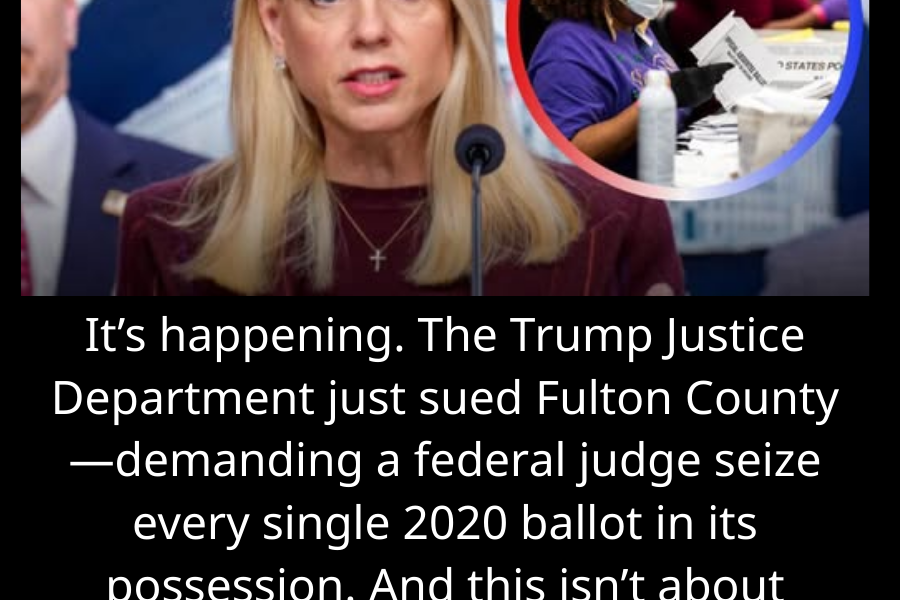
The United States Department of Justice has filed suit in federal court against Fulton County, Georgia, to physically seize every ballot, envelope, and digital record from the 2020 presidential election.
The reason given is straightforward: the county refused to comply with a federal subpoena.
The underlying motive, however, touches the third rail of American democracy: a sitting administration using the power of the federal government to forcibly unseal and re-examine state election results from four years prior.
This is not a routine records request.
It is a constitutional and political earthquake.
The Mechanics of the Move
According to the filing, the DOJ’s subpoena—issued months ago as part of an unspecified investigation—demanded:
-
Every used and void ballot from the November 2020 general election in Fulton County.
-
All absentee ballot envelopes with voter signatures.
-
Complete digital election records, including ballot images, audit logs, and tabulator data.
Fulton County officials declined, citing Georgia law that requires ballots to remain sealed under state custody unless opened by court order in specific legal contests. Their response, as characterized in the DOJ filing: “The ballots are sealed. We need a court order.”
The DOJ’s reply, in essence: “Here is the lawsuit. Now you have one.”
The department is now asking a federal judge to compel immediate compliance and authorize federal marshals to take physical possession of the materials if necessary.
The Unprecedented Nature of the Action
To be clear:
Federal investigators have examined election materials before.
States have fought subpoenas before.
But a full-scale seizure of an entire county’s presidential election records—ballots and all—by the DOJ, four years after the fact, outside the context of a traditional election contest or credible allegation of criminal fraud in that jurisdiction is without modern precedent.
“This is not an audit. It is an exhumation,” says Rebecca Green, a professor of election law at William & Mary. “They aren’t just asking for copies of reports or digital files. They are asking for the physical ballots themselves—the fundamental, forensic artifacts of democracy. Once those leave state custody under a federal subpoena, you cross a line between review and repossession. The chain of custody, the integrity of the records, the very precedent of federal control over state election evidence—all of it is now in play.”
Fulton County is, of course, ground zero for the Trump campaign’s post-2020 legal and political offensive. It is where the now-famous Raffensperger call took place, where state officials investigated and repeatedly affirmed the outcome, and where multiple GOP-led reviews found no evidence of widespread fraud.
By targeting Fulton, the DOJ is targeting the symbolic heart of the ‘stolen election’ narrative—and doing so with the full force of federal litigation.
The Legal Battleground: Federal Power vs. State Sovereignty
Fulton County’s “sealed ballots” argument is not a bureaucratic dodge.
It is a state sovereignty shield.
Georgia law treats voted ballots as secured material, accessible only under strict conditions—typically in an election contest brought under state law. The state has already conducted multiple hand recounts and audits of these same ballots, all verifying Joe Biden’s victory.
The DOJ’s lawsuit asserts federal subpoena power trumps those state protections when related to a federal investigation.
The unanswered—and explosive—question: What is the federal investigation?
The filing does not specify. It could relate to potential civil rights violations, to allegations of malfeasance by federal employees, or to something else entirely. But the timing, target, and totality of the demand unavoidably signal a forensic reinvestigation of the 2020 results under the guise of federal law enforcement.
The Political Fallout: An Election on the Ballot
Regardless of the legal merits, the political signal is blindingly clear:
-
Legitimizing the “Evidence” Narrative: By suing to seize ballots, the DOJ transforms a partisan talking point—“the evidence is in Fulton County”—into a federal litigation premise. It creates the appearance of a serious, pending discovery of fraud, even if none is ever found.
-
Weaponizing the DOJ: This action frames the Department of Justice not as an independent arbiter of law, but as an arm of the presidency’s political mission to unsettle the last election.
-
Testing Institutional Walls: It pressures the federal judiciary to either bless an extraordinary federal intrusion into state election administration or reject it and be painted as “obstructing justice.”
For election officials nationwide, the message is chilling: Your certified results are not final. Your custodial authority is conditional. Four years later, the federal government can come for your ballots.
What Happens Next
The case now goes before a federal judge, likely in the Northern District of Georgia.
The judge must decide:
-
Whether the DOJ’s subpoena is valid and enforceable.
-
Whether federal interest outweighs Georgia’s statutory protections for sealed ballots.
-
Whether the requested seizure is proportionate to the investigative need.
Any ruling will be immediately appealed.
The battle could reach the Supreme Court, placing the justices in the impossible position of deciding whether to allow the executive branch to effectively re-litigate a presidential election through evidence seizure.
The Real Stakes
This is not about paperwork.
It is about finality.
American democracy relies on the premise that elections end. That ballots are counted, certified, and archived—not indefinitely subject to re-examination by each new administration.
By moving to unseal Fulton County’s 2020 ballots, the DOJ is not just seeking evidence.
It is testing whether the artifacts of a past election can be made permanent evidence in a perpetual political war.
The lawsuit’s outcome will determine more than who controls some cardboard boxes in Atlanta.
It will signal whether the foundational materials of democracy are public records or political hostages.
The clock is now on the wall of a federal courthouse.
And every election official in America is watching.