(The sound here is not a prepared speech. It’s the unfiltered, percussive rhythm of the street, the church, and the campaign rally fused into one. It’s code-switching as a political weapon. This isn’t political rhetoric; it’s cultural declaration.)
“Finna Be a Sena-TA”: How Jasmine Crockett Redraws the Map of Power in Its Own Language
Let’s be clear: Congresswoman Jasmine Crockett isn’t just announcing a Senate run. She is performing a cultural and political takeover. Her statement is a multi-layered manifesto, delivered in a register that deliberately exists outside the sterile, polished lexicon of the traditional U.S. Senate.
She is not asking for permission. She is issuing a warning and a promise. Let’s decode the layers.
Layer 1: The Phonetic Claim – “Sena-TA”
The deliberate pronunciation—”Sena-TA”—is the first shot across the bow. It’s AAVE (African-American Vernacular English) inflection claiming a title that has historically been pronounced with a crisp, white, Anglo-Saxon finality: “Senator.”
This is an act of linguistic sovereignty. It says: This institution, with its marble columns and Latin mottos, will now answer to a name spoken in the cadence of the Black community I come from. I am not assimilating; I am arriving, and I am bringing my whole voice with me.
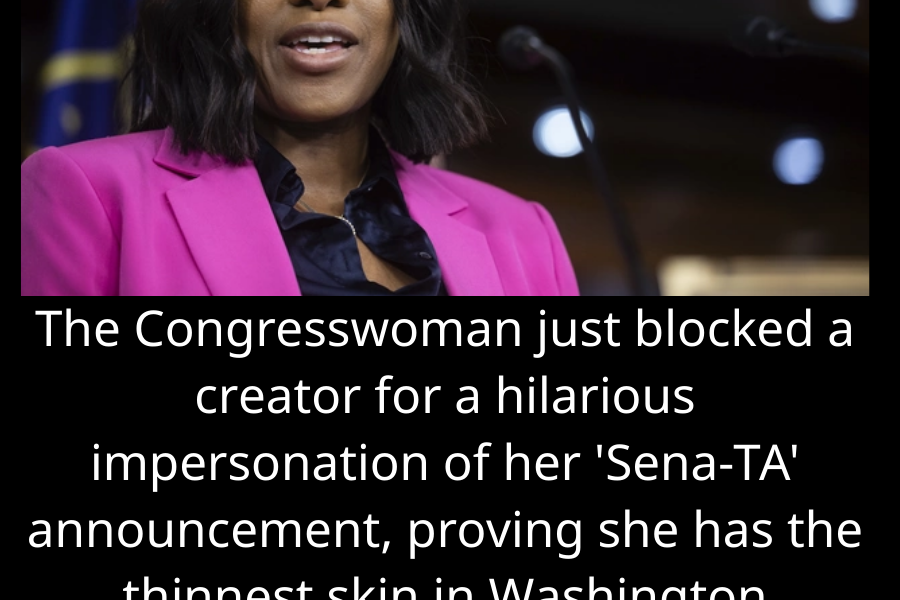
The impersonator being blocked for mimicking this isn’t about hurt feelings; it’s about theft. It’s the appropriation of her authentic, cultural voice for mockery. She is protecting her narrative.
Layer 2: The Racial Calculus – “They Don’t Want Black People… They Know We Don’t Play.”
Here, she dispenses with euphemism. She names the game.
-
“They don’t want Black people.” A blunt assessment of the opposition’s desired demography for the Senate.
-
“They don’t want no Black people in there because they know we don’t play.” This flips the script. It’s not that Black people aren’t qualified; it’s that they are too effective, too disruptive of the comfortable, genteel club. “We don’t play” means we don’t abide by the unspoken rules of decorum that maintain the status quo. We call out. We fight. We don’t “go along to get along.”
She frames her potential exclusion not as a lack of merit, but as a preemptive strike by a club afraid of a new, uncompromising member.
Layer 3: The “Fix” and The Foe – Personal Agency vs. “The White Boy Senate”
Her promise—“I’m gonna fix all of this”—is deeply personal and messianic. It’s not “I will propose legislation.” It’s “I will fix it.” This speaks to a constituency exhausted by incrementalism and hungry for a warrior who sees the problems as clear and the solutions as a matter of will.
Then, she identifies the archetypal antagonist: Donald Trump. But she doesn’t just oppose him politically. She diminishes him culturally.
-
“The child…” Repeatedly. This is the ultimate diss in the cultural context she’s operating in. It denies him gravitas, frames him as emotionally stunted, petulant, unserious.
-
“He wants it to be a white boy senate.” She reduces the entire MAGA project to its racial essence: a desire for a regression to a monochromatic, male-dominated power structure. “White boy” isn’t just descriptive; it’s derisive, connoting a cliquish, immature fraternity.
She positions herself not just as Trump’s political opponent, but as his cultural and moral antithesis: the serious, fix-it Black woman versus the childish, regression-seeking white man.
The Verdict: A New Political Grammar
Jasmine Crockett is not just running for the Senate. She is writing a new rulebook for how to claim power within it. She is rejecting the idea that to gain a seat at the table, you must first master the table’s existing dialect and manners.
Her speech is a direct challenge to the performative neutrality of American politics. It is explicitly racial, explicitly cultural, and explicitly confrontational. It will be heralded as a long-overdue injection of authentic voice and condemned as “divisive” and “unprofessional.”
But that’s the point. Her “professionalism” is being judged by a standard she is actively rejecting. Her power lies in her refusal to translate her lived experience, her anger, or her ambition into a more palatable, bureaucratic tongue.
She isn’t seeking a seat in the “Senate.” She is declaring war on it to become a “Sena-TA.” And in that one shifted syllable, she announces a revolution. 🎤⚖️👑