(The atmosphere shifts from the historical to the geopolitical. The argument is no longer about historical receipts, but about cold, national calculus. The tone isn’t emotional; it’s managerial. The question isn’t “What is just?” but “Who do we work for?”)
The Vice President’s Ledger: A Job Description That Ends at the Water’s Edge
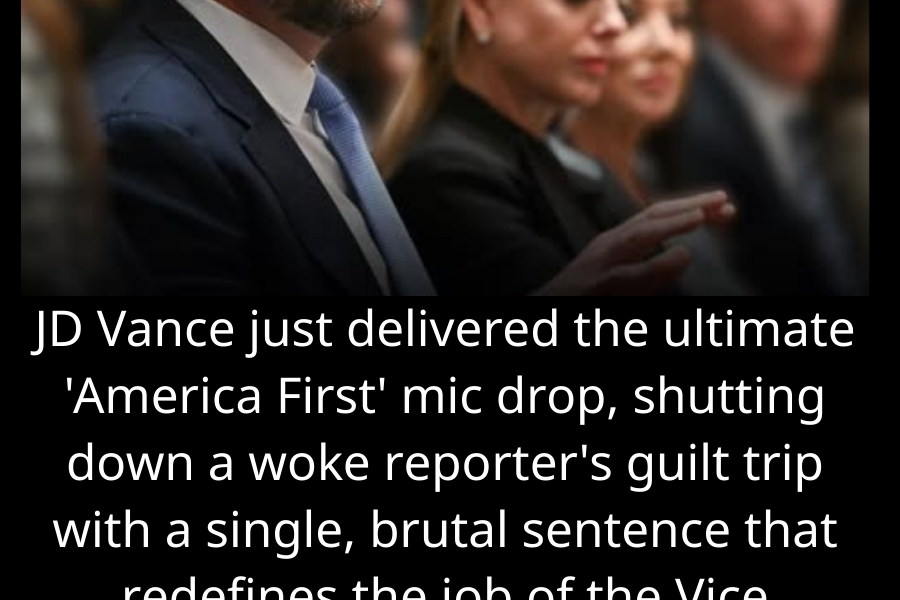
Senator JD Vance’s response isn’t a rebuttal about policy details. It’s a redefinition of the Vice President’s—and by extension, the nation’s—fiduciary duty.
He takes the reporter’s moral frame (“policies that hurt immigrants”) and swaps it for an arithmetic and fiduciary frame. The exchange is a perfect collision of two irreconcilable worldviews:
-
The Reporter’s Frame: Governance as a moral project, where policies are measured by their humanitarian impact on affected individuals, regardless of nationality.
-
Vance’s Frame: Governance as a fiduciary contract, where the officeholder is an agent for a specific principal: “the people of the United States.”
His statement is a pithy manifesto of sovereigntist realism.
Part I: The Arithmetic Defense – “There’s too many people…”
Vance’s opening is a dismissal of the premise. The issue isn’t the moral quality of the immigrants; it’s their quantity. It’s a matter of scarcity and capacity.
“Too many” implies:
-
Absorptive Limits: A finite capacity in housing, jobs, social services.
-
Systemic Overload: Courts, schools, hospitals pushed beyond design.
-
Cultural Saturation: A speed of demographic change that disrupts social cohesion.
By starting here, he bypasses debates about “good” vs. “bad” immigrants. It doesn’t matter. The system is full. The “hurt” caused by restrictive policies is framed not as cruelty, but as the necessary triage of a system in overload. It’s the emergency room doctor turning away the walking wounded to save the critical cases. The “hurt” is a symptom of the disease (overwhelming numbers), not the medicine (restrictive policy).
Part II: The Fiduciary Clarification – “My job… is not to look out for the interests of the whole world”
This is the intellectual and emotional core. It’s a direct rejection of what critics call “globalism” and proponents call “our shared humanity.”
Vance is articulating a specific, limited theory of representation. The Vice President is not a U.N. ambassador. He is not a philanthropist. He is not a global humanitarian. He is an executive of a specific nation-state.
His statement draws a bright, unapologetic border around his moral and professional responsibilities. That border is the same as the nation’s. His duty of care ends where American citizenship (or legal residency) begins.
This reframes the criticism entirely. To accuse him of “hurting immigrants” is, in this view, to accuse him of doing his job. It’s like accusing a public defender of “hurting the victim” by defending the accused. He would argue: My client is the American citizen. My obligation is to them.
Part III: The Implied Worldview – A Zero-Sum Globe
Beneath this statement lies a foundational, often unspoken, premise: In a world of limited resources, the gain of one group is often the loss of another.
If his job is to look out for American workers, then policies that increase labor competition (through immigration) by definition hurt his constituents. If his job is to safeguard American social services, then extending them to non-citizens by definition drains them for citizens.
This is the zero-sum mentality that progressive universalism rejects. Vance’s statement embraces it as simple, clear-eyed realism. Compassion is not infinite; it must be budgeted. And the U.S. Treasury of compassion is earmarked for U.S. stakeholders first.
The Verdict: The Sheriff of the National Interest
Vance’s response casts him not as a ideologue, but as a stern fiduciary. He is the trustee of the American national interest, and he sees unchecked immigration as a leak in the trust fund.
The “destroy” narrative in the headline plays into this. He didn’t just argue. He re-framed the entire debate from morality to accounting. He forced the conversation onto the terrain of national selfishness, which he re-labels as “national responsibility.”
His logic is circular and powerful: I was elected by Americans. My duty is to them. Therefore, any policy that prioritizes non-Americans over Americans is a dereliction of my duty. Q.E.D.
He isn’t arguing about the details of immigration policy. He is issuing a reminder of his job description. And in that job description, the word “immigrant” does not appear in the list of beneficiaries. The ‘hurt’ is not his concern; the protection of his principals is.
The debate is over. The ledger is closed. The only stakeholders with a seat at this table hold an American passport. 🇺🇸⚖️📊