(The sound you just heard is the gavel of public trust cracking. Let’s examine the fracture.)
The Verdict vs. The Void: A Minnesota Judge, a $7.2 Million Mystery, and the Ghost of “Circumstantial”
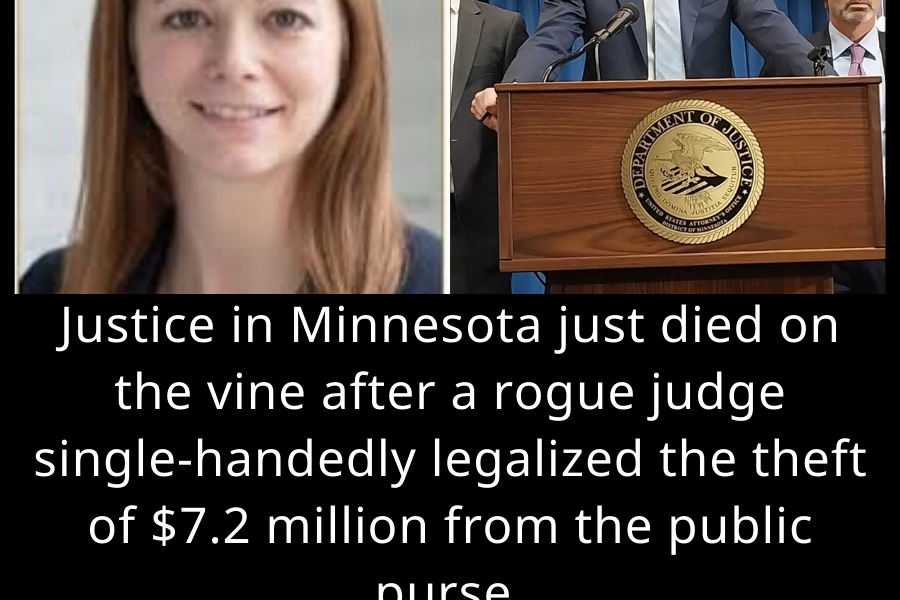
Here’s the scene: a jury of twelve peers. Four hours of deliberation. A unanimous, swift, and decisive verdict: Guilty. The target: $7.2 million in Medicaid funds—money earmarked for the sick, the elderly, the vulnerable—allegedly funneled into a phantom home-healthcare scheme. The community sees a monster, caught and caged.
Then, Judge Sara West enters. With a judicial stroke, she doesn’t just sentence; she erases. The conviction is overturned. The man, Abdi Fatah Yusuf, walks free. The reason? The mountain of evidence that convinced a jury was, in her view, “circumstantial.”
The outrage is nuclear. “BETRAYAL!” the headlines scream. And on the surface, it’s a story so simple it tells itself: a corrupt judge, a stolen fortune, and justice denied.
But what if the real story isn’t in the outrage, but in the silence? The silence of the legal reasoning we haven’t fully heard? Let’s pull back the curtain.
1. “Circumstantial”: The Most Misunderstood Word in Law
First, let’s murder a myth. “Circumstantial” does not mean “weak.”
In the court of public opinion, “circumstantial evidence” is a whisper, a rumor, a maybe. In a court of law, it’s often the entire case. It’s the brick-and-mortar of virtually every complex prosecution.
Direct Evidence: A video of you stealing a laptop. (A smoking gun.)
Circumstantial Evidence: Your fingerprint is on the empty desk. You were seen near the office. You suddenly have a new, identical laptop you can’t afford. (A constellation of facts pointing to one, inescapable conclusion.)
Most fraud cases are built entirely on this constellation. There’s rarely a CEO on tape saying, “Let’s defraud Medicaid.” There are documents. There are financial trails. There are patterns of billing for services that never existed.
A jury looked at this constellation and saw a guilty man. A judge looked at the same stars and saw a different picture. This isn’t necessarily a betrayal; it’s the system working as designed—with terrifying, frustrating checks and balances.
2. The Judge’s Gambit: The “JNOV” Heard ‘Round the State
Judge West didn’t just have a bad day. She executed a specific, rare, and powerful judicial tool: a Judgment Notwithstanding the Verdict (JNOV).
This isn’t a casual overturning. It’s a legal declaration that, even viewing all the evidence in the light most favorable to the prosecution, no reasonable jury could have reached a guilty verdict. It’s a judge saying the prosecution’s case was so legally insufficient that the jury’s decision was irrational.
Why would she do this? The risks are colossal. Professional ruin. Public vilification. The headlines writing themselves.
She would only take this nuclear option if she genuinely believed a fundamental legal error was occurring—that a man was about to be imprisoned for a crime the state, in her view, did not prove he committed. She isn’t ruling on his innocence; she’s ruling on the adequacy of the proof of his guilt.
This is the cold, hard math of “beyond a reasonable doubt.” It is the highest burden of proof in our legal system, designed not to convict the guilty, but to protect the innocent. Even when it feels like a gut punch.
3. The Real Victim: Trust, Tangled in Legal Barbed Wire
So, who is right? The jury who saw a clear path to guilt, or the judge who saw a legal dead end?
We may never know. And that’s the true crisis here.
The $7.2 million is a ghost. It’s gone. Whether it was stolen through cunning fraud or lost in a poorly managed business is the core of the question the legal system just failed to answer conclusively.
The real casualty is trust.
-
The public’s trust in a system that can make a verdict vanish.
-
The trust of healthcare providers who play by the rules.
-
The trust of vulnerable Minnesotans who wonder if their safety net has a hole the size of $7.2 million.
This case is no longer about one man or one judge. It’s a stark, ugly exhibit in the ongoing trial of our justice system itself. It pits the raw, emotional certainty of a community against the dispassionate, often infuriating, mechanics of the law.
The Aftermath: A Verdict Without a Resolution
The outrage is justified. The feeling of betrayal is real. But before we march on the courthouse, we have to ask: Are we angry at a failure of justice, or are we angry at the rules that sometimes prevent a swift, satisfying conclusion?
Judge Sara West has thrown a legal grenade. She has bet her reputation on a reading of the law that defies public sentiment. The prosecution will almost certainly appeal, kicking this political and legal firestorm to a higher court.
For now, we are left with a void where a verdict used to be. A community’s certainty has been replaced by a legal limbo. And the most uncomfortable question of all hangs in the air:
Is it worse to let a potentially guilty man go free, or to imprison a man on evidence a judge deemed legally insufficient?
The gavel has fallen. But the echo is one of profound, and deeply unsettling, silence.
The appeal is coming. The debate is just getting started. ⚖️