(The tone shifts. The arena is now a briefing room, not a rally. The weapon is not a flame-thrower, but a scalpel. The target: the very concept of belonging.)
The Privilege Gambit: How a Press Secretary’s Warning Redraws the Map of Belonging
Let’s be clear about what just happened. This isn’t a random policy reminder. This is a paradigm weaponized into a headline.
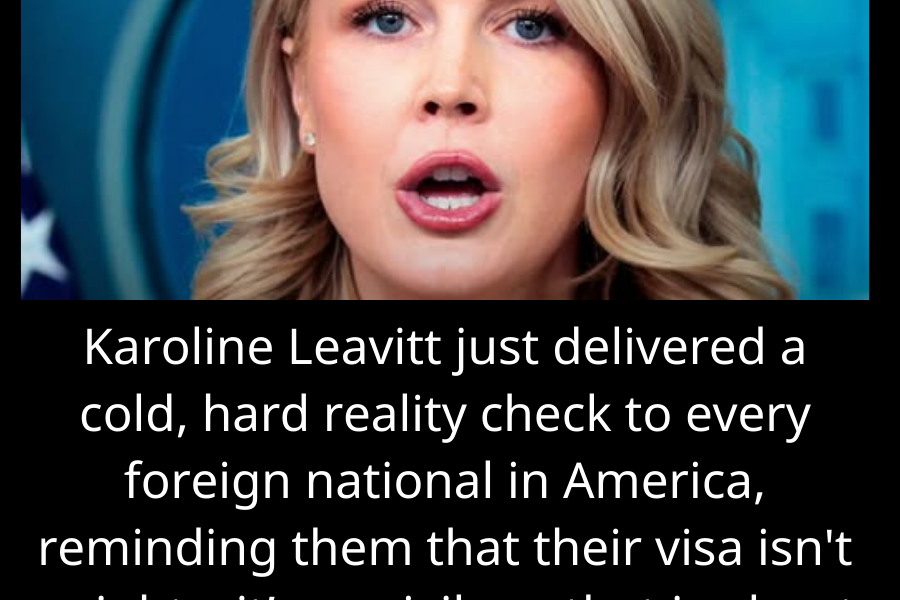
Press Secretary Karoline Leavitt didn’t just state a fact of immigration law. She performed a quiet, deliberate act of philosophical repositioning. She took a foundational concept of diplomacy and human mobility—the visa—and placed it into a specific, cold, and powerful frame: Privilege. Not right. Not opportunity. Privilege.
The full statement is a masterclass in bureaucratic gravitas with a sharp political edge:
“A visa is a privilege. The Trump administration will take action against anyone deemed contrary to our country’s foreign national interests.”
Two sentences. One seismic shift.
Part 1: The Lexicon of Contingency – From “Right” to “Privilege”
First, let’s dissect the keyword: Privilege.
In the modern lexicon, “privilege” is a term loaded with social justice connotations—an unearned advantage one is born into. By applying it to a visa, Leavitt inverts and weaponizes the term. Here, it becomes an earned, revocable gift from the sovereign nation. It is inherently conditional. It carries an unspoken suffix: …which can be taken away.
This linguistic move is profound. It deliberately dismantles any notion of a universal human “right” to movement or opportunity. It rejects the idea that America is, in any inherent way, a destination for the world’s ambitious or oppressed. Instead, it frames the nation as a gated community. We extend invitations (privileges) based on our own criteria, and we revoke them the moment you become a problematic guest.
It transforms the foreign national from a potential future citizen, contributor, or even guest, into a perpetual probationer. Their presence is not a mutual benefit, but a unilateral concession.
Part 2: The “Deeming” Power – Sovereignty as a Blunt Instrument
Then comes the enforcement mechanism: “deemed contrary to our country’s foreign national interests.”
This phrase is a black box of authority. “Deemed” by whom? Under what specific criteria? What constitutes “our country’s foreign national interests”? Is it criticism of the U.S. government? Participation in a protest? Membership in a legal political party abroad that our current administration dislikes?
This is the crux. It replaces clear, statutory law (e.g., “engaging in espionage,” “overstaying a visa”) with a fluid, subjective, and inherently political standard. It places immense discretionary power in the hands of the executive to define “interests” in real-time.
This isn’t just about keeping out spies. It’s about creating a climate of behavioral compliance. It sends a chilling message to every foreign student, worker, journalist, and visiting academic: Your legal status is tethered not just to your actions, but to our political interpretation of your actions. Step out of line—a line you cannot clearly see—and the “privilege” evaporates.
It is the bureaucratization of the travel ban logic. Instead of a blanket “NO” to nations, it is a targeted “YOU” to individuals.
Part 3: The Unspoken Audience – A Message in Duplex
Like all expert political communication, this statement speaks to two audiences simultaneously.
- To the World (and Foreign Nationals): It is a cold-eyed warning. It establishes hierarchy and control. It says, “You are here at our pleasure. Act accordingly.” It seeks to quell dissent and enforce a specific kind of political quietism from non-citizens within U.S. borders.
- To the Domestic Base: It is a powerful reassurance. It telegraphs vigilant, uncompromising sovereignty. It answers a deep-seated anxiety about lost control, affirming that this administration sees the border not as a physical line but as a permeable boundary of loyalty that extends into the homeland itself. It says, “We are watching. We are judging. We are not sentimental.”
The Grand Strategy: The Architecture of Conditional Welcome
Leavitt’s statement is not an isolated remark. It is a keystone in an emerging architecture.
Connect the dots:
- Musk’s Call: Revoke citizenship for betrayal (punishing the naturalized).
- Noem’s Manifesto: A full travel ban (stopping them at the gate).
- Leavitt’s Warning: Visas as revocable privileges (controlling them inside the house).
Together, they form a coherent, three-layer doctrine:
- The Outer Gate (Noem): Keep unwanted groups out entirely.
- The Inner Threshold (Leavitt): Control the behavior of those admitted temporarily.
- The Core Identity (Musk): Expel those who attained membership but violated the covenant.
This is a vision of America not as a melting pot or a nation of immigrants, but as a fortified community with a strict membership contract. Belonging is not organic; it is administrative. Loyalty is not assumed; it is continuously audited.
Press Secretary Leavitt, in the sterile light of the press room, did more than issue a warning. She codified a new social contract for the non-citizen: your presence is a provisional grant, your conduct subject to a political litmus test, and your future here hinges on remaining “deemed” in our interest.
It’s a reminder that the most powerful borders are not always made of steel and concrete. Sometimes, they are built from words, delivered calmly from a podium.
The privilege, it seems, is also ours: to watch it happen. ⚖️