(The air in the briefing room, already thick with curated statistics, suddenly develops a hairline fracture—a tiny, telling crack in the monolith of the message. It’s the sound of a narrative hitting a fact and being asked to reconcile. The response isn’t reconciliation. It’s a pivot into identity.)
The $1,000 Question: When a Tax Refund Miracle Meets the Unasked “How?”
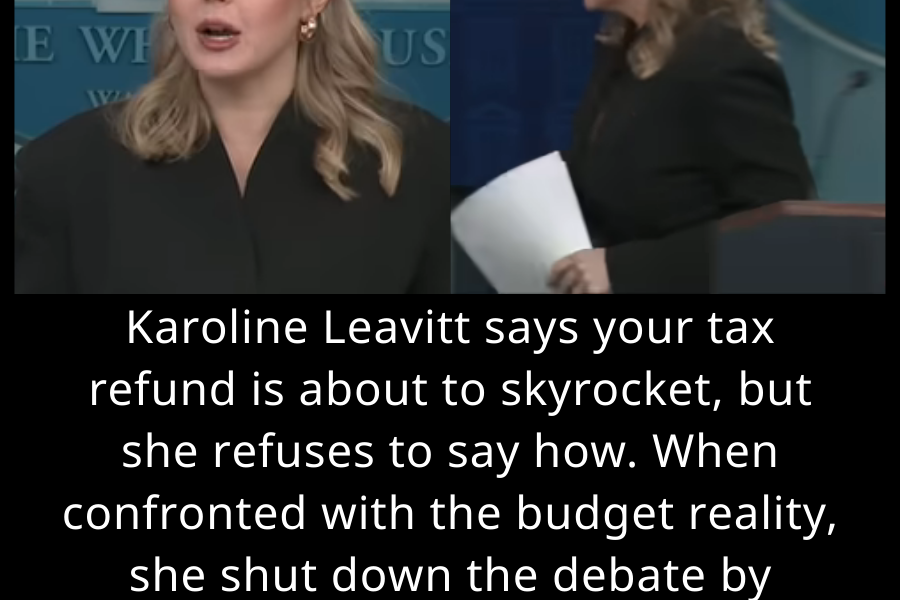
Press Secretary Karoline Leavitt painted a gleaming picture of holiday cheer: “an extra $1,000 per filer” in tax refunds next year, refunds “one-third larger than usual.” It’s a political sugar plum, a direct deposit of promise.
But then came the inevitable, nagging question from the realm of reality: Where is the money coming from?
The reporter pointed to the fracture. The Agriculture Secretary had said the farmer relief program (a separate but related piece of the “One Big Beautiful Bill”) was paid for by an existing fund. The President keeps saying it’s paid for by tariff revenue. Which is it? The question isn’t just about accounting; it’s about the fictional versus the fungible in Trumpian economics.
Leavitt’s response is a masterclass in deflection. She doesn’t answer. She transforms the question.
She pivots from fiscal mechanics to personal biography: “Do you think the people in that room… don’t know the president’s a billionaire?… he’s a businessman who understands the economy.”
This is the ultimate escape hatch. When the math gets fuzzy, appeal to the myth of the mogul. The argument becomes: Don’t look at the ledger. Look at the man. He’s rich. He gets money. Therefore, he can make money appear for you. The “how” is irrelevant; the “who” is everything.
Part 1: The “Magic Money” Dilemma – Sovereignty Over Scarcity
The promise of massive, painless tax refunds taps into a potent political fantasy: the end of economic scarcity through sheer sovereign will. Tariffs are framed not as taxes on consumers, but as tribute from foreigners, a new revenue stream that magically appears outside the old, painful choices of taxing and spending.
When pressed on the source, the administration’s conflicting answers reveal a tension:
-
The “Existing Fund” Answer (Rollins): Admits this is a reallocation, a shell game within the federal budget. Money moved from one pocket to another.
-
The “Tariff Revenue” Answer (Trump): Insists it’s new money, created by his brilliant negotiations, a pure gain with no domestic cost.
Leavitt, caught between her boss’s narrative and her cabinet colleague’s paperwork, chooses the narrative. She ignores the contradiction and appeals to a higher truth: Trump’s financial genius.
Part 2: The “Billionaire” Defense – Credibility as a Function of Net Worth
This is the core of the modern Trumpian economic argument. Complexity is dismissed as the chatter of “over-educated elites.” True understanding is inferred from worldly success.
The logic is brutally simple and emotionally effective:
-
Premise: Donald Trump is a billionaire.
-
Assumption: Billionaires understand money better than anyone.
-
Conclusion: Therefore, his economic plans must work, and questioning their mechanics is the province of envious or ignorant people who have never built anything.
It reframes skepticism from legitimate inquiry into a character flaw of the skeptic. You’re not asking for details; you’re revealing you don’t understand how a winner operates.
Part 3: The “Pennsylvania Room” Gambit – The Authenticity Shield
Leavitt’s final move is to ground this billionaire defense in populist soil: “Do you think the people in that room in Pennsylvania… don’t know the president’s a billionaire?”
This is brilliant. It does two things:
-
Accuses the Media of Elitism: It paints the reporter’s question as a D.C. “gotcha” game, out of touch with the common-sense understanding of real Americans in Pennsylvania.
-
Claims a Deeper Connection: It suggests that those voters like that he’s a billionaire. They see it not as alienation, but as qualification. His wealth is proof he’s not a career politician; it’s his resume. They trust the billionaire because he doesn’t need their money, not in spite of it.
The Verdict: Faith-Based Economics
The exchange reveals that Trumpian economic policy is moving from a theory to a theology. The numbers are not to be analyzed; they are to be believed. The mechanism is not to be scrutinized; it is to be trusted, because it emanates from a figure whose defining characteristic is transactional success.
The $1,000 refund isn’t a line item. It’s a article of faith. To ask for its sourcing is to commit a kind of secular blasphemy—to prioritize sterile fact over powerful belief.
Leavitt didn’t clarify the contradiction. She consecrated it. She declared that in this administration, the ultimate source of funding is not the Treasury or tariff ledgers, but the mythic business acumen of the President himself. The money comes from the same place the confidence does: from him.
The briefing room isn’t for forensic audits anymore. It’s for the weekly sermon of the Gospel of the Deal, where the collection plate is the tax form, and the miracle is a four-digit direct deposit from a deity in a red tie. 💸📿🤑