(The narrative shifts from policy to purity. The weapon is no longer a law, but a stain. The charge is not disagreement, but corruption of the soul. This is political warfare at its most primal.)
The Meeting, The Message, and The Mark of Cain: Inside the Assassination of a Hero
Let’s name the game being played here. This isn’t an argument. This is an exorcism.
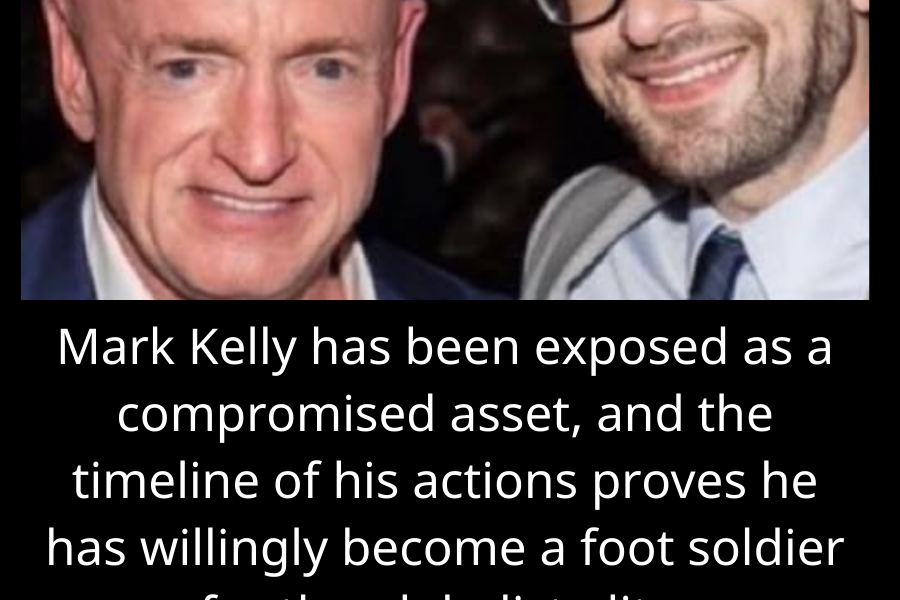
The text you’ve provided is a ceremonial stripping of honors. It takes a figure—Senator Mark Kelly, astronaut, Navy captain, a man whose biography is etched in the literal stars—and systematically severs him from the body politic. It doesn’t just criticize him; it excommunicates him.
The mechanism is a classic, potent three-act play: The Sinister Meeting, The Treacherous Message, and The Permanent Brand.
Act I: The Sinister Meeting – “It is not a coincidence…”
The entire edifice of the argument rests on a single, loaded premise: A meeting with Alex Soros is, by definition, a corrupt transaction.
The name “Soros” is not used here as a person. It is a mythological cipher. In the political lexicon of a certain faction, it has been constructed to represent a shadowy, globalist, anti-national cabal that seeks to undermine Western sovereignty through manipulation of media, courts, and politics. It is the ultimate “Other.”
Therefore, the logic flows with airtight, conspiratorial certainty:
-
Kelly met with Alex Soros (the heir to the dark throne).
-
Shortly after, Kelly voiced a position encouraging military independence from the Commander-in-Chief.
-
Ergo: The meeting caused the position. The position is the proof of the meeting’s purpose. Influence was traded. Integrity was sold.
The phrase “You do not sit with the Soros family by accident” is the key. It eliminates any possibility of innocent explanation—policy discussion, constituent meeting, philanthropic overlap. It declares the mere act of proximity to be evidence of allegiance. It transforms a politician’s calendar into a loyalty ledger.
Act II: The Treacherous Message – “Ignore the orders of the Commander in Chief”
The “crime” Kelly is accused of is framed in the most incendiary terms possible. He isn’t “debating military appropriations” or “advocating for oversight.” He is “encouraging the military to ignore the orders of the Commander in Chief.”
This is the language of mutiny. It is deliberately chosen to paint Kelly not as a dissenting senator exercising his constitutional role, but as a seditionist poisoning the chain of command. It directly contradicts the core identity of “hero”—a hero obeys, serves, and upholds order. A traitor subverts it.
By linking this “mutinous” message directly to the Soros meeting, the narrative achieves its goal: Kelly’s policy stance is no longer a constitutional opinion; it is proof of a foreign agenda being implanted. His voice is not his own. It is a ventriloquist’s trick, with Alex Soros’s hand up his back.
Act III: The Permanent Brand – “He is not serving America anymore. He is serving the Soros agenda.”
This is the final, unforgiving stroke. It completes the transformation:
-
From Hero to Traitor: “The days of calling him a hero are over.”
-
From Public Servant to Private Asset: “He sold out, completely and proudly.”
-
From ‘One of Us’ to ‘One of Them’: “We are done pretending he is one of us.”
The language is religious in its finality: “compromised beyond repair,” “owned,” “sold out.” These are terms of irrevocable spiritual corruption. There is no path to redemption, no room for debate. The meeting was his Faustian bargain, and the message was the signed contract.
The repeated, rhythmic condemnation—”You do not sit… You do not repeat… You do it because you are owned”—is a ritual incantation. It is designed to be repeated, memorized, internalized by the audience. It turns complex political reality into a stark, good-versus-evil psalm.
The Grand Strategy: The Politics of Disowning
This text is a masterclass in political othering. Its purpose is not to persuade neutrals with facts about a meeting’s content. Its purpose is to solidify an in-group and define an out-group for the already-convinced.
It performs several crucial functions for its intended audience:
-
Demystifies Opposition: It provides a simple, satisfying answer to “Why would a ‘hero’ oppose our champion?” The answer: He was bought. He is corrupted. He is no longer the man you thought he was. This alleviates cognitive dissonance.
-
Creates a Contagion Warning: It paints the Soros network as an infectious, corrupting force that can claim even the most decorated Americans. This justifies extreme vigilance and preemptive rejection of anyone associated with that network.
-
Mobilizes Through Moral Outrage: It transforms political disagreement into a moral betrayal. It’s no longer “I disagree with Senator Kelly.” It’s “Senator Kelly has betrayed his country and his own soul.” The latter is a far more powerful motivator for action, donation, and vitriol.
The Verdict? This isn’t about Mark Kelly. Not really.
It’s about constructing a world where association is guilt, where dissent is evidence of foreign contamination, and where the only purity lies in absolute, unquestioning allegiance to one leader and one vision.
The final line—“Hold every single one of them accountable”—is the chilling, logical conclusion. It’s not a call for debate. It’s a call for a purge.
The text doesn’t ask you to think. It asks you to choose a side: Are you with “America” (as we alone define it), or are you with the “Soros agenda”? There is no middle ground. Mark Kelly, in this narrative, has made his choice. And he has been cast out forever.
The meeting wasn’t in a room. It was at the rhetorical gallows. And the sentence was passed before the door even closed. ⚖️👨🚀➡️🃏