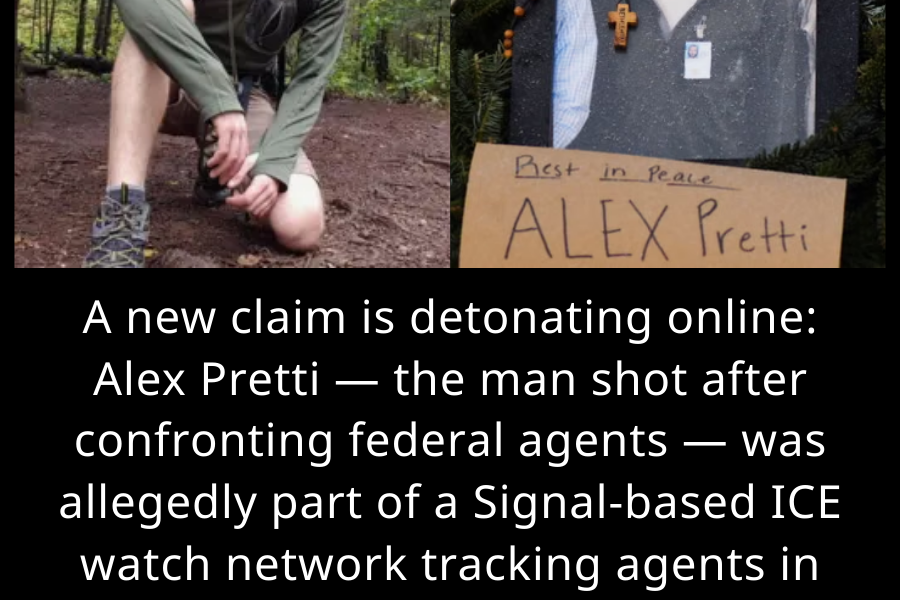
The ICE Watchman: When Vigilante Tracking Escalates to a Firefight
MINNEAPOLIS — The narrative around the shooting of Alex Pretti has just undergone a seismic, violent shift. Initial reports framed a chaotic scene. Now, a new, critical detail emerges from within the anti-ICE movement itself: Pretti was an active member of the “Kingfield Signal ICE watch group.” According to network coordinator Jeanne Massey, these groups “track agents around the clock, follow them, confront them, and sometimes show up armed.”
This admission doesn’t just add context; it re-categorizes the event. It moves the incident from a possible “police shooting during an enforcement action” into the far more volatile territory of a clash between federal officers and an armed, organized surveillance militia dedicated to impeding them.
The statement that Pretti was “targeting ICE to impede law enforcement while carrying a loaded gun and extra magazines” is not an allegation from law enforcement—it is, effectively, a posthumous mission statement confirmed by his own network. This changes everything.
The “ICE Watch” Model: From Protest to Para-Policing
The described activities of the Kingfield group represent a radical, militarized evolution of protest:
-
Surveillance & Tracking (“Track agents around the clock”): This is not passive observation. It is persistent, targeted intelligence-gathering on federal law enforcement. It aims to eliminate their operational secrecy, map their patterns, and anticipate their moves. In any other context, this sustained surveillance of law enforcement personnel would be considered stalking or pre-operational reconnaissance.
-
Confrontation & Impediment (“Follow them, confront them”): The goal is not just to witness, but to interfere. This creates a volatile, high-stakes environment for every encounter, forcing agents to operate under the constant pressure of hostile observation and physical obstruction.
-
Armed Presence (“Sometimes show up armed”): This is the critical escalation. It transforms the dynamic from civil disobedience into a potentially lethal standoff. A loaded gun with extra magazines, carried by someone actively tracking and confronting officers, represents an objectively articulated threat. It signals preparedness for armed conflict.
Pretti, according to this depiction, was not a bystander. He was a participant in a system designed to create friction and fear for ICE agents. His armed presence at the scene was not accidental; it was a feature of the strategy.
“This is the paramilitarization of sanctuary,” says Dr. Ben Torres, a criminologist specializing in extremism and policing. “These ‘watch’ groups are mirroring the structure of anti-government militias that monitor federal agencies like the BLM or FBI. They have shifted from a model of witnessing and protest to a model of counter-surveillance and armed deterrence. When someone from such a group is shot while ‘impeding’ officers, it’s no longer just a law enforcement incident. It’s a skirmish in a low-grade, asymmetric conflict between a federal agency and a decentralized, ideologically driven network that has adopted operational tactics of resistance. The admission from the network coordinator is a chillingly candid acknowledgment of this new battlefield.”
The Legal and Political Vortex
This revelation creates an inescapable logic for federal prosecutors:
-
The Narrative of Self-Defiance Strengthens: ICE will argue Pretti was not a “protester” but an armed operative of a group explicitly formed to track, confront, and impede federal officers. His actions were the direct execution of the group’s stated mission.
-
The Network Itself Becomes a Target: Jeanne Massey’s confirmation provides a public roadmap for a potential DOJ conspiracy investigation. Who funds, coordinates, and trains these groups? The line between “rapid response network” and “criminal conspiracy to obstruct justice” is now razor-thin.
-
The Lt. Governor Link Compounds: If the previously alleged Signal group involving Lt. Gov. Flanagan is connected to networks like Kingfield, the implication becomes staggering: that elements of the state government may have been aware of, or linked to, networks engaged in armed surveillance of federal agents.
For the anti-ICE movement, this is a strategic and public relations catastrophe. It validates the Trump administration’s most damning characterization of them as “domestic terrorists” or an “armed mob.” It makes it exponentially harder to frame ICE as the sole, unprovoked aggressors.
The Human Cost and the Inevitable Cycle
A man is dead. The circumstances now suggest he placed himself in a role designed to create a confrontation while armed. The agents who fired did so under the palpable threat articulated by the very network he belonged to.
This death will be mourned as a martyrdom within the movement, fueling greater anger and likely more aggressive tactics. For ICE and its supporters, it will be cited as tragic proof of the violent, organized resistance they face, justifying even more robust and pre-emptive security measures.
The Bottom Line
The shooting of Alex Pretti is no longer an isolated tragedy. It is a data point in an escalating conflict with a known ideology and a stated methodology.
The “ICE watch” model, as described, has crossed a threshold. It has moved from the realm of civil rights monitoring into the realm of armed opposition to federal authority. The admission of Pretti’s role and the group’s tactics pulls back the curtain on a shadow war being fought in Minneapolis neighborhoods—a war with Signal chats as its command posts, cars as its surveillance platforms, and now, guns as its instruments.
This changes the rules, the risks, and the reckoning to come. The next time ICE moves in the Twin Cities, its agents will know they are not just enforcing the law. They are, in the eyes of a coordinated, armed network, occupying forces in hostile territory. And Alex Pretti’s death ensures that for members of that network, the next confrontation may not just be about tracking and confronting. It may be about settling a score.