The Storming of the Sanctuary: When a Journalist Becomes the Defendant
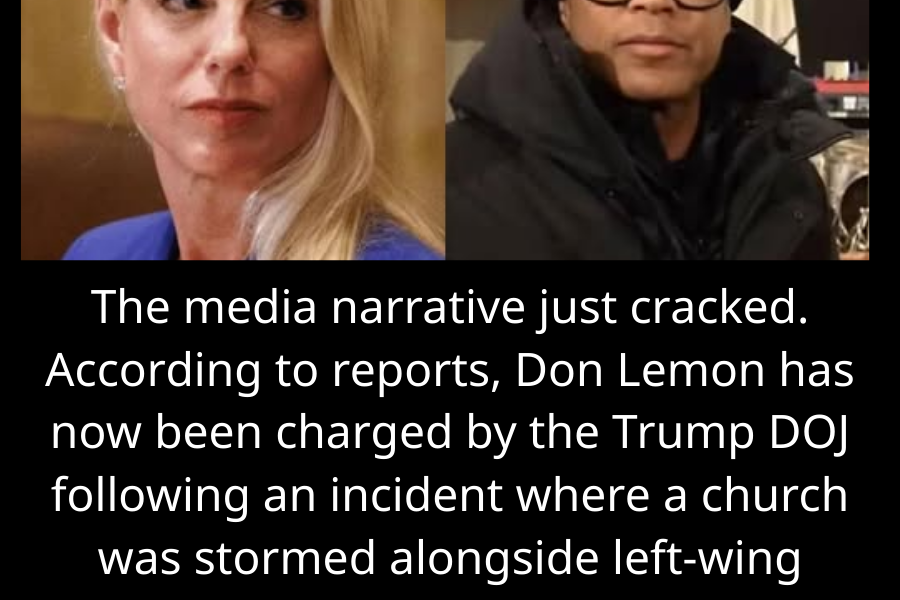
WASHINGTON, D.C. — The narrative has achieved a kind of grim, poetic symmetry. Don Lemon, the former CNN anchor whose press credentials were just stripped for what certifying bodies called conduct “outside the ethical boundaries… of journalism,” now faces a far more concrete charge: federal prosecution. According to a POLITICO report, the Trump Department of Justice has charged Lemon and seven others in connection with storming a church alongside leftist protesters.
If the credential revocation was a professional death sentence, this is a potential literal incarceration. The charge transforms Lemon from a disgraced commentator into a criminal defendant, and it elevates the cultural clash over protest, religion, and politics into a federal courtroom drama with a famous face at its center.
The accompanying commentary—“If the roles were reversed and a conservative did this at a mosque, the outrage would be nonstop. The law applies to everyone”—is not an aside. It is the central political thesis of the prosecution. This case is being framed not merely as law enforcement, but as the long-awaited application of equal justice in a sphere its proponents believe has been dominated by selective outrage.
The Anatomy of the Charge: From Protest to Prosecution
While specific charges from the DOJ filing are not detailed in the prompt, the act of “storming a church” during a protest suggests potential federal statutes in play:
-
Interference with Religious Exercise (18 U.S.C. § 247): The Church Arson Prevention Act makes it a crime to intentionally obstruct, by force or threat of force, any person in the enjoyment of that person’s free exercise of religious beliefs. “Storming” a service would squarely fit.
-
Conspiracy Against Rights (18 U.S.C. § 241): If prosecutors can show Lemon conspired with others to deprive congregants of their civil right to freely worship.
-
Entering a Religious Property to Commit a Violent Act (18 U.S.C. § 248): Part of the Freedom of Access to Clinic Entrances Act, but applicable to religious obstruction.
The critical leap from a chaotic protest moment to a federal indictment hinges on proving intent and coordination. The DOJ will need to demonstrate that Lemon didn’t just get swept up in a crowd, but willfully participated in or conspired to commit the unlawful entry and disruption.
“This is a signal prosecution,” says former federal prosecutor Anya Sharma. “The DOJ is making a statement that certain forms of political protest, when they target the sanctity of religious worship, cross into federal felony territory. By including a high-profile media figure, they achieve multiple goals: they deter similar actions, they satisfy a political base that feels religious conservatives are unprotected, and they personally ensnare a vocal critic. The ‘equal justice’ framing is the entire ballgame—it’s an attempt to preempt accusations of political motivation by saying, ‘You demanded consequences for January 6th. Here are consequences for this.’”
The “Roles Reversed” Frame: The Political Heart of the Case
The commentary about a mosque is the case’s political and cultural subtext made text. It argues that liberal America and its media apparatus apply a double standard: outraged by threats to mosques or LGBTQ+ venues, but permissive or justificatory when the target is a Christian church.
By prosecuting Lemon, the DOJ is attempting to enforce ideological neutrality through the law. It is saying: the legal protection of religious exercise is blind to the faith being exercised or the politics of the disruptor. This is a direct challenge to a worldview that sees some forms of protest as inherently more righteous—and thus more forgivable—than others.
For Lemon’s supporters, this will look like victimization and weaponization of the law. They will argue the charge is disproportionate, politically motivated retribution for his years of criticism, and an attempt to criminalize civil disobedience against institutions they see as complicit in political agendas.
The Unraveling of Don Lemon: From Anchor to Alleged Co-Conspirator
This charge completes a staggering, three-act downfall for Lemon:
-
Act I (The Fall from Grace): Fired from CNN, reduced to a smaller platform at NewsNation.
-
Act II (The Professional Excommunication): Stripped of press credentials, declared “not a journalist” by his own industry’s standards bodies.
-
Act III (The Criminal Defendant): Facing federal charges that could result in fines and imprisonment.
This trajectory paints a picture of a man whose conduct has escalated from professional misconduct to alleged criminality. It will be used by his critics as proof that his on-air arrogance and perceived ethical abandon were symptoms of a deeper contempt for societal norms and laws.
The Legal and Media Firestorm Ahead
The case guarantees a media circus, but with a bizarre twist: the defendant was once one of the circus’s most prominent ringmasters. Every hearing will be dissected not just for legal merit, but as a cultural allegory.
-
For the DOJ: They must prove a clean, by-the-book case that withstands accusations of being a political show trial. Any misstep will be magnified.
-
For the Defense: They will likely argue Lemon was exercising First Amendment rights, that the “storming” is hyperbole, and that this is a politically driven prosecution intended to silence a critic.
-
For the Media: They must cover a former star’s prosecution while grappling with their own organizations’ recent verdict that he is not, ethically, one of them.
The Bottom Line
The charge against Don Lemon is more than a legal filing. It is a cultural collision point. It’s where the debates over “cancel culture,” media bias, religious liberty, and prosecutorial power all crash together in a single courtroom.
The “law applies to everyone” mantra is a powerful one. But in this hyper-polarized climate, the verdict—both legal and public—will depend entirely on who people believe “everyone” is. Is Don Lemon a journalist whose protest went too far, now being made an example? Or is he a leftist activist who finally faces the same accountability he long championed for others?
The gavel will fall in a court of law. But the trial of public opinion has already begun, and its jury is a nation bitterly divided over what justice, and journalism, even mean anymore.