The Incident on Arcade Street: ICE, a U.S. Citizen, and the “Kidnapping” Question
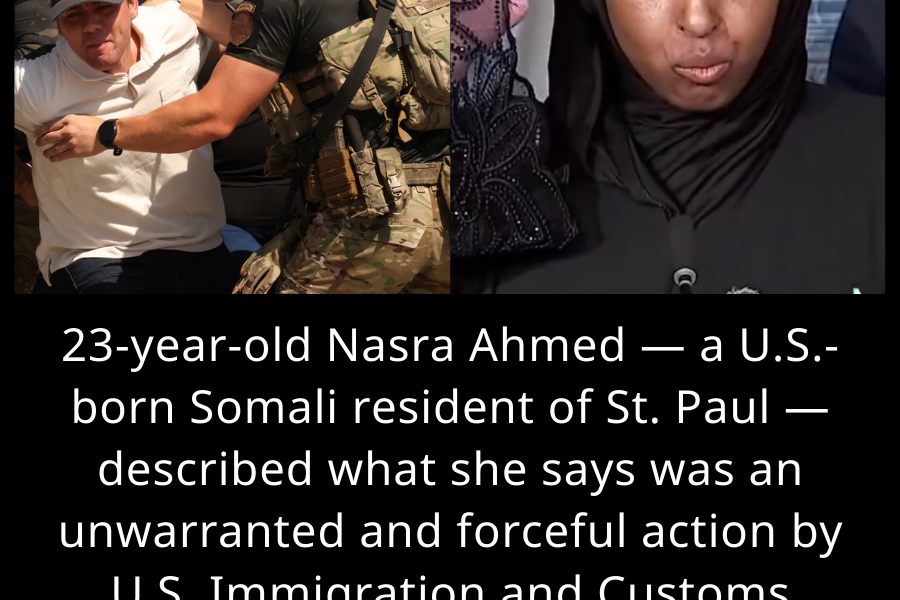
ST. PAUL, Minnesota — The central fact is undisputed: Nasra Ahmed, a 23-year-old U.S. citizen, born in Minneapolis, was detained by Immigration and Customs Enforcement agents on a residential street in St. Paul for approximately 48 hours. Everything else—the legality, the force used, the intent—has erupted into a fierce battle over narrative, civil rights, and the very nature of enforcement in American communities.
Ahmed’s account, delivered from the steps of the Minnesota State Capitol, is stark and incendiary. She describes an unprovoked assault: agents shoving her to the ground, causing a head injury requiring a large bandage, and hurling a racial slur. She frames it not as an arrest, but as a “kidnapping.”
This single case has become a lightning rod, condensing national debates about immigration enforcement, racial profiling, and the rights of citizens into one fraught question: How does a native-born American end up in ICE custody?
The Competing Narratives: Mistaken Identity or Malicious Conduct?
Nasra Ahmed’s Account (The “Kidnapping” Narrative):
-
Unwarranted Force: Agents approached without clear explanation, used physical force resulting in injury (concussion, visible head wound).
-
Lack of Due Process: She was not read her rights, not presented with a warrant, and not promptly afforded legal counsel or contact with family.
-
Racial Animus: The alleged use of a slur suggests bias-driven conduct, not procedural error.
-
The Core Outrage: A U.S. citizen was subjected to the kind of detention meant for undocumented immigrants. This frames ICE as an agency operating with such reckless, aggressive impunity that it no longer respects the fundamental boundary of citizenship.
The Implied ICE Defense (The “Operational Error” Narrative):
While ICE has not released a detailed public statement on Ahmed’s specific allegations, the standard defense in such cases involves:
-
Targeted Enforcement: Agents were likely seeking a specific individual with a deportation order, possibly someone with a similar name, description, or address.
-
Presumption of Authority: In the field, during a dynamic encounter, agents may act on what they believe to be probable cause.
-
Internal Review: Any allegation of excessive force or misconduct would be subject to an internal Office of Professional Responsibility (OPR) investigation.
-
The Implied Frame: This was a regrettable mistake in a high-stakes operation, not a deliberate abduction. The release after two days, without charges, is cited as evidence that the error was corrected—though for critics, it proves the detention was unjustified from the start.
“The word ‘kidnapping’ is legally provocative but politically precise,” says civil rights attorney Amira Johnson. “Under Minnesota state law, kidnapping requires confinement or removal without consent and without legal authority. Ahmed’s supporters are asserting that ICE had no legal authority to detain a U.S. citizen, rendering their actions fundamentally unlawful from inception. This isn’t just about excessive force; it’s about the illegitimacy of the detention itself. The 48-hour hold becomes a state crime, not a federal procedural oops.”
The Larger Context: Why Minnesota? Why Now?
This incident did not occur in a vacuum.
-
The Minnesota Somali Community: Home to the largest Somali diaspora in the U.S., the Twin Cities have long been a focal point for federal counterterrorism and immigration investigations. This has bred deep community distrust of federal agencies, where encounters are often viewed through a lens of historical surveillance and profiling.
-
ICE’s “At-Large” Operations: ICE frequently conducts street and home arrests based on administrative warrants (not judicial warrants). These operations are high-risk for errors, as they rely on sometimes-outdated biometric or biographical data.
-
The Political Climate: With immigration a dominant election-year issue and promises of escalated enforcement, ICE operations are under a microscope. Advocates argue a “deportation force” mentality leads to corner-cutting and rights violations.
Ahmed’s case exemplifies activists’ worst fears: that expanded enforcement powers will inevitably sweep up citizens, particularly those from racial and ethnic minorities, and that the mechanisms for redress are feeble.
The Legal and Political Fallout
The immediate consequences are twofold:
-
The Demand for Transparency: Minnesota’s congressional delegation, led by Democrats like Ilhan Omar and Amy Klobuchar, will demand a full accounting from ICE and the Department of Homeland Security. They will seek records of the operation, body camera footage (if any), and the basis for Ahmed’s detention.
-
The Inevitable Lawsuit: A significant federal civil rights lawsuit is virtually guaranteed. It will allege false imprisonment, excessive force, and violation of Ahmed’s Fourth and Fifth Amendment rights. The alleged racial slur could support a claim of discriminatory intent.
For ICE, this is a public relations and legal disaster. Even if their internal review finds agents followed protocol, the factual core—a citizen detained for two days—is indefensible. It will be cited for years as evidence of the agency’s systemic overreach.
For the community, it is a traumatic validation of long-held fears. It signals that citizenship alone is not a shield if you “fit a profile.”
The Unanswered Question and the Broken Trust
The most haunting question is not “What happened?” but “What if she hadn’t been a citizen?”
If Nasra Ahmed had been an immigrant without papers, her story—of being shoved, detained, and insulted—would likely have ended in deportation, not a press conference. Her citizenship granted her a platform and eventual release. For many, this exposes the brutal reality of the system: its reliance on individuals to know and assert their rights from within detention, and the peril faced by those who cannot.
This incident will fade from headlines. But in St. Paul’s Somali community and in neighborhoods across America where ICE operates, the lesson will endure: The border is not just at the Rio Grande. It is on Arcade Street. And the agents who patrol it sometimes cannot—or do not care to—tell the difference between a citizen and a target.
The bandage on Nasra Ahmed’s head is a potent symbol. It represents a wound inflicted not by a criminal, but by the state. And the story she tells is a challenge to the nation: Is this how enforcement works in America now? And if so, who among us is truly safe?