The 490: A Political IED in the Immigration and Sanctuary Wars
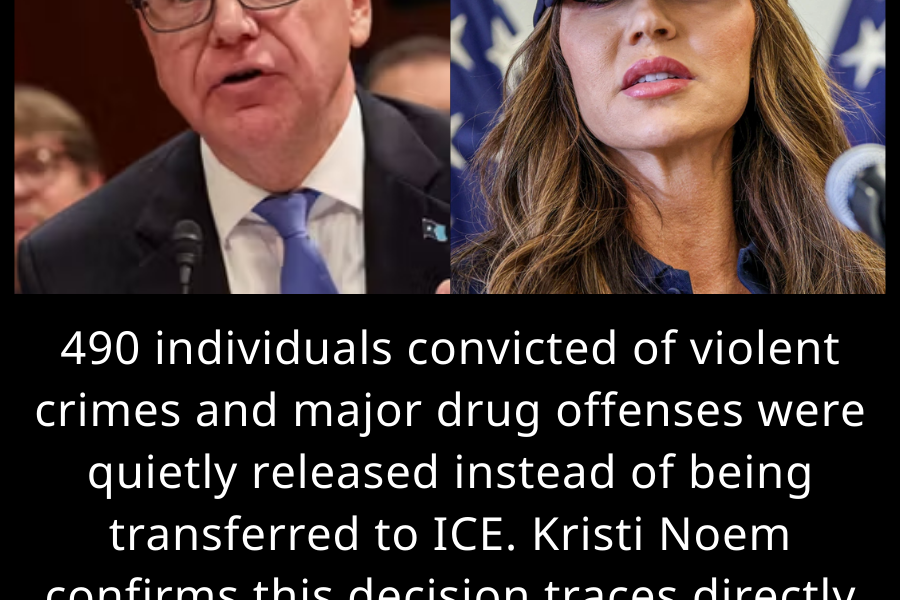
MINNEAPOLIS / PIERRE — The number is precise, damning, and politically incendiary: 490. According to South Dakota Governor Kristi Noem, that is the count of individuals—non-citizens convicted of crimes ranging from violent offenses to major drug trafficking—who were released from custody in Minnesota rather than transferred to U.S. Immigration and Customs Enforcement (ICE) for potential deportation.
This is not a bureaucratic footnote. It is a forensic-grade political weapon, launched from one governor to implicate another, and it strikes at the core of the most volatile domestic policy debate in America: Sanctuary policies versus federal immigration enforcement.
Noem’s statement is a masterclass in politically charged framing: “This was not a mistake. This was not unavoidable. This was a decision.” It transforms a complex interplay of law, policy, and discretion into a simple, moral choice between safety and ideology.
Let’s dissect the explosive device.
The Anatomy of the Allegation: What “Release Over Cooperation” Means
At the heart of the claim is the mechanism of the ICE detainer. This is a request—not a judicial warrant—from ICE to a local jail to hold an individual for up to 48 hours beyond their scheduled release so that federal agents can take them into custody.
The Sanctuary Policy Position (Minnesota/Minneapolis):
Many sanctuary jurisdictions, including Minneapolis and the state of Minnesota under Governor Tim Walz’s policies, limit or prohibit compliance with ICE detainers. Their legal and ethical reasoning is multi-faceted:
-
Constitutional Concerns: Federal courts have repeatedly ruled that holding someone without a judicial warrant, based solely on an ICE administrative request, can constitute a Fourth Amendment violation (unlawful detention). Jurisdictions fear lawsuits.
-
Community Trust: The core philosophy is that if local police are seen as an extension of immigration enforcement, immigrant communities—including crime victims and witnesses—will not report crimes or cooperate with investigations, making everyone less safe.
-
Prioritization: They argue resources should focus on prosecuting the underlying crime. Once that state sentence is served, immigration enforcement is a separate, federal matter.
The Law Enforcement Argument (Noem & ICE Advocates):
This perspective views sanctuary policies as a willful, dangerous obstruction. The argument is simple: if someone is already in jail for a serious crime and is deportable, releasing them into the community instead of handing them to ICE represents a conscious, preventable risk. It prioritizes a political stance over the immediate, physical safety of residents.
“Public safety should never come second to politics” is the definitive soundbite of this position.
The “490 Serious Offenders”: The Power of the Specific
The potency of Noem’s attack lies in the specificity. Not “some,” not “many,” but “490.” And not just any offenders, but “serious offenders… including individuals convicted of violent crimes and major drug offenses.”
This detail is designed to bypass abstract debates about federalism and due process. It forces the conversation onto the most emotionally powerful ground: the graphic, specific threat of violent criminals being turned loose. It invites the public to imagine 490 individual stories of potential victimization that could have been prevented.
It frames the issue not as “cooperation with ICE,” but as “releasing violent criminals when you had the chance to deport them.” The moral charge is almost impossible to deflect with legal nuance.
“This is data weaponized for narrative warfare,” says Dr. Liana Cruz, a professor of criminal justice policy. **“The number ‘490’ does rhetorical heavy lifting that pages of legal analysis cannot. It concretizes an abstract policy into a tally of perceived betrayals. For supporters of sanctuary policies, these are 490 cases where due process was protected and community trust was prioritized. For opponents, it is a scoreboard of negligence. The battle is no longer over law; it’s over which story—catastrophic risk or systemic protection—the public believes.”
The Political Theater and National Implications
Noem’s move is high-stakes political theater with clear objectives:
-
National Profile: As a potential VP contender, she establishes herself as a fearless champion of law-and-order federalism, directly confronting a liberal governor and mayor.
-
Blueprint for Attack: She provides a ready-made template for Republican candidates nationwide: Find the number. Name the crimes. Demand accountability.
-
Pressure Campaign: It places immense political pressure on Walz and Frey, forcing them to defend a policy that can be made to sound, in soundbite form, like protecting criminals over citizens.
The response from Minnesota will likely focus on the legal necessity of their policy, the importance of community trust for overall safety, and perhaps a challenge to the categorization of all 490 as “violent” or the implication that all were necessarily deportable. But in the court of public opinion, nuance often loses to a stark, frightening number.
The Unspoken Questions & The Human Reality
Behind the number are critical, unanswered questions:
-
What, precisely, were the convictions? How many were for violent crimes versus drug offenses?
-
What was the legal status of each individual? Were all 490 definitically deportable under federal law?
-
What has happened since their release? How many have been re-arrested or subsequently taken into ICE custody?
The human reality is a clash of two legitimate fears: the fear of violent crime and the fear of families being torn apart by a system perceived as unjust and predatory. Policy is the battleground where these fears collide.
The Bottom Line
Governor Noem has not just criticized a policy. She has indicted a philosophy of governance. She has drawn the sharpest possible line: you are either for cooperating with federal immigration enforcement to remove criminal non-citizens, or you are for releasing them into American communities.
The number 490 is now a rallying cry. It is the quantified cost, in the eyes of one side, of the sanctuary city experiment. For the other side, it is a misleading statistic obscuring a principled stand for constitutional rights and inclusive safety.
The debate over these 490 individuals will not stay in Minnesota. It is a national referendum in miniature, and its verdict will resonate in every city and state wrestling with the same impossible choices.