The Unicorn and the Gavel: Inside Congress’s Defining Vote on Trans Youth
WASHINGTON — The poster board was the first clue. On the floor of the U.S. House of Representatives, Representative Marjorie Taylor Greene (R-GA) pointed to an image of a child who she claimed had undergone a mastectomy, a visual prop in a debate over the most intimate and scientifically complex of medical decisions. Her rhetorical pivot was even more stark: “If a child believes they’re a unicorn, do adults take their word for it as well?”
In that moment, the “Protect Minors from Medical Mutilation Act” (or its legislative equivalent) ceased to be just a bill. It became a cultural and philosophical referendum, distilled into a single, surreal question about belief, reality, and the limits of childhood identity.
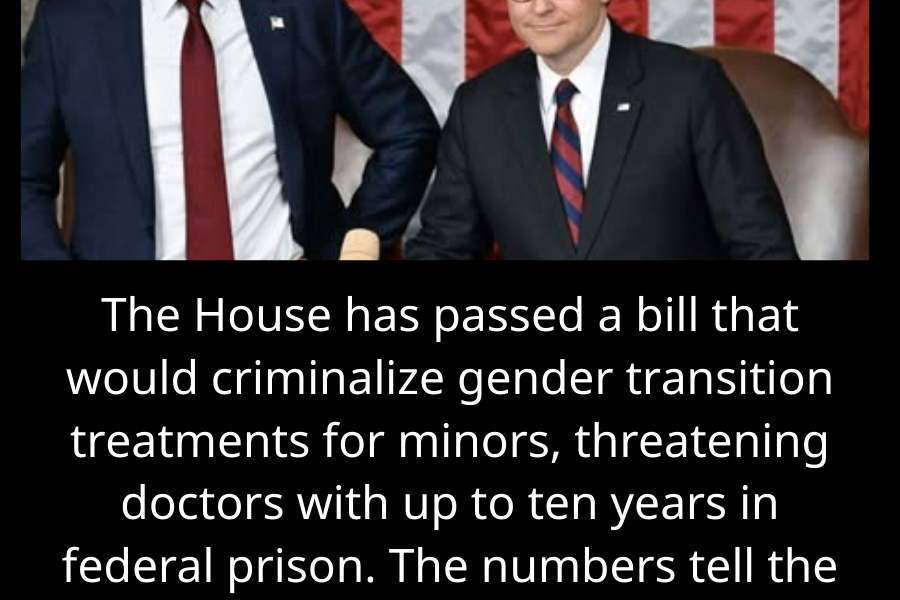
The House’s 216-211 vote to federally criminalize gender-affirming medical care for minors—punishing providers with up to ten years in prison—was not a legislative turning point. Its fate in the Senate is sealed; it will not become law. It was, instead, a political landmark. It officially cemented the medical care of transgender youth as a primary front in the national culture war, elevated to the highest legislative chamber as a core GOP priority and a fulfillment of a Trump campaign pledge.
The Anatomy of the Bill: A Federal Criminalization of Care
The legislation, propelled by Greene in exchange for her support on a defense bill, seeks to enact a nationwide ban on puberty blockers, hormone therapy, and surgeries for transgender minors. Its penalties are severe: felonies for medical providers, stripping them of licenses and threatening them with a decade in federal prison.
The Proponents’ Frame (Greene, Moore, GOP Majority):
-
“Child Abuse” & “Mutilation”: This is the foundational language. It frames medical consensus as criminal conspiracy. As Rep. Barry Moore (R-AL) stated: “It is not lifesaving care. It is child abuse.”
-
Parental Rights, Selectively Applied: The argument paradoxically champions parental rights to reject vaccines or mask mandates, while using federal law to override parental consent in concert with doctors for gender-affirming care.
-
The “Wait Until Adulthood” Principle: Greene’s “kids just need to grow up” argument posits adolescence as a period of confusion that should not be met with irreversible medical intervention, despite medical guidelines that emphasize extensive evaluation and reversible approaches (like puberty blockers) as first steps.
The Opponents’ Frame (Raskin, Takano, McBride, Medical Orgs):
-
“Medicine vs. Ideology”: Democrats argue this replaces decades of clinical research and guidelines from every major medical association (AMA, AAP, APA) with political dogma. As Rep. Mark Takano (D-CA) noted, the specific surgeries cited are vanishingly rare and already heavily restricted; the bill’s true target is mainstream, non-surgical care.
-
Lifesaving Intervention: They cite overwhelming data showing gender-affirming care drastically reduces suicidality, depression, and anxiety among trans youth. Denying it is framed as state-sanctioned harm.
-
The Privacy Invasion: The bill creates a surveillance apparatus, potentially forcing the disclosure of private medical data and criminalizing doctors for following standard care.
“This vote is not about medicine. It is about ontology—about who gets to define reality for a child,” says Dr. Anya Petrova, a bioethicist specializing in adolescent care. “The ‘unicorn’ analogy is revealing. It equates a child’s persistent, documented gender identity—affirmed by parents, psychologists, and doctors over years—with a fleeting fantasy. It asserts that the state’s biological definition of the child (‘you are your birth certificate’) must trump the child’s lived experience and the medical community’s framework for treating the distress that arises from that clash. It is a raw assertion of political power over professional and personal autonomy.”
The Political Calculus: Greene, Trump, and the GOP’s New Frontier
The bill’s passage is a victory for Marjorie Taylor Greene’s brand of confrontational politics, proving her ability to wield her vote as leverage to set the House agenda. It also delivers on a central Trump campaign promise, aligning the congressional GOP with the presumptive nominee’s “eradication” rhetoric.
For Republicans, this is a base-mobilizing wedge issue with clear resonance in a primary electorate. It allows them to position themselves as defenders of children against what is portrayed as a radical, progressive ideology run amok in medicine.
The three Democratic “yes” votes—from more conservative districts in Texas and North Carolina—highlight the political vulnerability some feel on this issue, even as the party’s mainstream rallies behind trans rights.
The Human Core: What the Debate Erases
In the clash of soundbites—“mutilation” vs. “lifesaving care”—the actual lived experience of transgender youth and their families is often erased. The process is not a whim. It involves:
-
Years of evaluation by teams of mental health and medical professionals.
-
Social transition (name, pronouns, clothing) long before any medical step.
-
Puberty blockers (fully reversible) to pause development and allow more time for decision-making.
-
Hormone therapy (partially reversible effects) only in later adolescence after extensive assessment.
-
Surgery, almost exclusively in adulthood, with rare, case-by-case exceptions for older teens under rigorous standards.
The bill, by making early steps a felony, aims to block this pathway at its origin.
The Road Ahead: A Symbolic Vote with Real Consequences
While the bill will die in the Senate, its passage in the House has concrete effects:
-
It legitimizes state-level bans: It provides a federal model and political cover for the 24 states that have already enacted similar restrictions, emboldening further litigation and legislation.
-
It chills medical practice: Even in states where care remains legal, the threat of a future federal ban or criminal penalty may deter providers from entering the field or parents from seeking care.
-
It signals a national priority: It ensures that the rights of transgender youth will be a defining issue in the 2024 election and beyond, a clear point of conflict between the two parties’ visions of liberty, family, and the role of government.
The Final Analysis
The House did not pass a law on Wednesday. It passed a judgment. It declared, by a majority vote, that the established medical standard of care for a vulnerable population is not just wrong, but criminal.
The poster of the child, the analogy of the unicorn, the ten-year prison sentence—these are the tools of a political movement that has chosen transgender children as the symbolic battleground for a larger war over authority, science, and identity itself.
The bill will not reach the president’s desk. But the message from the People’s House has been delivered, with chilling clarity, to every transgender teenager in America: Your identity is a political debate. Your healthcare is a crime. Your existence is a problem to be solved by legislation.