The Unseen 66,000: Inside the $45 Billion “Disappearance” Campaign
WASHINGTON, 4:32 PM — The number arrives not as a statistic, but as a geography. 66,000. That is the current population, according to Representative Pramila Jayapal (D-WA), of a hidden American archipelago—a constellation of over 200 detention centers, privately-run jails, and converted warehouses scattered from the Texas desert to rural Louisiana to the frozen plains of Illinois. It is a population larger than that of Carson City, Nevada. And with the passage of what Democrats have branded the “Big Bad Betrayal Bill,” that nation-within-a-nation just received a $45 billion capital infusion.
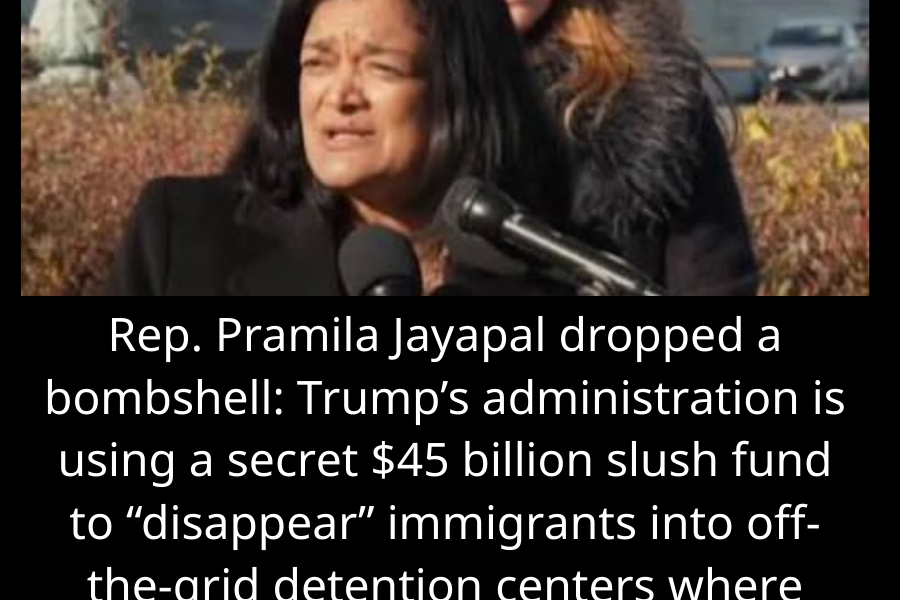
Jayapal’s speech on the Capitol steps today was not a policy critique. It was an indictment delivered in the language of a human rights report. She framed the immigration enforcement system not as a flawed bureaucracy, but as a deliberate apparatus of “kidnapping,” “disappearance,” and dehumanization, now turbocharged by Congress and shielded from democratic oversight.
This is the new, brutal front in the immigration wars: no longer just a debate about borders, but a confrontation over what happens in the dark, interior heart of America once people are captured by the state.
The Anatomy of a $45 Billion “Betrayal”
Jayapal’s central charge is one of moral and fiscal cruelty. The bill in question, a sprawling appropriations package, paired a massive increase for Immigration and Customs Enforcement (ICE) with cuts to social programs, including health care. The political calculus, as she paints it, is grotesque: fund a system of incarceration while defunding systems of care.
The $45 billion is not for border security. It is explicitly for internal enforcement and detention beds. It pays for:
-
Expanded Capacity: More beds in existing facilities and funding to stand up new ones.
-
Transportation Networks: The planes (dubbed “ICE Air”) and buses used to move detainees between facilities, often thousands of miles from their families or legal counsel.
-
Private Contracts: A significant portion flows to for-profit prison corporations like GEO Group and CoreCivic, which operate roughly 65% of ICE detention beds.
“This isn’t about stopping crime,” Jayapal stated, citing ICE’s own data that 73% of detainees have no criminal record. “This is a campaign of terror against immigrant communities. It is a business model of human caging, and Congress just signed the biggest check in its history.”
The “Disappearance” Playbook: How the System Obfuscates
The most potent, chilling part of Jayapal’s accusation is her use of the word “disappear.” It is a term loaded with the history of authoritarian regimes. Her argument details how the system operationalizes it:
-
The No-Standards Jail: She describes facilities operating as jails but without the constitutional or regulatory standards of the Bureau of Prisons. Food safety, sanitation, medical care, and access to recreation exist in a patchwork of voluntary guidelines, not enforceable rules.
-
The Perpetual Transfer: Moving detainees between facilities—from California to Alabama, from Texas to Pennsylvania—is described as a strategy to sever connection. It isolates individuals from family who cannot afford cross-country travel and from non-profit legal organizations whose services are geographically limited.
-
The Oversight Blackout: The claim that the Department of Homeland Security (DHS) is refusing Congressional oversight visits is a direct attack on the constitutional system of checks and balances. The reference to the arrest of a member of Congress (a clear allusion to Rep. García’s attempted visit to a New Jersey facility in 2023) frames DHS as an agency acting above the law it is supposed to enforce.
“When you combine unlimited funding with zero enforceable standards and a blockade on transparency, you have created the perfect engine for abuse,” says Dr. Amalia Campos, a legal scholar specializing in immigration detention. “Jayapal is not using hyperbolic language. She is applying the precise terminology of international human rights monitoring to a domestic system. ‘Disappearance’ doesn’t just mean death; it means being placed outside the protection of the law, where the state can deny your very location and condition. That is her core accusation.”
The Political Theater and the Ground Truth
Jayapal’s speech is, undeniably, high-stakes political theater. The caption—“kidnap and disappear”—is designed for the Instagram graphic and the fundraising email. It galvanizes the progressive base and draws a stark, moral line in the sand.
But beneath the rhetoric lies a bedrock of documented crises:
-
Medical Neglect: Multiple investigative reports and lawsuits have detailed deaths in detention due to untreated conditions like heart disease, diabetes, and sepsis.
-
Sexual Assault: Numerous allegations of abuse by guards, with inadequate reporting mechanisms.
-
Overcrowding & COVID: The pandemic exposed horrific, deadly conditions in facilities where social distancing was impossible.
The $45 billion, critics argue, will institutionalize and expand this system rather than reform it. The money is for more cages, not better judges, legal representation, or community-based case management programs that are proven to be more humane, effective, and far cheaper.
The Counter-Narrative: “Law, Order, and Removal”
The Republican and administration rebuttal is familiar and politically potent: This is about enforcing the law. The $45 billion is necessary to end “catch-and-release,” to ensure individuals who cross the border illegally or overstay visas are detained and removed, and to uphold the integrity of the legal immigration system. They argue detention is a necessary tool to ensure compliance with court dates and final removal orders.
The debate, therefore, is irreconcilable. One side sees a humanitarian gulag. The other sees a necessary tool of sovereignty. Jayapal’s speech rejects that binary. She frames it not as a policy dispute, but as a moral failure and a constitutional crisis.
The final, unsettling question Jayapal leaves hanging is not about policy, but about legacy: What will America choose to build with this $45 billion? A more efficient system of human warehouses, hidden from view and accountable to no one? Or will the sheer, staggering size of the appropriation finally force the nation to look, truly look, at the 66,000 people it has already built them for?
The oversight visits she demands are not just congressional errands. They are an attempt to force a witnessing. To make the invisible archipelago visible. And in the age of the $45 billion betrayal, that act of looking may be the most radical—and necessary—act of all.