(The sound this time is the foundational, metallic clang of a gavel. It’s not an emotional appeal. It’s a procedural argument dropped like a plumb line through the chaos.)
The Conviction Clause: How Due Process Becomes the New Border Wall
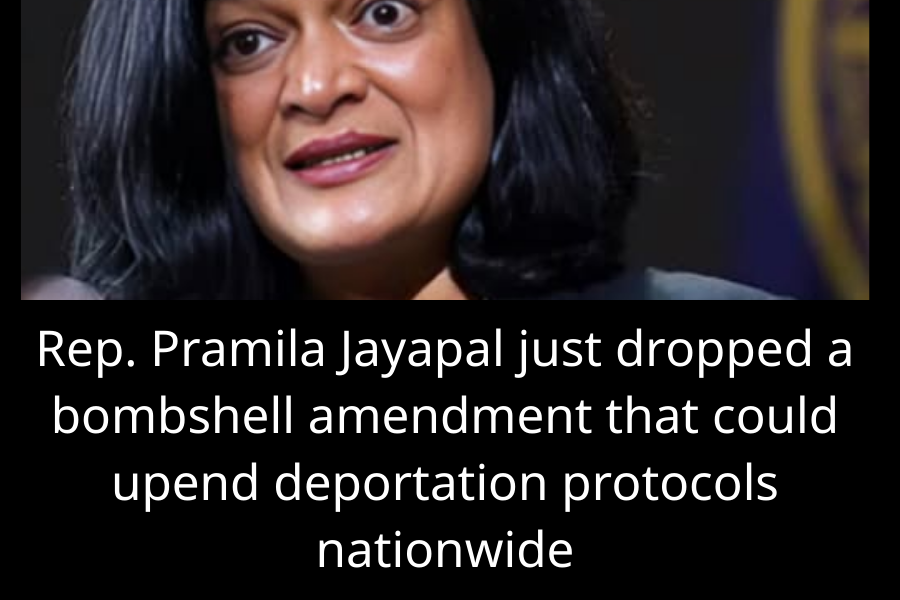
Congresswoman Pramila Jayapal didn’t just propose an amendment. She threw a constitutional grappling hook into the heart of America’s most heated, least rational debate.
Her statement is a two-part surgical strike:
-
The Principle: “EVERY person deserves their day in court.”
-
The Mechanism: “My amendment requires a conviction before people can be deported.”
This is not about open borders. This is not about compassion. This is about installing a judicial firewall at the precise moment where politics and punishment collide. She is attempting to move immigration enforcement from the realm of executive action and bureaucratic determination back into the realm of criminal law.
This is a radical, quiet revolution in how we conceptualize “illegality.”
Part 1: The Power of “Conviction” – From “Status” to “Crime”
The key word is “conviction.” It’s a term with weight, finality, and sacred standing in American law.
Currently, the vast majority of deportations are civil administrative proceedings. Being present without authorization is a civil violation of immigration law, not a criminal felony. Deportation is an “order of removal,” not a “sentence.” The standard of proof is lower, the procedural rights are fewer, and the system is housed within the Department of Justice’s Executive Office for Immigration Review—a system critics call “assembly-line justice.”
Jayapal’s amendment would fundamentally change this. By tethering deportation to a criminal conviction, she would:
-
Raise the Bar: Require proof “beyond a reasonable doubt,” not just a “preponderance of the evidence.”
-
Guarantee Counsel: Grant the right to a government-funded attorney (currently not guaranteed in immigration court for the indigent).
-
Invoke the Full Jury: Potentially invoke the right to a jury trial for the underlying criminal act.
-
Sever the Link from Mere Presence: Mere undocumented presence could not, in itself, be grounds for removal. There would need to be a separate, prosecutable crime with a conviction.
She is arguing that deportation—the forcible, permanent expulsion from a community, often tearing apart families—is such a severe penalty that it should only follow the most severe, deliberative finding of guilt. It is the legal equivalent of saying you can’t impose the death penalty after a traffic court hearing.
Part 2: The Political Counter-Strike – “Lawlessness” vs. “The Rule of Law”
The Republican rebuttal writes itself, and it will be framed in two words: “Sanctuary Country.”
The attack ad virtually scripts itself: “While families are being destroyed by fentanyl and gangs, radical Democrats like Pramila Jayapal want to make it ILLEGAL to deport criminal aliens unless they are first convicted in our backlogged courts. They want to handcuff ICE, not criminals.”
The argument against her is potent:
-
It Creates a “Catch and Release” Legal Mandate: An individual accused of a crime (but not yet convicted) could not be deported. They would have to be released into the U.S. to await a criminal trial that could take years.
-
It Overburdens an Already Broken System: The federal criminal court docket would be swamped with what are currently immigration cases.
-
It Redefines Sovereignty: It frames deportation primarily as a punishment for a crime rather than a sovereign nation’s inherent right to control its borders and enforce its civil immigration laws.
Jayapal’s opponents will claim she is not upholding the rule of law, but destroying it by grafting criminal procedure onto a civil enforcement system, effectively paralyzing it.
Part 3: The Philosophical Chasm – Deportation as Punishment vs. Deportation as Prerogative
This is the core, unbridgeable divide.
-
Jayapal’s View (The Constitutionalist): Deportation is a life-altering, devastating act of state power. In America, such severe deprivations of liberty require the full panoply of criminal due process protections. The state must prove you did something wrong, not just that you are here wrongly.
-
The Opposition View (The Sovereignist): Deportation is not punishment. It is the administrative correction of a legal status. A nation has a fundamental, non-negotiable right to remove those who violate its entry and residency laws. Granting criminal trials for a civil infraction is a category error that would annihilate border integrity.
She sees her amendment as applying the brakes to a runaway state power.
They see it as pouring concrete into the engine of national sovereignty.
The Verdict: A Legal IED in the Political Trench
Jayapal’s amendment has zero chance of passing in the current Congress. But that’s not its purpose.
Its purpose is doctrinal. It is a marker, a flag planted on the far shore of a legal argument. It is meant to:
-
Shift the Overton Window: Make “conviction before deportation” a mainstream Democratic position, not a progressive fantasy.
-
Force a Specific Debate: Move the argument away from nebulous “border security” and into the sharp, technical realm of procedure and rights.
-
Highlight the Two-Tiered Justice System: Emphasize that millions are subject to a “shadow court” system with fewer protections than any American citizen gets for a speeding ticket.
She is not just proposing a law. She is issuing a challenge: If you believe in the rule of law you claim to defend, then prove it. Give them a real trial. Or admit that this separate, unequal system exists by design.
The amendment is less a piece of legislation and more a litmus test for what kind of nation we believe we are: one where the might of the state is checked by the rigor of the courtroom, or one where removal is a prerogative, unchecked by the burden of proof. ⚖️🚫