The Unyielding Gaze: Rob Reiner, Rush Limbaugh, and the Morality of Withholding Sympathy
LOS ANGELES — In the unwritten liturgy of public life, certain rituals are sacrosanct. When a prominent figure falls ill, we offer prayers. When they die, we offer condolences. It is a performance of decency that transcends politics, a temporary ceasefire in the culture wars where humanity is supposed to take precedence over ideology.
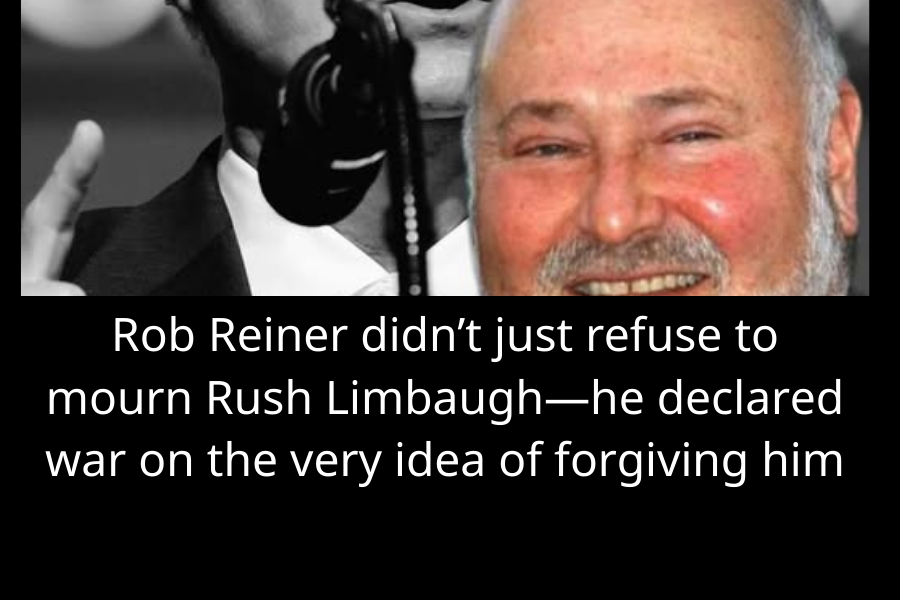
Rob Reiner, the director who gave America Stand By Me and The Princess Bride, looked at that script and ripped it to pieces.
In 2020, after Rush Limbaugh, the volcanic architect of modern conservative talk radio, announced a terminal lung cancer diagnosis, Reiner was asked for a comment. His response was not a prayer, not a well-wish, not even the empty “thoughts and prayers” platitude. It was a moral verdict.
He refused sympathy. He argued that Limbaugh’s decades of rhetoric—a torrent of divisive, often cruel commentary that he saw as poisoning the national discourse—had caused too much harm. A diagnosis, Reiner stated, did not absolve that. When Limbaugh died in 2021, Reiner doubled down. Death, he insisted, did not erase a legacy he viewed as fundamentally damaging to the country.
The reaction was a perfect fission of the American psyche. Critics howled: Cruel! Vindictive! Have you no decency? Supporters nodded: Finally, someone telling the blunt truth about consequences.
This wasn’t a gaffe. It was a deliberate, philosophical strike at the heart of a nagging national question: Are we obligated to perform compassion for those we believe showed none?
The Reiner Doctrine: Sympathy as a Moral Currency, Not a Social Reflex
Reiner’s position rests on a challenging premise: that public sympathy is not an automatic social courtesy, but a form of moral capital. To bestow it is to engage, however briefly, in a tacit endorsement of a person’s standing in the human community. In his calculus, Limbaugh had forfeited that standing through his life’s work.
“He spent his entire career dividing people, attacking the vulnerable, and profiting from hatred,” a source close to Reiner’s thinking explained. “To then turn around and offer hollow sympathy felt like participating in the very whitewashing of harm that allows such figures to be rehabilitated in death. Rob saw it as a matter of integrity, not bitterness.”
This is the antithesis of the “speak no ill of the dead” maxim. It is the belief that an honest eulogy is more respectful than a dishonest one, even if that honesty is brutal.
“Reiner was engaging in what we might call ‘ethical accounting,’” says Dr. Liana Marks, a professor of media ethics at UCLA. “He was publicly refusing to let the biological fact of illness or death settle the moral ledger. In an era where bad-faith actors are often memorialized as ‘complicated’ or ‘controversial’ rather than held accountable, his stance was a radical insistence that a public figure’s impact—their ‘legacy damage’—outweighs the private tragedy of their demise. It asks: when does personal suffering eclipse public harm? His answer was: not automatically.”
The Backlash: The Accusation of Dehumanization
The counter-argument is visceral and rooted in a different moral framework. Critics accused Reiner of committing the very sin he condemned: dehumanizing an opponent.
“There’s a difference between criticizing a legacy and dancing on a grave,” wrote conservative commentator Ben Shapiro. “Reiner’s refusal to acknowledge even the basic human tragedy of cancer or death reveals a malignant self-righteousness that mirrors what he claims to hate.”
The charge is that Reiner, in his quest for moral purity, abandoned empathy itself. By denying Limbaugh the basic acknowledgment of shared mortal frailty—the cancer, the fear, the finality—he stepped outside the bounds of civilized discourse. He wasn’t just criticizing ideas; he was withholding a fundamental human recognition. In this view, compassion for a dying man isn’t an endorsement of his politics; it’s an affirmation of a common humanity that must remain the bedrock, even amidst profound disagreement.
The Support: A Rejection of False Equivalence and Forced Nostalgia
For Reiner’s supporters, particularly on the left, his stance was a long-awaited breach in a frustrating convention. They saw the media and political class preparing to anoint Limbaugh a “legend” and a “giant,” softening his edges in death, integrating him into a pantheon of American icons.
Reiner’s refusal was a roadblock on the path to rehabilitation. It was a statement that some legacies are not redeemed by a microphone or ratings, but are judged by their tangible, corrosive effect on civil society. His bluntness was celebrated as a refusal to participate in the sentimental laundering of a divisive history.
“Why should we be forced to perform grief for someone who spent his life weaponizing resentment?” asked activist and commentator Brittany Packnett Cunningham at the time. “Rob Reiner didn’t wish harm on him. He simply refused to pretend the harm Limbaugh caused didn’t matter more.”
The Larger Stage: A Precedent for the Post-Trump Era
The Reiner-Limbaugh episode was a prelude to our current, even more fractured moment. It established a playbook for how to handle the passing of polarizing architects of the culture war.
It asks: In a nation where public figures are increasingly seen not as opponents but as existential threats, what do we owe them when they fall? Is the ritual condolence a necessary glue for a functioning society, or is it a coercive act of historical revisionism that demands the victims of a rhetorician’s wrath offer tribute to their tormentor?
Reiner chose the latter. He traded his reputation for “niceness”—the director of heartwarming stories—for a harder one: the uncompromising moral accountant.
His stance guarantees he will be remembered not just for the films he made, but for the condolence he withheld. In that refusal, he crafted a final, controversial scene for his own public life: a man staring into the camera, breaking the fourth wall of political decorum, and declaring that in the balance between kindness and justice, he had chosen his ledger.