The New Secretary of War: Pete Hegseth and the Reshaped Language of American Force
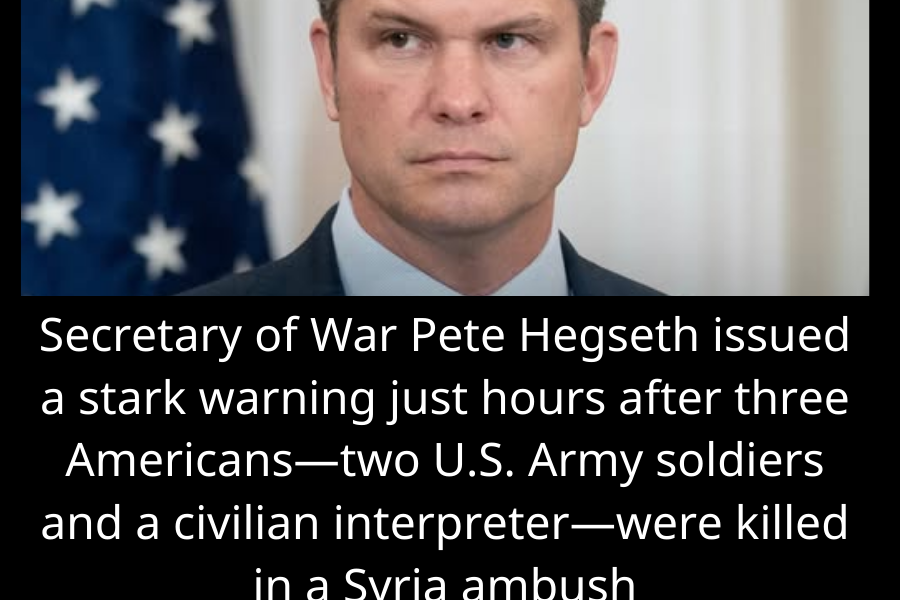
WASHINGTON — The title itself was a relic, a piece of historical set-dressing pulled from the national attic: Secretary of War. Its reappointment for the first time since 1947 wasn’t just a bureaucratic curiosity. It was a statement. And the man now holding it, Pete Hegseth, has now delivered his first public declaration—a stark warning following the deaths of two U.S. soldiers and a civilian interpreter in Syria.
The message was concise, its tone forensically calibrated between official notification and primal threat. The “savage” was killed. An investigation is active. And a warning is issued to “anyone who targets Americans.”
This is not standard Pentagon boilerplate. This is the opening stanza of a new doctrine, delivered in the unfiltered vernacular of a former infantry officer and cable news combatant now handed the reins of a renamed, reimagined department.
The Hegseth Doctrine: Brevity, Blame, and Biblical Retribution
Deconstructing the statement reveals its layered intent:
-
The Lexicon of “War”: By resurrecting the title “Secretary of War,” the administration deliberately shed the clinical, managerial connotations of “Secretary of Defense.” It signals a return to a binary, unambiguous view of global conflict—us versus them, civilization versus savagery. Hegseth’s language fits the title perfectly. He did not speak of “asymmetric threats” or “non-state actors.” He spoke of a “savage” and issued a “deadly warning.” This is the rhetorical posture of a bygone era, repurposed for an era of perpetual, shadowy engagement.
-
The Closure of Vengeance: “The savage who perpetrated this attack was killed by partner forces.” This is not merely a status update. It is a narrative of instant, conclusive justice. It short-circuits the typical period of uncertainty and speculation. It tells the public and the enemy: We identify you, we end you. The ledger is settled in blood, not in courts. This fulfills a deep public craving for decisive action and clear moral arcs, a craving Hegseth spent years articulating on television.
-
The Warning as Deterrence Theater: The “deadly warning to anyone who targets Americans” is performative. Its primary audience is not the scattered insurgent cells in Syria, who likely expect a U.S. response. Its audiences are:
-
The Domestic Base: To show resolve and strength.
-
Adversarial States (Iran, Russia): To signal a lower tolerance and a more direct attribution of blame.
-
The Bureaucracy: To tell the national security apparatus that the new leadership speaks and acts in absolutes.
-
“This is the ‘cable news briefing’ translated into official policy,” says General (Ret.) Marcus Thorne, a former Pentagon strategist. “Hegseth is applying the logic of prime-time commentary—moral clarity, instantaneous judgment, demonstrative retaliation—to the complex, gray-zone reality of the Syrian battlefield. The risk isn’t in the warning itself; it’s in the expectation it sets. It pledges a specific, overwhelming style of response to any attack, which can force escalation, limit diplomatic options, and turn every skirmish into a test of credibility that must be met with visible force.”
The Shadow of the “Partner Forces” and the New Syrian Calculus
The mechanism of retaliation is notable: “killed by partner forces.” This is the modern playbook. It maintains a layer of deniability for the U.S. while ensuring local allies execute the mission. It is efficient and politically insulated. But it also reveals a dependency and a potential vulnerability—the U.S. strategic footprint is now often the sum of its partnerships.
The ambush itself, and Hegseth’s response, underscore the intractable reality of the U.S. mission in Syria: a small, exposed force propping up a decentralized conflict against ISIS remnants and Iranian-backed militias, with the constant threat of Russian entanglement. Hegseth’s rhetoric suggests a move away from a posture of deterrence-through-presence to one of deterrence-through-exemplary punishment.
The “Department of War” as a Political Symbol
The resurrection of the title is the most potent signal of all. “Defense” is reactive, protective. “War” is active, declarative, and morally charged. It frames every engagement not as an unfortunate necessity, but as a chapter in a continuous, recognized struggle. It prepares the public mind for a more confrontational, less apologetic use of American power.
Hegseth, a figure who built his career arguing that the Pentagon had become too risk-averse and politically correct, is now perfectly cast as the face of this shift. His first public statement after American deaths was a chance to embody the new ethos: swift, moralistic, and unforgiving.
The Road Ahead
The warning has been issued. Its credibility will now be judged not by words, but by the next attack, and the response that follows. Hegseth has placed his own reputation, and that of the resurrected department he leads, on a simple, brutal proposition: Target Americans, and you will be erased, immediately and totally.
In doing so, he has traded the ambiguity of modern conflict for the chilling clarity of an earlier age. The world is now watching to see if that clarity can be enforced, or if it will become a promise too stark to keep in a complex and unforgiving world. The Secretary of War has spoken. The echo will be measured in actions, not words.