The Refugee as Political Rorschach Test: Deconstructing Cory Booker’s American Story
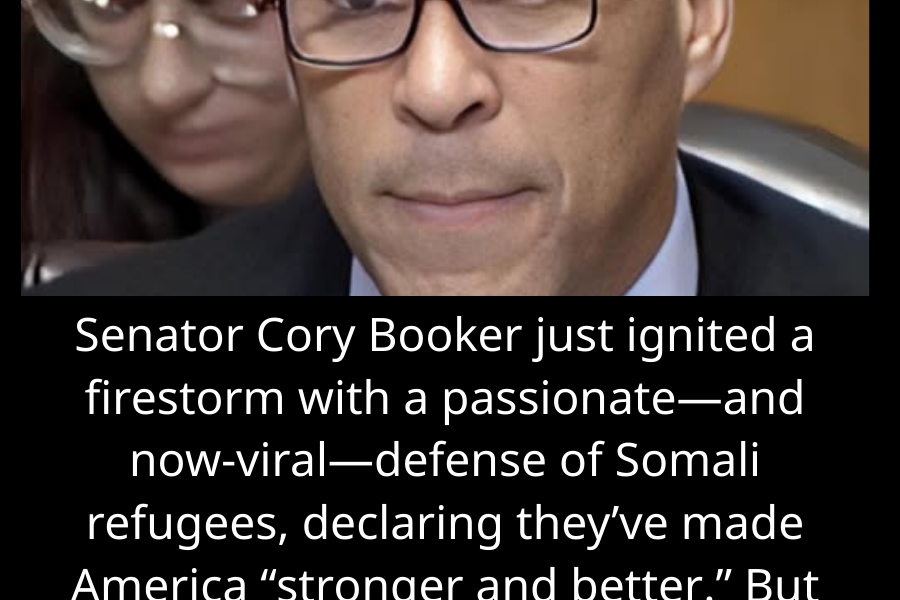
WASHINGTON — Watch the clip. It’s 18 seconds. In it, Senator Cory Booker (D-NJ) stands before an audience, his cadence measured but fervent, and delivers a line that, in the algorithm-driven theater of modern politics, functions less as a statement and more as a cultural IED.
“Somali refugees have made America stronger and better.”
The syntax is simple. The sentiment, to his supporters, is self-evident: a recognition of immigrant contribution. But in the hyper-polarized ecosystem of 2024, this is not just praise. It is a political signal flare. It lands in a media landscape where the very words “Somali refugees” are not neutral descriptors but heavily coded terms, conjuring a cascade of pre-existing narratives about immigration, security, assimilation, and national identity.
Booker’s statement is a Rorschach test. What you see in it reveals less about Somalia or New Jersey, and more about your vision of the American project itself.
The Two Americas in the Comment Section
The reaction to the clip fractures along a now-familiar fault line.
In one America, Booker’s words are a straightforward affirmation of a foundational truth. They point to places like Columbus, Ohio or Minneapolis, Minnesota—home to the largest Somali diaspora communities in the nation. Here, the narrative is one of resilience and economic energy:
-
Entrepreneurship: Somali-Americans have revitalized commercial corridors, launching thousands of small businesses from restaurants and coffee shops to import-export firms and tech start-ups.
-
Cultural Mosaic: They’ve added new threads to the national fabric—from the vibrant art scene in the Cedar-Riverside neighborhood of Minneapolis to the growing political representation in local and state offices.
-
Military Service: Hundreds of Somali-Americans serve in the U.S. Armed Forces, a fact often highlighted by advocates as the ultimate testament to their commitment.
This America hears Booker and nods. He is stating a factual, demographic reality of contribution.
In the other America, the clip is heard through a filter of border crisis rhetoric, terrorism fears, and cultural anxiety. Here, “Somali refugee” is often conflated with:
-
Security Threats: Isolated incidents involving returning ISIS fighters or cases of terrorism recruitment are amplified to represent an entire community.
-
Cultural Conflict: Debates over religious accommodation in schools or workplaces are framed as a failure of assimilation.
-
Resource Strain: The legitimate challenges of resettlement—housing, education, social services—are portrayed not as a logistical hurdle to be managed, but as an existential drain.
This America hears Booker and hears naiveté at best, deliberate subversion at worst. To them, he is prioritizing the narrative of diversity over the reality of security and cohesion.
“This isn’t a debate about facts; it’s a clash of archetypes,” explains Dr. Laila Ali, a sociologist specializing in diaspora studies. “Booker is invoking the ‘Nation of Immigrants’ archetype—the idea that each wave of newcomers renews and strengthens the country. His detractors are invoking the ‘Fortress America’ archetype—the idea that the nation is a fragile vessel requiring vigilant protection from external threats. Both are powerful, deeply rooted American stories. The clip is just the latest battlefield where they collide.”
Booker’s Deeper Calculus: The Politics of the “More Perfect Union”
For Cory Booker, this isn’t a random comment. It’s brand-level communication.
-
Solidifying the Base: It reinforces his identity as a progressive champion of multiculturalism and a descendant of the Civil Rights movement, framing inclusion as patriotic strength.
-
Counter-Narrative Warfare: It directly challenges the isolationist, “America First” rhetoric that dominates one wing of the GOP. He is offering a deliberate, values-based counterpoint: strength through diversity, not in spite of it.
-
Local Politics, National Stage: With a significant and politically active Somali-American community in neighboring Minnesota (and pockets in New Jersey), the statement resonates in key Midwest battlegrounds and within the progressive donor ecosystem.
He is not just describing a community; he is crafting a parable for the Democratic vision of America itself. One where diversity is a strategic asset, compassion is a form of strength, and the nation’s moral character is judged by how it treats the vulnerable.
The Unspoken Context: Why “Somali” Triggers a Unique Reaction
The statement would land differently if he had said “Ukrainian refugees” or “Vietnamese refugees.” The “Somali” designation carries specific historical and political baggage:
-
The “Black Hawk Down” Legacy: A generation’s understanding of Somalia is framed by the 1993 battle in Mogadishu, an event that entrenched a perception of the nation as a zone of chaos.
-
The “Security Risk” Frame: Persistent, though often overstated, concerns from intelligence officials about terrorist recruitment in diaspora communities.
-
Visible Difference: As predominantly Black, Muslim immigrants, Somali refugees face the intersection of racial, religious, and cultural prejudice.
Booker, by specifically naming them, is thus doing something brave or reckless, depending on your view. He is choosing to uplift the most stigmatized archetype in the current immigration debate. He is not taking the easy path of praising a less-controversial immigrant group. He is walking directly into the storm and planting a flag.
The Verdict Beyond the Viral Clip
The 18-second clip will be cut into attack ads and celebratory montages. It will be cited as proof of either enlightened leadership or dangerous idealism.
But beyond the binary warfare, a more complex reality persists in cities across the heartland. It is the reality of first-generation parents working brutal hours so their children can become doctors, the reality of community leaders brokering peace between gangs and police, the reality of a new cuisine enriching a city’s palate, and the undeniable reality of ongoing struggles with poverty, trauma, and integration.
Booker’s statement simplifies this mosaic into a powerful, political thesis. His critics simplify it into a powerful, political warning. Both are selling a story.
The truth, as always, is not in the tweet or the clip, but in the quieter, messier, more human spaces in between—spaces where a nation is constantly being made, broken, and remade, one family, one business, one conflicted sentiment at a time. Booker isn’t reporting from those spaces. He’s offering a moral interpretation of them. And in 2024, that interpretation is itself a declaration of war in the endless battle over what—and who—makes America “stronger and better.”