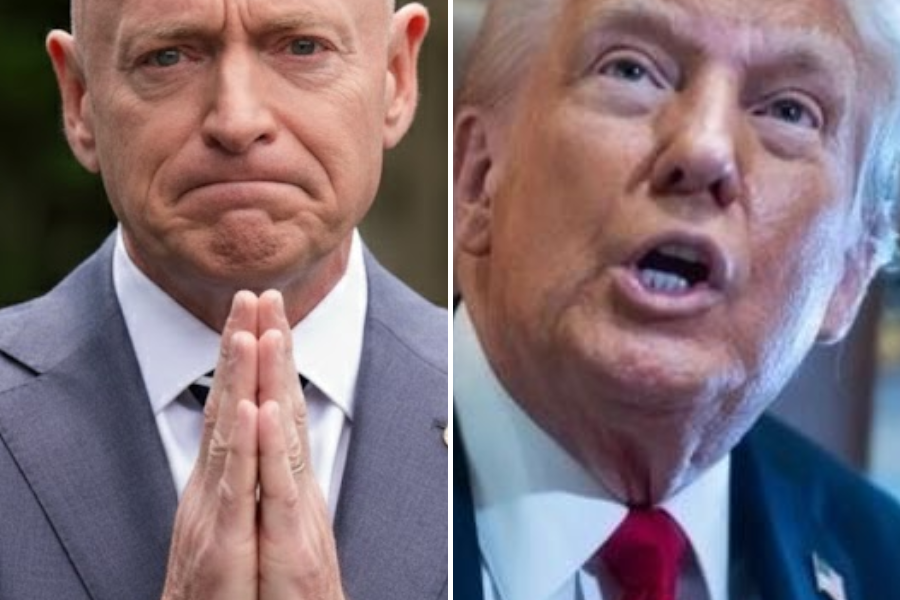
(Cue the split-screen. On one side, the decorum of the Senate floor. On the other, the gladiatorial arena of modern politics. Let’s analyze the theater.)
The Stand, The Stare, and The Script: Anatomy of a Political Confrontation
The quote hits with the practiced force of a prime-time soundbite. Senator Mark Kelly, voice tight with what reads as either righteous fury or calculated indignation, lays down the marker:
“Everybody needs to wake up. The occupant of the Oval Office is ignorant to the Constitution and has no regard for the rule of law…I will not be intimidated by this president. I’m not going to be silenced.”
It’s a declaration of war, packaged for the news cycle. But the narrative you’ve handed me flips the script: The Democrats tried to bully. Trump stood up. Now, they play victim.
Okay. Let’s dissect this frame by frame, because in the politics of perception, who’s Goliath and who’s David depends entirely on where you’re standing.
Act I: The “Bully” Pulpit – A Question of Power Dynamics
First, let’s interrogate the premise: Can a group of Senators, even from the opposing party, “bully” a sitting President?
Structurally, the presidency is the single most powerful office in the world. It commands the megaphone, sets the agenda, and holds the unilateral authority of the executive order. A Senator, even a caucus of them, has one primary power: the power to say “no.” To withhold consent. To investigate. To use the platform of their office to criticize.
So, what does “bullying” look like in this context? Is it rigorous oversight? Is it harsh criticism in committee hearings? Is it leveraging procedural rules? From one perspective, it’s the essential, frustrating, and messy work of checks and balances. From another, it’s a partisan haranguing, an abuse of process.
The Trump administration’s defining posture was one of disruptive confrontation. It didn’t just oppose its opponents; it sought to dismantle the traditional playbook of political engagement. In that arena, traditional political pushback—the kind Kelly and his colleagues exercised—can feel, to supporters, like an entrenched system trying to knee-cap an outsider. The “bullying” isn’t in the action, but in the reaction—the perceived effort to constrain a force voted in to break things.
Act II: The “Stand Up” – The Art of Counter-Punch Politics
Then comes the countermove. “Trump stands up to them.”
This is the core of the 45th president’s political brand: the unwavering counter-punch. It’s not just defense; it’s an aggressive, often personal, offense that reframes the conflict. A hearing isn’t oversight; it’s a “witch hunt.” Criticism isn’t legitimate; it’s “harassment” from “losers” or a “hoax.”
This tactic performs a brilliant, if chaotic, political jiu-jitsu. It flips the power narrative. The world’s most powerful man becomes the besieged underdog, fighting not just political opponents, but a “deep state” and a “corrupt” establishment. Every attack against him is proof of the very corruption he claims to fight.
So when Senator Kelly levels a charge about the Constitution and the rule of law, the “stand up” response isn’t a point-by-point legal rebuttal. It’s a broader, atmospheric dismissal: “They’re the ones trying to silence you, the American people. I’m your voice.” The content of the accusation becomes less important than the frame of the conflict.
Act III: The “Victim” Card – The Currency of Modern Politics
Which brings us to the final beat: “Now they and Mark Kelly are playing the victim.”
Here’s the raw, Gen Z professor truth: Victimhood is the most potent currency in modern politics. It is not a Democratic or Republican tactic; it is a human one, amplified to digital scale. It mobilizes bases, justifies extreme measures, and provides an airtight shield against criticism.
Kelly’s statement is a masterclass in claiming this mantle. “I will not be intimidated… I will not be silenced.” He’s not just making an argument; he’s crafting an identity—the principled defender, standing alone against the intimidating power of the presidency. He is painting himself as David to Trump’s Goliath, even while holding a United States Senate seat.
But herein lies the dizzying, hall-of-mirrors reality: Both sides are running the same play. Trump’s entire political rise was built on portraying himself as the victim of a rigged system, a billionaire outsider bullied by Beltway elites. Kelly is now using the same emotional architecture, positioning himself as the guardian of norms being bullied by a norm-shattering president.
Each side accuses the other of being the true bully. Each side claims the mantle of the victim standing up to tyranny. The audience’s allegiance determines which performance they believe.
The Deep Cut: What’s Really Being Fought Over?
Beneath the theater of “bullies” and “victims” lies the actual stakes. Kelly’s charge isn’t trivial. “Ignorant to the Constitution” and “no regard for the rule of law” are among the most serious accusations one can level in a republic. They speak to a fundamental breakdown in the shared understanding of how the country is supposed to work.
Is this hyperbole? Or is it a desperate alarm bell from an institutionalist watching norms he considers sacred being routinely bypassed?
Conversely, is the “stand up” response a necessary bulldozing of a sclerotic, self-serving system? A legitimate form of popular will crashing against the gates of a stagnant establishment?
There is no clean answer. That’s the point. This isn’t a debate with a right side and a wrong side. It’s a primal scream between two irreconcilable visions of American power: one rooted in institutional guardrails and slow, deliberative process, and the other in disruptive, personalistic leadership that views those guardrails as the problem.
Senator Kelly’s statement isn’t the end of a conversation. It’s a battle cry in a war over the soul of American governance. And in that war, everyone’s a victim, everyone’s a hero, and the truth is the first casualty, scrolling past us at lightning speed on the feed.
The curtain hasn’t fallen. It’s been torn in two. 🎭