The Patronage Dividend: When Economic Policy Becomes a Political Loyalty Test
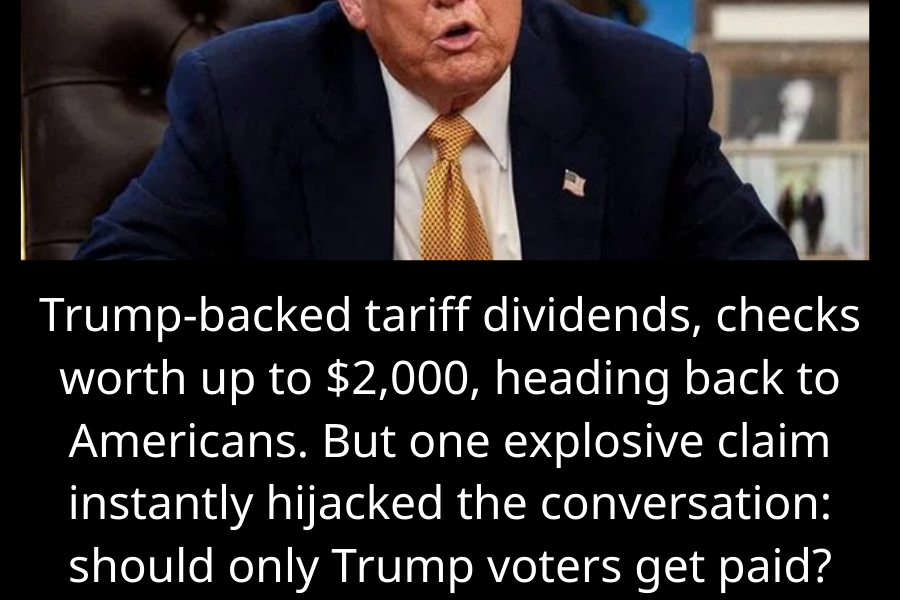
WASHINGTON — The idea is as politically potent as it is constitutionally radioactive: a direct cash transfer, tied explicitly to presidential policy, distributed only to those who voted for the president who enacted it. The proposal—that only Trump voters should receive the hypothetical “$2000 tariff dividend”—is not a serious policy blueprint. It is a rhetorical thermobaric device, detonated to reveal the deepest fault lines in the American social contract.
This isn’t about tariffs or dividends. It’s about a fundamental, haunting question that has simmered beneath the surface of our politics for years: In an era of bitter division, can public benefits be treated as rewards for political loyalty, or must they remain neutral expressions of civic membership?
Let’s dissect the anatomy of this explosive notion.
The Core Proposition: The “Patronage State”
The argument rests on a simple, brutal logic:
-
The Policy Victory: A president implements a policy (e.g., aggressive tariffs).
-
The Claimed Revenue: The government collects revenue from these tariffs (the “dividend”).
-
The Rightful Recipients: Those who voted for the president are the ones who “made it happen,” and thus should be the sole beneficiaries. Non-voters or opposition voters, by this logic, are free-riders on a victory they opposed.
This transforms the state from a neutral administrator of public goods into a patronage machine, distributing spoils to its political supporters. It is the logical endpoint of the politics of grievance and “us vs. them,” applied to the Treasury itself.
“This is the clientelization of citizenship,” argues Dr. Eleanor Vance, a political theorist. “It proposes replacing the concept of universal public benefit—where you receive Social Security or a road repair regardless of your vote—with a system of political tributes. It frames the relationship between citizen and state not as one of shared rights and responsibilities, but as a transactional loyalty to a specific leader. It is, in essence, a proposal to formalize a political ‘in-group’ and ‘out-group’ in federal disbursements, which is antithetical to the 14th Amendment’s guarantee of equal protection under the law.”
The Legal and Constitutional Blowtorch
Such a scheme would be instantly, and unanimously, obliterated in court. The barriers are not high—they are foundational walls:
-
The Fourteenth Amendment (Equal Protection Clause): The government cannot distribute benefits based on a political classification like voting record. This is the definition of invidious discrimination.
-
The Twenty-Fourth Amendment & Voting Rights Act: It creates a poll tax in reverse—a financial reward for voting a certain way, which is just as coercive and corrupting as a financial penalty.
-
The Privacy of the Ballot: Voting is secret. Tying a cash payment to it would require an impossible and terrifying violation of that secrecy, destroying the anonymous ballot.
-
The Purpose of Taxation and Revenue: Federal revenue is for the “general welfare,” not for the specific welfare of a political faction.
The proposal is legally absurd. But its power lies in its absurdity—it is a pure, undiluted expression of a sentiment: Why should they benefit from our victory?
The Psychological Payoff: Reward, Resentment, and Revenge
While impossible to implement, the idea serves three powerful psychological purposes for its proponents:
-
The Reward Fantasy: It offers a visceral, gratifying fantasy of tangible reward for political loyalty. In an age of abstract economic policies, a $2000 check is concrete. It validates the supporter’s choice in the most direct way possible.
-
The Weaponization of Resentment: It formalizes the resentment that “others” are benefiting from policies they didn’t support. It says, Your feelings of being cheated are valid, and here is the solution.
-
The Performance of Tribal Sovereignty: Merely floating the idea signals a willingness to prioritize the tribe over the nation. It’s a declaration that the in-group’s cohesion and reward are more important than universalist civic norms.
The Real-World Parallel: The “Tariff Dividend” as Political Theater
The concept likely references a political talking point that tariff revenue could be redistributed to citizens as an “offset” to higher consumer prices. But even in that legitimate (if debated) policy framework, the distribution would be based on economic criteria (e.g., income, geography), not political ones.
By grafting the loyalty test onto it, the proposal exposes the underlying desire: not just to share economic gains, but to politically purify the recipient pool. It’s about identity, not economics.
The Dangerous Precedent in the Suggestion
The gravest danger of this idea is not its reality—it will never happen—but its rhetorical normalization. It further inoculates the public against the core democratic principle that government exists for all citizens.
When the notion of partisan distribution of public benefits is entertained, even as fantasy, it:
-
Erodes the legitimacy of all universal programs (What if your Social Security is next?).
-
Justifies further partisan retaliation.
-
Advances the idea that political opponents are not fellow citizens to be governed with, but adversaries to be deprived.
The Bottom Line
The “$2000 for Trump voters only” idea is a thought experiment in political tribalism. It is a mirror held up to a polarized nation, reflecting a dark desire to replace the common good with the factional reward.
It will never be law. But its very utterance is a symptom of a disease where the bonds of shared citizenship are becoming weaker than the bonds of political hatred. The proposal isn’t a policy; it’s a provocation that asks: How much of the Republic’s foundational principle of equal treatment are we willing to abandon for the sweet satisfaction of rewarding our friends and punishing our enemies?
The answer, for now, remains in the courts and the Constitution. But the question is now hauntingly, publicly, on the table.