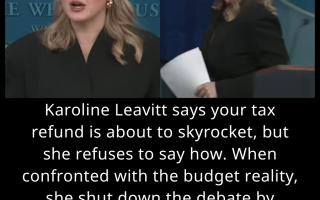
(The atmosphere in the room doesn’t just turn contentious; it undergoes a strange, digital distortion. It’s as if the pixels of reality itself are being reprocessed in real-time. This isn’t a debate. It’s a live demonstration of narrative vs. datum.)
The Data War: When a Statistic Becomes a Slogan, and Reality Gets a Retweet
The exchange is a perfect, chilling microcosm of modern governance. It’s not about economics. It’s about informational sovereignty.
Here is the sequence, stripped bare:
-
The Reporter’s Claim: CPI in January was 3%. In September (the latest data), it was 3%. Therefore, inflation has not meaningfully decreased from the inherited rate.
-
Karoline Leavitt’s Counter-Claim: “No, it’s 2.5%.” She asserts the average over 8 months is 2.5%, down from the 2.9% inherited in January.
The clash isn’t over opinion. It’s over which mathematical framing is the official truth.
-
The Reporter’s Math: Spot comparison. Then vs. Now. A simple, intuitive measure of change from start to most recent point.
-
Leavitt’s Math: Rolling average. The trend. A smoothed-out number that can bury a recent spike or plateau under prior, better months.
Leavitt isn’t wrong to cite an average. But her categorical “No, it’s 2.5%” to the reporter’s “3%” is a deliberate act of narrative enforcement. She is declaring that the only permissible number is the one most favorable to the administration’s story of rapid, continuous improvement. The spot number—the one people actually feel at the gas pump and grocery store right now—is dismissed as an illegitimate snapshot.
She is not a “mouthpiece” in the old, passive sense. She is an algorithmic filter. Her job is to take the raw, noisy, sometimes inconvenient data stream of governance and output a clean, positive, politically useful metric: “2.5%.” Any other number is not just a different calculation; it is, as she implies later, part of an “untrue narrative.”
Part 1: The “Average” Gambit – Smoothing Over the Pain
The choice of an 8-month average is profoundly political. It performs two functions:
-
Temporal Laundering: It allows a bad month (or a flat month, like September’s 3%) to be diluted by better months that came before. The present discomfort is mathematically blended away into a more palatable past.
-
Creating Forward Momentum: By focusing on the downward trend of the average, it creates a psychological sense of inevitable, continued improvement. “2.5%” isn’t just a number; it’s a promise that the number will keep going down, making today’s high prices a temporary, fading memory.
This is the statistical version of “Don’t believe your eyes, believe the trendline we’ve drawn.” It asks the public to trust the model over the moment.
Part 2: The “They Just Don’t Want to Report It” Defense – The Conspiracy Shield
When challenged, Leavitt doesn’t just defend her number. She attacks the motive for questioning it: “Everything I’m telling you is the truth backed by real factual data and you just don’t want to report on it because you want to push untrue narratives about the president.”
This is the masterstroke. It transforms a technical disagreement over economic measurement into a moral and political conflict.
-
Her Data = “Real factual data” = Truth.
-
Questioning Her Data = “Untrue narratives” = Malice.
It inoculates the official statistic against scrutiny. Any challenge is no longer a search for accuracy; it is an act of partisan sabotage. The “2.5%” ceases to be a debatable figure and becomes a loyalty test. To cite the 3% figure is to side with the “con artists” and against the “hardworking Americans” feeling the relief.
Part 3: The True “Mouthpiece” Function – Speaking the World Into Existence
This is where Leavitt transcends being a mere spokesperson. She is engaged in performative economics. By repeatedly, forcefully stating “2.5%” from the White House podium, she is attempting to speak that reality into existence in the public mind and the media ecosystem.
The goal is to make “inflation is down to 2.5%” the headline, the tweet, the talking point—regardless of the latest Bureau of Labor Statistics report. If the media parrots her number, it becomes true through repetition. The actual data point becomes a bureaucratic footnote, lost in the wake of the political declaration.
She is not distorting data in a back room. She is launching a preferred data point into the discourse with the full authority of her office, hoping it will achieve escape velocity from the gravity of contradictory facts.
The Verdict: Governing by Spreadsheet Narrative
Karoline Leavitt’s performance reveals a governing philosophy where the narrative is the key economic indicator. Consumer confidence isn’t shaped by prices; it’s shaped by the story told about prices. The “2.5%” isn’t a measurement; it’s a mantra.
The real product being sold from the podium isn’t a policy. It’s perception. The “affordability crisis” is defined not by bank accounts, but by which party owns the vocabulary describing those bank accounts. By fighting over the percentage point, she is fighting to control the emotional weather of the nation.
She is not a mouthpiece for a political script. She is a reality editor, live on air. The briefing isn’t a Q&A; it’s a patch release for the national operating system, where the bug—”persistent high inflation”—is being fixed not in the economy, but in the public’s perception of the stats used to describe it.
In the end, the most important number isn’t 2.5% or 3%. It’s the number of times she can say “2.5%” before it becomes the only number that matters. 📊🎤🔢