The Algorithm of Outrage: How Elon, Ilhan, and “Treason” Fuel the Infinite Scroll Machine
It begins, as it often does, in the dead of digital night. A single word, typed into the void by the world’s richest man. Two syllables that detonate like a silent warhead in the bloodstream of the internet: “Treason.”
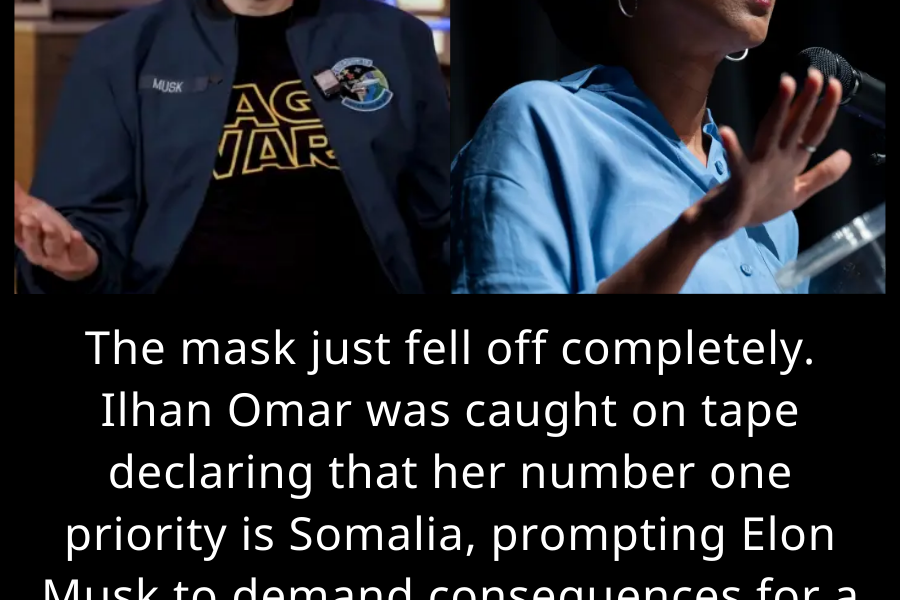
The target: Ilhan Omar. The catalyst: a clip, ripped from a January 2024 town hall, translated, stripped of context, and hurled into the timeline by Elon Musk. Hours earlier, Donald Trump, on a stage in Pennsylvania, had performed his own ritual—the mocking cadence (“whatever the hell her name is”), the racialized Othering (“the little turban,” “her country”), and the blood-pumping chant he both conducted and conjured: “Send her back!”
This is not a coincidence. This is a coordinated narrative strike. And to understand its power, you must see it not as politics, but as high-performance content engineering. We are living inside the algorithm, and this is its most potent product.
Act I: Deconstructing the Clip – The Soundbite as Weapon
Let’s isolate the viral audio, the alleged “smoking gun”:
“The US government will only do what Somalians in the US tell them to do… They must follow our orders… As long as I am in the US Congress, Somalia will never be in danger… Sleep in comfort, knowing I am here to protect the interests of Somalia from inside the US system.”
Taken at face value, it’s incendiary. It seems to depict a U.S. congresswoman claiming to control American foreign policy for a foreign power. It frames her not as a representative of Minnesota’s 5th district, but as a sleeper agent for Somalia.
But context is the first casualty in a content war. This was a speech to a Somali-American constituency, in Somali. The tone, the cadence, the cultural shorthand of speaking to a diaspora—it’s fundamentally different from a House floor speech. It’s the politics of affirmation, of telling a community that feels unseen, “I see you, and your concerns matter in the halls of power.”
The substance? She was opposing a port deal between Ethiopia and Somaliland—a breakaway region Somalia claims. This is diaspora politics 101. Greek-Americans lobby on Cyprus. Armenian-Americans on Nagorno-Karabakh. Cuban-Americans on embargo policy. It’s not “treason”; it’s a centuries-old feature of the American pluralistic experiment. The blunt, boastful phrasing is political rally talk—the same genre where a politician might tell Iowa farmers, “I’ll make sure Washington works for you!”
But the clip isn’t sold with context. It’s sold as pure signal. And the signal it broadcasts to a certain audience is primal: The immigrant is not here to assimilate. She is here to infiltrate. She is loyal to “there,” not “here.”
Act II: The Amplification Matrix – Musk, Trump, and the Feedback Loop
This is where the architecture of modern outrage reveals itself. Observe the perfect, brutal synergy:
-
The Grassroots Fuel: The clip and the “treason” framing didn’t originate with Musk. They’ve been circulating in right-wing media and forums since January, a simmering narrative waiting for a catalyst. The previous financial scandal laid the kindling—the allegation of corruption. This clip provides the spark—the allegation of disloyalty.
-
The Billionaire Amplifier: Elon Musk, owning the digital public square, doesn’t just retweet. He certifies. His “This sounds like treason” is not an opinion; it’s an algorithmically-prioritized verdict delivered to 150 million followers. It transforms a partisan attack into a mainstreamable question. Media outlets now have to cover it: “Elon Musk suggests treason…”
-
The Political Incendiary: Trump’s rally rant provides the emotional, tribal framework. He doesn’t debate policy; he dehumanizes. “The little turban.” “Her country… the worst in the world.” He reduces a complex individual to a caricature, making the leap to “treason” feel intuitive, not intellectual. The “Send her back!” chant is the offline viralization, a physical meme of exclusion.
-
The Closed Loop: Omar’s response—calling Trump “beyond weird,” a “national embarrassment”—feeds right back into the machine. It’s dismissed as hysterical, proving (to the other side) her inability to engage the “serious” accusation. The cycle spins faster. Donations are driven. Engagement soars.
This isn’t a debate. It’s a content engine, and Ilhan Omar is the raw material being fed into it.
Act III: The Real “Treason” – Against Nuance, Complexity, and Pluralism
Let’s be brutally clear: the legal definition of treason is aiding an enemy with whom the United States is at war. Somalia is not an enemy. This is rhetorical napalm, not a legal argument.
But the deeper “treason” being alleged here is against a mythic, monolithic idea of America.
Stephen Miller’s previous attack framed Omar’s financial scandal as proof that migration was a “weapon” to “steal sovereignty.” Musk’s attack frames her words as proof that dual allegiance is inherently treasonous. The underlying argument is: You cannot be truly Somali and truly American. Your heart must have a single loyalty. To express care for your country of origin is to betray your country of citizenship.
This strikes at the core of the immigrant experience, which is almost always a dialogue of the heart. It is possible—it is human—to love the soil that raised your parents and defend the soil that raised your children. To want justice for Somalia and prosperity for Minnesota. To see no contradiction in that.
The narrative strike seeks to make that duality illegitimate. It is a project of purification. It says America is not a mosaic; it is a melting pot that demands you evaporate your past.
Act IV: The Human in the Machine – Why This Cuts So Deep
Beyond the politics, sit with the human reality.
Ilhan Omar spent her childhood in a refugee camp. She arrived in America as a teenager, learned English, rose through local politics to the United States Congress. She is, by any classic measure, the American Dream incarnate.
And yet, she is perpetually told she does not belong. That her faith (signified by the hijab, demeaned as a “little turban”) is alien. That her concern for her birthplace is seditious. That her financial success is proof of crime. That her very existence is a political weapon.
This is the psychic gauntlet of the “Other” in 2025. You are simultaneously accused of being too successful (the $30 million) and not assimilating enough (the “Somalia-first” clip). You are a parasite and an infiltrator. The logic is airtight because it is not logic; it is identity-based animus, algorithmically optimized.
The Bottom Line: We Are All in the Feed Now
The Ilhan Omar story is no longer about one congresswoman. It is a template, a perfect storm of modern narrative warfare:
-
A financial scandal (the $30 million question) providing a veneer of “corruption.”
-
A decontextualized clip providing the “smoking gun” of disloyalty.
-
A billionaire algorithm-lord certifying the allegation.
-
A former President providing the tribal, dehumanizing rallying cry.
It works because it bypasses the brain and goes straight to the gut. It feels true before it can be fact-checked.
Omar’s plea—that Trump has “no economic policies to tout” so he resorts to “bigoted lies”—misses the point. In the attention economy, this is the policy. Division is the product. Outrage is the engagement. And “Send her back!” is the slogan for an America being sold, piece by piece, to the highest bidder of our collective fear.
The question is no longer about Ilhan Omar’s loyalty.
It’s about ours.
Do we log off the loop?
Or do we keep scrolling, chanting, feeding the machine?