(The sound is the dry, precise rustle of a judicial robe, and the sharp crack of a gavel landing on the most sacrosanct principle of American law enforcement: the inviolability of the grand jury. This is not a political scandal. It is a constitutional tremor.)
The Sealed Room Breached: When a Judge Orders the Grand Jury’s Veil Lifted
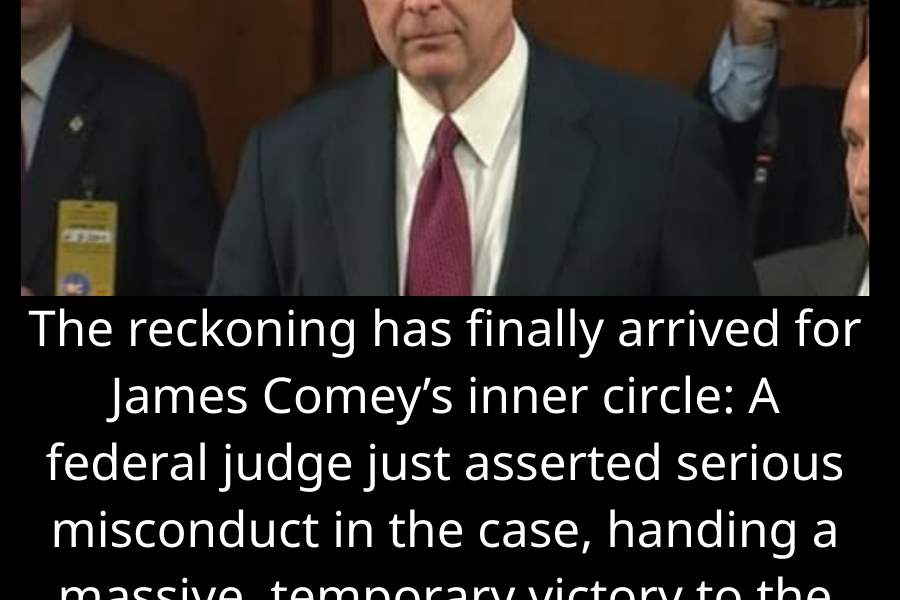
This story is not about James Comey, Donald Trump, or Lindsey Halligan. Not really. It is about a locked room. For centuries, the federal grand jury room has been the ultimate black box of American justice. Its proceedings are secret. Its witnesses are shielded. Its transcripts are sealed. This secrecy is the bedrock of its power—to investigate without fear, to accuse without public prejudice.
Magistrate Judge William Fitzpatrick didn’t just criticize a prosecutor. He took a chisel to that bedrock. His finding of “profound investigative missteps” and a “slapdash indictment” was so severe that he ordered the ultimate remedy: unlock the black box. Hand the sacred transcript over to the accused.
This is not a ruling. It is a five-alarm fire in the temple of justice.
Part I: The “Profound Missteps” – Not Error, but Corruption of Process
Fitzpatrick’s language is not the typical dry legalese of judicial correction. It is the language of systemic failure.
-
“Disturbing pattern”: Not one mistake, but a practice.
-
“Profound investigative missteps”: Errors so deep they go to the foundation of the investigation.
-
“Undermine the integrity of the grand jury proceeding”: This is the nuclear charge. The grand jury’s integrity is its only product. To undermine it is to poison the well from which the indictment springs.
-
“Indict first, investigate second”: An accusation of prosecutorial malpractice that inverts the entire purpose of the grand jury, turning it from a shield for the citizen into a sword for the state.
These findings paint a picture of a process so rushed, so ideologically charged or incompetent, that it breached the constitutional covenant between the state and the accused.
Part II: The “Extraordinary Remedy” – Why Breaking Secrecy is the Only Answer
Grand jury secrecy is “sacrosanct” for a reason: to protect witnesses, to encourage candid testimony, to prevent the flight of suspects. Ordering its disclosure is, as the experts say, “highly unusual.” It is the judicial equivalent of a surgeon breaking a patient’s rib to perform emergency heart massage.
Fitzpatrick argues this drastic move is “necessary under unique circumstances.” The “unique circumstance” is the credible allegation—which his ruling substantiates—that the prosecutor, U.S. Attorney Halligan, may have “tainted” the proceeding from the inside.
If the prosecutor misled the grand jurors, if privileged material was exposed, if the process was a predetermined “slapdash” hunt for an indictment, then the resulting indictment is fruit of a poisoned tree. The only way for Comey’s team to prove that, and for the court to assess it, is to see what happened in the room. Secrecy must yield to the greater imperative: due process.
Part III: The Political Vortex and the Institutional Crisis
While the ruling is a legal earthquake, it lands in a political fault line. The dramatis personae ensure it will be seen through a partisan lens: a Trump-appointed, allegedly inexperienced prosecutor; a Biden-appointed judge granting a stay; the ghost of the 2016 election haunting the courtroom.
But to view this only as politics is to miss the profound institutional crisis it signals.
This case has become a stress test for the Department of Justice’s perceived independence. The fact that a magistrate felt compelled to take this step, that an earlier grand jury rejected a broader indictment, that multiple high-profile Trump critics are simultaneously facing charges—these facts coalesce into a portrait of a DOJ where the line between lawful prosecution and political weaponization appears, to a federal judge, to have been blurred.
The stay by Judge Nachmanoff is just a pause. The appeal will be a battle over the soul of prosecutorial discretion. Can the DOJ “vigorously defend the integrity of the proceedings” when a federal judge has already declared that integrity to be in question?
The Verdict: A Crisis of Legitimacy
This ruling, even stayed, is a catastrophic loss for the Department of Justice. It is not a setback on a case; it is an erosion of institutional authority.
A single judge has publicly declared that in this case, involving a famously polarizing figure, the government’s conduct was so suspect that the most protected process in American law must be opened to the defense. This grants immense credibility to Comey’s claim of a “vendetta” and fuels the narrative of a two-tiered, politicized justice system—a narrative that now has a footnote in a federal court order.
The grand jury’s door has been cracked. Not by a conspiracy theorist, but by a federal magistrate. And the light now spilling out doesn’t illuminate guilt or innocence in the charges against James Comey. It illuminates the disquieting possibility that the machinery of justice itself was miswired.
The question is no longer “Did James Comey lie?” The question has become: “Can the public trust the process that accused him?” And for now, a federal judge has answered: We cannot be sure. ⚖️🔒📜