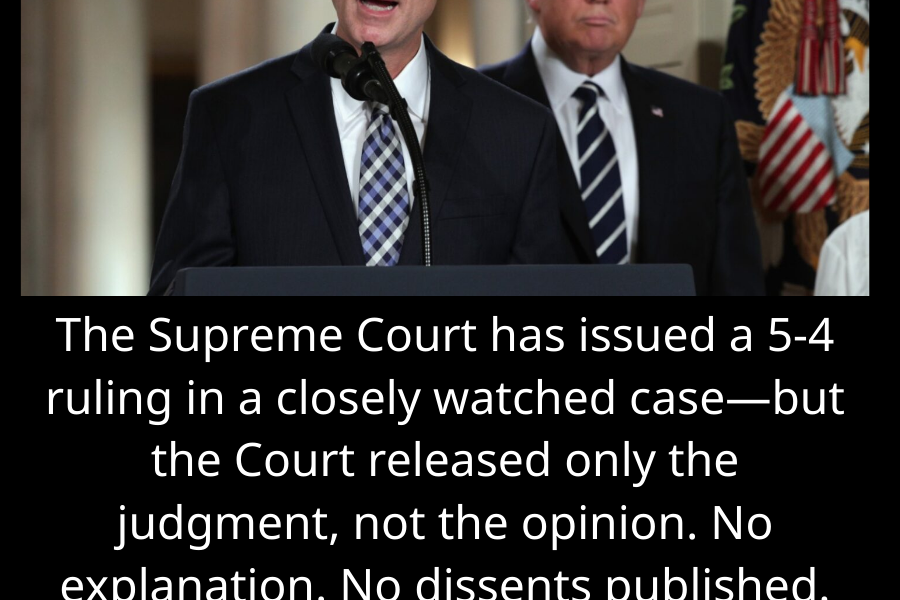
The Shadow Docket’s Spotlight: A 5-4 Nation Reveals Its Seams
WASHINGTON — The numbers themselves have become a kind of national shorthand: 5-4. In a Supreme Court term defined by seismic, culture-shifting rulings, this most slender of margins is not just a tally. It is a diagnosis. It reveals a Republic so fundamentally riven that its ultimate legal arbiter consistently splits along a fault line forged in the confirmation wars, reflecting a nation where the most basic questions of rights, power, and truth have two bitterly contested answers.
This isn’t about judicial philosophy. It is about political physics. The 6-3 conservative supermajority, a legacy of one presidential term and unprecedented Senate maneuvering, has reshaped the landscape. But within that bloc, the enduring 5-4 split on the most incendiary cases is the real story. It shows a Court where the conservative revolution is not monolithic, but depends on the uneasy alliance of its most aggressive theorists and its most institutionally cautious member. It is a division that simultaneously legitimizes and destabilizes each ruling.
The Anatomy of a 5-4 Nation
Every 5-4 decision does three things at once:
-
It Creates Precedent with a Whisper of Illegitimacy. The ruling becomes the law of the land, but its razor-thin margin screams to the losing side: “This was not inevitable. This was a choice made by one person.” It invites future challenges, fervent dissent, and a grassroots conviction that the fight is not over, but was merely decided by a coin toss in robes.
-
It Turns the Swing Justice into a Sovereign. In an age of hardened ideological blocs, a single justice—currently, most often Chief Justice John Roberts—holds disproportionate, quasi-monarchical power. Their personal judicial temperament, their view of the Court’s institutional standing, becomes the decisive factor for millions of Americans on issues of abortion, guns, religion, and regulation. The entire political ecosystem now orbits around the psychology of one or two individuals.
-
It Fuels the Engine of Democratic Discontent. For the left, each 5-4 conservative victory is proof of a “stolen” court—the fruit of Merrick Garland’s blocked seat and Ruth Bader Ginsburg’s death. It justifies calls for court expansion, jurisdiction stripping, and a profound loss of faith in the institution as neutral. For the right, each 5-4 decision that goes against them (a rarer event now) is framed as betrayal by an insufficiently pure “squish,” feeding a purist impulse that demands ever more ideologically vetted nominees.
“The 5-4 ruling is the perfect artifact of our political era,” says Dr. Rebecca Tancredi, a constitutional historian. “It provides the appearance of resolution while guaranteeing the reality of perpetual conflict. It satisfies the base of the winning side with a victory, but does so in a way that feels so precarious, so personal, that it radicalizes the losing side. The Court, designed to be cooling saucer, has become the nation’s most prestigious battleground, and the 5-4 opinion is its most explosive ordnance.”
The Cases in the Balance: What Hangs by a Thread
Look at the docket. The issues most likely to produce these cliffhanger rulings are not minor technicalities. They are the third rails of American life:
-
The Administrative State: Will a 5-4 majority dismantle the Chevron doctrine, transferring vast power from federal agencies to the judiciary?
-
Social Media & Speech: Will a 5-4 bloc redefine the First Amendment’s application to online platforms, potentially forcing them to host extremist content?
-
Guns: How far will a 5-4 majority go in striking down state and federal firearm regulations under its new, expansive Second Amendment test?
-
Elections: Will a 5-4 ruling embrace the “independent state legislature” theory or other doctrines that could fundamentally alter the balance of power in federal elections?
In each scenario, a single justice’s reading of history, precedent, or consequence will decide the operational reality for 340 million people. This is not stability. This is governance by judicial suspense.
The Human Cost of the Margin
Beyond the political theater, the 5-4 split has a human geometry. It means:
-
A woman’s ability to terminate a pregnancy depends on which side of a state line she lives on, a line drawn by one justice’s concurrence.
-
The ability of a state to regulate weapons of war on its streets hinges on a single legal interpretation of 18th-century militia law.
-
The federal government’s capacity to address climate change or a pandemic could be curtailed based on a theory of the “major questions doctrine” embraced by five, but not four.
The fragility is the point. It makes every Supreme Court retirement, every presidential election, a potential constitutional crisis in waiting. It incentivizes a politics of apocalyptic urgency.
The Final Gavel
The Supreme Court’s 5-4 rulings are not just legal opinions. They are the official, signed receipts of America’s unfinished civil argument. They settle nothing. They merely record, in exquisite legal prose, the exact coordinates of our national schism.
With each new 5-4 decision, the Court doesn’t resolve a conflict. It ritualizes it, elevates it, and ensures it will return, with more intensity, in another case, another term, another generation. The shadow docket has a long shadow indeed, and within it, a nation is learning to live with governance by the thinnest possible reed.