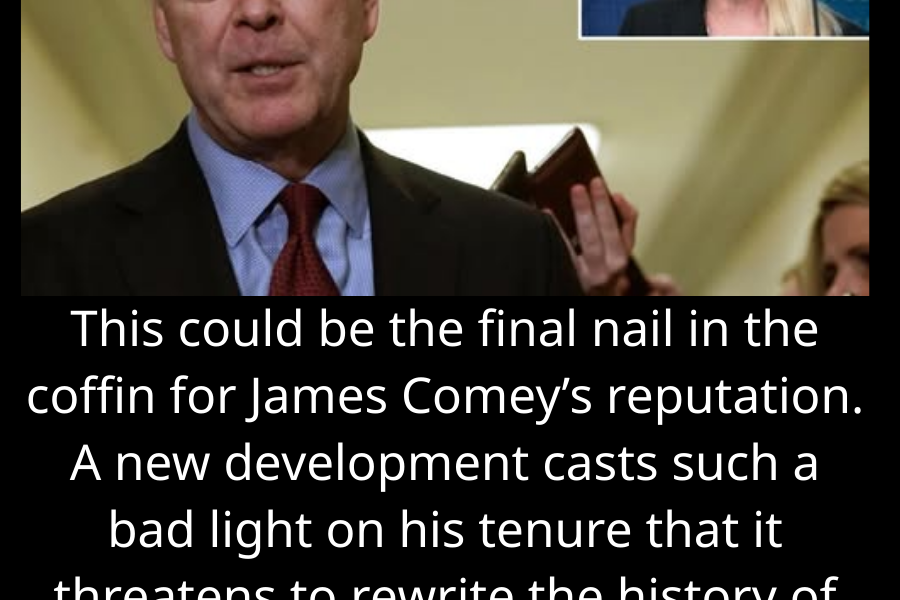
(The sound is not a gavel or a detonation, but the soft, insidious hiss of a sealed historical container being depressurized. This is not breaking news; it’s the past, revisited, re-litigated, and weaponized for a present-day courtroom. The artifact is an email. The crime is a contradiction. The stakes are the corpse of the 2016 election.)
The Email and the Exhumation: How a Single Sentence Reopens a National Wound
The newly released email is a time capsule, cracked open seven years too late. Its contents aren’t surprising, but its context is everything. In October 2016, James Comey typed: “I hate having to do it.”
At the time, that “it” was the infamous “October Surprise” letter to Congress, reopening the Clinton email investigation. Now, in 2025, that same sentence is being entered into evidence for a different purpose: not to explain 2016, but to incriminate James Comey in 2025.
This is the hall of mirrors of modern political justice. A past act, undertaken with one set of pressures and perceptions, is being retroactively audited under the forensic light of a new political era. The email isn’t evidence of the original decision; it’s alleged evidence of a later lie about that decision.
Part I: The 2016 Context – “I hate having to do it”
In its original moment, the email reveals a man trapped in a Kafkaesque dilemma of his own making.
-
He had publicly closed the Clinton case in July, with a scalding rebuke.
-
New emails were found on Anthony Weiner’s laptop (known to the FBI for weeks).
-
To stay silent risked being accused of a cover-up if the emails were later revealed.
-
To speak risked tipping an election.
His email to confidant Daniel Richman captures the existential nausea of that choice. He “hated” it because he knew it was a political grenade, regardless of intent. He expected Clinton to win anyway (“president-elect Clinton”), making the act seem both necessary and cosmically unfair—a self-inflicted wound on the inevitable victor.
This is the tragedy of James Comey: a man so terrified of appearing partisan that he made the most politically cataclysmic decision imaginable.
Part II: The 2025 Allegation – The “Coordination” Narrative
The Justice Department’s filing uses this email not to understand 2016, but to build a case for 2025. Their argument appears to be a threading of needles:
-
Comey was aware of the Weiner laptop emails earlier than suggested (Strzok knew in September).
-
He “hated” sending the letter, suggesting a fraught, personal decision-making process.
-
He immediately coordinated with Richman on media coverage after sending it.
-
Therefore, this coordination, and his later statements to Congress denying he authorized leaks, constitute false statements and obstruction.
The charge is one of narrative control. Prosecutors allege Comey wasn’t just managing an investigation; he was managing the public story of that investigation through back channels, then lying to Congress about it. The “I hate having to do it” email becomes a piece of psychological evidence: it shows he was deeply, personally invested in the fallout, making his subsequent media coordination seem more sinister and intentional.
Part III: The Hypocrisy Flashpoint – The Personal Gmail Account
The revelation that Comey—who famously excoriated Clinton for her “extremely careless” use of a private server—used a personal, anonymous Gmail account to discuss FBI matters is the perfect, poetic dagger.
It may not be illegal, but it is devastatingly ironic. It undermines the moral high ground of his 2016 press conferences. It allows his critics to paint him not as a righteous boy scout, but as a hypocrite who wielded rules as a weapon against others while bending them for his own convenience. In the court of public opinion, this may be more damaging than any legal charge.
The Verdict: The Past as a Crime Scene
This case is no longer about Hillary Clinton’s emails. It’s about James Comey’s emails. It represents the ultimate bureaucrat’s nightmare: every internal doubt, every informal communication, every “I hate this” vent to a friend, can be subpoenaed, leaked, and parsed for criminal intent years later.
The DOJ, under the current administration, is prosecuting the former FBI director for how he communicated about one of the most consequential decisions in modern political history. It is a meta-prosecution. The crime isn’t the decision itself (which was within his authority). The crime is allegedly misrepresenting the process around that decision to Congress.
We are witnessing the criminalization of bureaucratic angst and public relations. Comey is not on trial for violating the law in 2016. He is on trial for how he talked about his adherence to the law in 2017.
The email release ensures this trial will be a seance for the 2016 election. Every day in court will summon the ghosts of Anthony Weiner’s laptop, Peter Strzok’s texts, and Hillary Clinton’s server. The jury won’t just be deciding James Comey’s fate. They will be forced to relive, and re-judge, the traumatic event that split the American psyche in two.
The case is titled United States v. James Comey. But in the gallery, the real defendant on trial is the ghost of 2016 itself. 👻📧⚖️