The Credential Guillotine: How Don Lemon Became Journalism’s Unperson
NEW YORK — In the cloistered world of institutional media, credentials are not just passes; they are sacraments. They signify ordination into the priesthood of the Fourth Estate, granting access to the inner sanctums of power. For that priesthood to collectively excommunicate one of its most famous—and infamous—members is an act of unprecedented corporate self-purge.
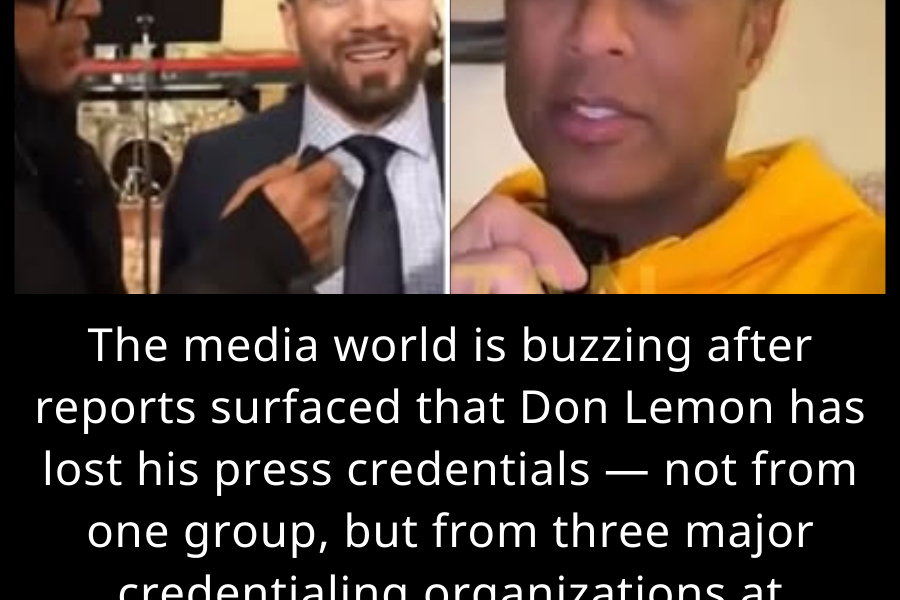
The simultaneous revocation of Don Lemon’s press credentials by the National Press Photographers Association (NPPA), the Radio Television Digital News Association (RTDNA), and the Society of Professional Journalists (SPJ) is not a firing. It is a ritual undoing. It is the three major bodies that define the profession’s ethical and technical standards declaring, in unison, that Lemon has ceased to be what his title claimed: a journalist.
This is not about one man’ career. It is about a profession in crisis, drawing a bright, harsh line around what it will no longer tolerate from within its own ranks.
The “Conduct” in Question: Two Incidents That Broke the Camel’s Back
The organizations cited “conduct that does not qualify as journalism.” Let’s dissect the two catalytic events:
1. The Pastor Interview: The Gaslighting Charge
The accusation here is not bias, but malpractice. Critics allege Lemon engaged in what the statement calls “deliberate manipulation of subjects” and “gross misrepresentation of constitutional protections.” The specific sin was using the First Amendment not as a framework for debate, but as a cudgel to morally bludgeon an interviewee who was criticizing protests that targeted a church. The charge is that he was not facilitating a discussion; he was engineering a humiliation, weaponizing his platform to gaslight a guest defending his own congregation. This violated the core journalistic covenant: to interrogate power, not to wield interview segments as power itself against a non-powerful subject.
2. The World Cup/Olympics Claim: The “Reckless Disinformation” Charge
The statement’s reference to “inflammatory rhetoric that undermines public trust” finds its clearest example here. Lemon’s claim that ICE arrests would cause the U.S. to lose major international sporting events was not a controversial opinion; it was a verifiably false assertion of fact that was swiftly and publicly dismantled by FIFA and the IOC. This moved him from the realm of commentator (who offers analysis) into the realm of purveyor of reckless fabrication (who invents reality). For credentialing bodies built on foundations of accuracy and fact-based discourse, this was a cardinal, unforgivable sin.
“This is a boundary-policing action of historic proportions,” explains Dr. Liana Cruz, a media ethicist. “These organizations have long been criticized as toothless. By acting in unison against a high-profile figure, they are asserting that there is, in fact, a line. That line appears to be: you cannot abuse the interview format to psychologically assault a guest, and you cannot propagate demonstrably false, inflammatory claims while claiming the mantle of journalism. They are saying Lemon’s conduct wasn’t bad journalism; it was anti-journalism. He was performing the aesthetic of news while violating its essential ethics.”
The Unspoken Precedent: A Weapon Against “Opinion Journalism”?
The move raises an existential question for the industry: Who gets to decide what “qualifies”?
Lemon’s defenders, and critics of the decision, will argue this sets a dangerous precedent where credentialing bodies can punish disfavored opinions or adversarial styles. They will ask: Is this about ethics, or is it about silencing a loud, controversial voice who made powerful enemies?
The organizations’ unified front is a direct rebuttal to that. They are staking their claim that this is not about content (his views on immigration or protest), but about conduct (manipulation, fabrication). They are drawing a distinction between robust debate and professional malpractice.
The Career Death Sentence and the NewsNation Dilemma
The practical effect is a mainstream media death sentence. Without these credentials, Lemon is locked out of the official apparatus of newsgathering: White House briefings, congressional hearings, federal press pools. He is relegated to the role of studio commentator or digital pundit—a fate that strips him of the institutional authority he has long wielded.
For NewsNation, this creates an impossible bind. They hired Lemon to be a flagship, credibility-bringing star. They now employ a man formally declared persona non grata by the very institutions that confer credibility. His utility as a “journalist” for them has been catastrophically undermined. Do they keep a commentator who cannot credibly cover breaking news from its source?
The Larger Reckoning: A Profession Attempting to Reclaim Its Soul
This action did not occur in a vacuum. It comes after years of plummeting public trust in media, accusations of activist journalism, and the blurring of lines between news and entertainment. The credentialing bodies, by making this extraordinary move, are attempting a dramatic act of quality control. They are telling the public: See? We do enforce standards. This man crossed a line we all recognize.
Whether this restores trust or is seen as a vindictive silencing will split along predictable political lines. For many conservatives, it’s a long-overdue comeuppance for a perceived arrogant activist. For many progressives, it will smell of censorship and the policing of dissent.
The Bottom Line
Don Lemon was not canceled by a mob. He was de-credentialed by a consortium. His fall is not the result of a tweet storm, but of a formal, institutional verdict that his specific, on-air actions were incompatible with the professional definition of journalism.
The door has been slammed. The message to every person holding a press pass is now chillingly clear: there is a limit. You can be partisan, you can be passionate, you can be wrong on occasion. But you cannot, as a pattern of conduct, manipulate guests and traffic in easily debunked, inflammatory fiction while expecting to retain the keys to the kingdom.
Lemon’s career in mainstream journalism is over. But the trial that just concluded was not his alone. It was a trial of what the industry will tolerate, and the verdict reveals a profession in turmoil, desperately trying to rebuild its walls even as the digital landscape has rendered them obsolete. The guillotine has fallen. Now we see if the body politic of the press feels cleaner, or just more bloodstained.