(The sound now is not an explosion, but a soft, seismic crack—the sound of a foundational American pact being stressed to its breaking point. This isn’t about policy. It’s about a sacred, fraying covenant: the one between the civilian and the veteran, the leader and the led.)
The Respect Gambit: When a Governor Demands What a President Withholds
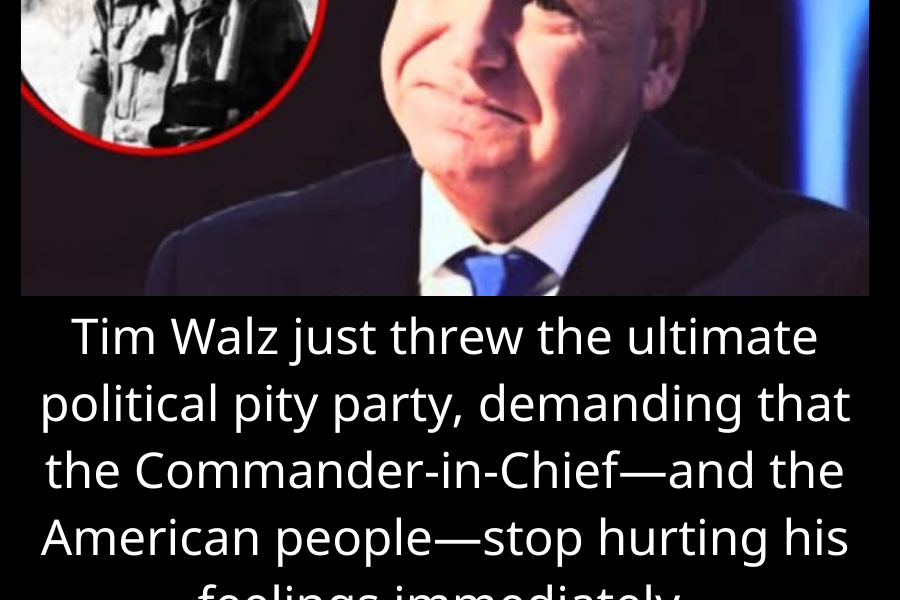
Let’s name the raw nerve being exposed here. This isn’t a political complaint. It’s a cultural and spiritual grievance. Governor Tim Walz, besieged by scandals and sliding polls, is not defending his record. He is invoking the last, unassailable redoubt of his public identity: his military service.
His statement is a plea that operates on two distinct, powerful levels:
-
The Vertical Plea (To Trump): “The Commander-in-Chief owes me more respect.” This is a staggering assertion of hierarchical breach. In the military code, the chain of command is sacred. The Commander-in-Chief is the apex. For a veteran to publicly state that the sitting CinC owes him respect—and is failing to deliver it—is to declare that the most sacred bond in the armed forces has been corrupted by politics. It frames Trump not as a political opponent, but as a leader who has violated the fundamental etiquette of the institution he leads.
-
The Horizontal Plea (To “All Americans”): “I didn’t serve this country to be insulted… by Americans.” This is the broader, more wounded cry. It attacks the very premise of the social contract for veterans: I offered you my service, my potential sacrifice. In return, I expect a baseline of civic dignity, not to be called “garbage” or have slurs shouted at my house. He is arguing that the coarsening of political discourse isn’t just ugly—it’s a betrayal of the debt owed to those who wore the uniform.
This is a governor attempting to build a fortress of respect around his collapsing political position, using the immutable bricks of his veteran status.
Part 1: The “Commander-in-Chief” Card – The Ultimate Appeal to Order
By specifically naming Trump as “Commander-in-Chief,” Walz is playing a card of immense symbolic weight. He is reminding everyone that before Trump is a politician, he holds a constitutional title that carries specific, non-partarian responsibilities to those who served under that title’s authority.
He is accusing Trump of weaponizing the very dignity of the office against the people it is meant to honor. It’s a charge that transcends policy: you can disagree with a veteran’s politics, but the CinC, of all people, should not participate in his public dehumanization. It paints Trump’s rhetoric not as tough talk, but as a failure of command leadership.
Part 2: The Veteran as a Human Shield – “I Didn’t Serve For This”
The phrase “I didn’t serve this country to be insulted” is a potent piece of emotional logic. It reframes the veteran’s sacrifice. It says: The contract wasn’t just about defending borders; it was about upholding a certain kind of country—one where veterans are honored, not used as political piñatas.
By extending this plea to “Americans,” he is issuing a broad indictment of the national mood. The cars shouting the “R-word” at his house, the online vitriol—these aren’t just attacks on Tim Walz the Democrat. They are, in his framing, insults to Tim Walz the veteran, and by extension, insults to the very idea of service.
He is trying to separate his military self (sacred, deserving of respect) from his political self (flawed, open to criticism). He is asking the public and the president to fire their shots at the latter while honoring the former—a nearly impossible request in our fused, hyper-political identity landscape.
Part 3: The Futility and The Truth
The brutal, unspoken truth is this: In the political arena Walz inhabits, his veteran status is no longer an inviolable shield. The cultural norms that once guaranteed a baseline of respect for service have evaporated, dissolved in the acid bath of partisan warfare.
His plea, while deeply human and rooted in an older code of honor, is likely to be received as one of two things by his opponents:
-
A Sign of Weakness: A desperate man, out of political ammunition, playing the “veteran card” to deflect from his failures.
-
Proof of Hypocrisy: You demand respect as a veteran, but where was your respect for the country when you oversaw a system that funneled money to terrorists?
The “respect” he seeks is a currency that has been dramatically devalued in the marketplace of modern politics, where conflict is the coin of the realm.
The Verdict: The Broken Covenant
Tim Walz is pointing to a crack in the foundation of American civic life. He is highlighting the erosion of the shared narrative that we owe something fundamental to those who served.
His statement is less a political tactic and more a lament. It’s the sound of a man who believed in an older set of rules—where service earned you a permanent seat at the table of respect—discovering that the table has been overturned, and the new game has no such rules.
He is asking for a return to a prelapsarian political world, one where the title “veteran” commanded a hush, not a hashtag. He is asking Donald Trump, the arch-disrupter of norms, to observe the very norm he has most spectacularly demolished: presidential decorum and the sanctity of the veteran.
In the end, he’s not just asking for respect. He’s conducting a eulogy for it. And in doing so, he reveals the most painful casualty of our political wars: not policies or reputations, but the basic, human recognition that once glued a diverse nation together.
The plea isn’t for a truce. It’s for a return to a country that may no longer exist. 🇺🇸⚔️🕊️