The Ghosts of the Strip: How Vegas Casinos Engineered Their Own Slow-Motion Bust
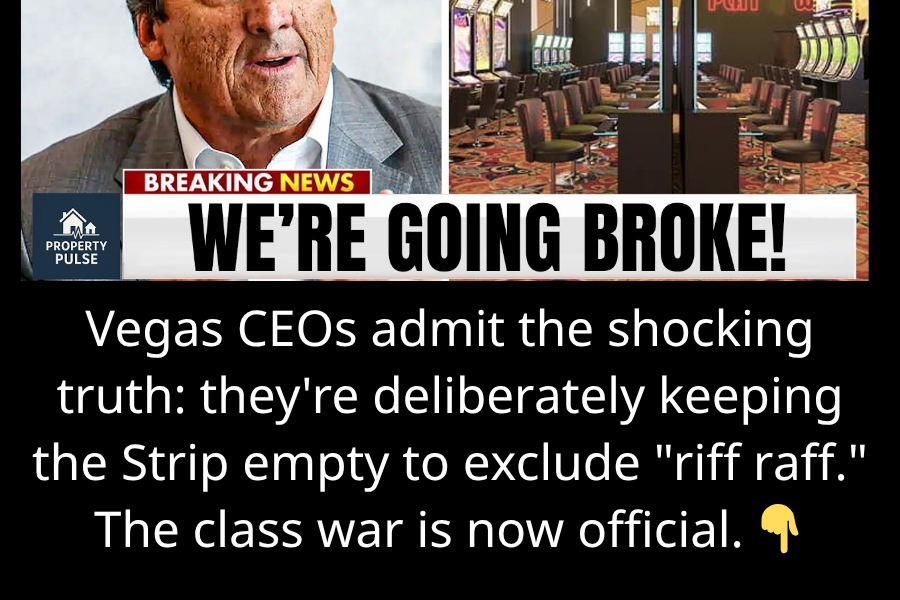
Let’s be clear from the outset: the thinning crowds on the Las Vegas Strip are not an accident of the economy. They are not a mystery. They are the direct, logical, and chillingly predictable result of a calculated corporate decision. The very titans who run the casinos looked at the city’s beating heart—the teachers, the truck drivers, the retirees, the middle-class dreamers—and declared them unworthy.
What we are witnessing is not a downturn. It’s a corporate-led exorcism of the city’s soul, and the ghosts left behind are the empty tables, the quiet bars, and the dealers shuffling cards for no one.
The Logical Analysis: The Fatal Flaw in “Quality over Quantity”
The new business model, articulated plainly by CEOs like Caesar’s Tom Reed and MGM’s Bill Hornbuckle, is a simple one: stop chasing the “low-end” budget traveler and focus on the “quality customer.” On a spreadsheet, this looks brilliant. Higher margins, fewer people to manage, a more “exclusive” brand.
But the logic is fatally flawed. Las Vegas is not a luxury boutique; it is an ecosystem built on volume and velocity. The math is brutal and inescapable:
-
The Tip Economy: A single high roller might drop $10,000 at a baccarat table, but they are served by one dealer. Twenty $500 blackjack players spread across five tables will generate more cumulative revenue and, crucially, tip five dealers, two cocktail waitresses, and a floor supervisor. By ejecting the volume, they collapsed the entire service-economy pyramid that supports the city.
-
The “Phantom” Losses: The report highlights the devastating impact of tax changes, where gamblers can end up paying taxes on money they never saw. For the coveted “high volume player,” this isn’t an inconvenience; it’s a business calculation. They will simply take their bankroll to markets without this disadvantage. The strategy to attract the wealthy is simultaneously pushing them away.
-
The Competition’s Gain: The data doesn’t lie. While the Strip bleeds, places like Laughlin and Mesquite are seeing double-digit revenue bumps. The “low-end” gamblers Vegas scorned have become the lifeblood for towns still willing to roll out the welcome mat. The house didn’t just change the rules; it handed its entire player base to its competitors, both physical and digital.
The corporate suite believed it could outsmart the fundamental law of the casino: you need a crowd to make the one big winner feel special. A half-empty, silent casino is a loser, no matter how high the table minimums are set.
The Storyteller’s Angle: The Silence After the Dream
The storyteller in me is haunted by the images the report paints. The waitress at the Flamingo who says weekends are alive, but by Tuesday, “it’s like someone flipped the switch.” This is the rhythm of a city in hospice, not one on holiday.
Think of the iconic scenes that defined Vegas for decades: the packed casino floors buzzing with energy, the clatter of a thousand slot machines, the roar from a crowded craps table. That noise wasn’t just sound; it was the market signal of a healthy city. It was the sound of money circulating, of dreams being bought and sold.
That sound is being replaced by a new one: the soft shuffle of a dealer playing solitaire, the quiet hum of an Uber circling an empty airport queue, the silence of a half-empty cocktail lounge. These are the sounds of a dream being dismantled, piece by piece. The city sold a fantasy of inclusion but is now building a reality of exclusion. And in that silence, the magic evaporates.
The “Conspiracy” Theory: The Boardroom Coup Against the Middle Class
Now, let’s put on our skeptic’s hat. Was this shift merely a business miscalculation? Or was it something more intentional?
The “conspiracy” isn’t a secret meeting, but a quiet, cultural coup in the C-suite. A decision, likely supported by consultants and focus groups, that the “chaos” of the middle-class vacationer was a brand liability. That the future was in becoming “Aspen with slot machines.”
They looked at the $4.99 steak dinner billboard from 1999 and saw an embarrassing relic. They failed to understand that it wasn’t just an ad for cheap food; it was a promise. A promise that in Vegas, you were always one bet away from a story you could tell for the rest of your life, no matter your tax bracket.
By instituting punitive resort fees and parking charges, they weren’t just increasing revenue; they were building a moat. They were filtering out the “undesirables.” What they failed to realize is that they weren’t building a moat to protect a castle; they were building a wall around a ghost town. The “riffraff” they priced out were the very people whose collective energy created the atmosphere the high rollers paid a premium to be near.
The Unvarnished Truth
The unvarnished truth is that Las Vegas is committing a slow, spectacular form of corporate suicide by forgetting its own origin story.
This city was not built by and for the elite. It was carved out of the desert by gangsters and visionaries who understood a universal human truth: everyone, from the janitor to the CEO, wants to feel like a king for a night. The magic of Vegas was that, for the price of a cheap room and a buffet, it let you live that fantasy.
The current corporate leadership has confused the trappings of wealth with the engine of wealth. They see the high roller’s bankroll but are blind to the economic ecosystem that his bankroll depends upon.
The story of Resorts World—which dropped resort fees and saw its rooms fill—is the proof. The demand for the real Vegas never went away. The city just stopped supplying it.
The final, brutal irony is this: In its desperate quest to become something more “respectable,” Las Vegas is becoming something far less valuable. It’s trading its vibrant, chaotic, profitable soul for the sterile silence of a luxury museum. And as every dealer waiting for a player knows, in a museum, the house always loses.