(This isn’t a policy announcement. It’s a cultural detonation. And the shockwave just redefined the entire 2024 battlefield.)
“We Don’t Want Those People”: The Unfiltered Id of a Movement Goes Supersonic
Forget the dog whistles. Shatter the euphemisms. What just unfolded aboard Air Force One and across the viral feeds was something raw, primal, and politically tectonic. This wasn’t President Trump “changing his tune.” This was the full, unfiltered symphony of a worldview, played at stadium volume.
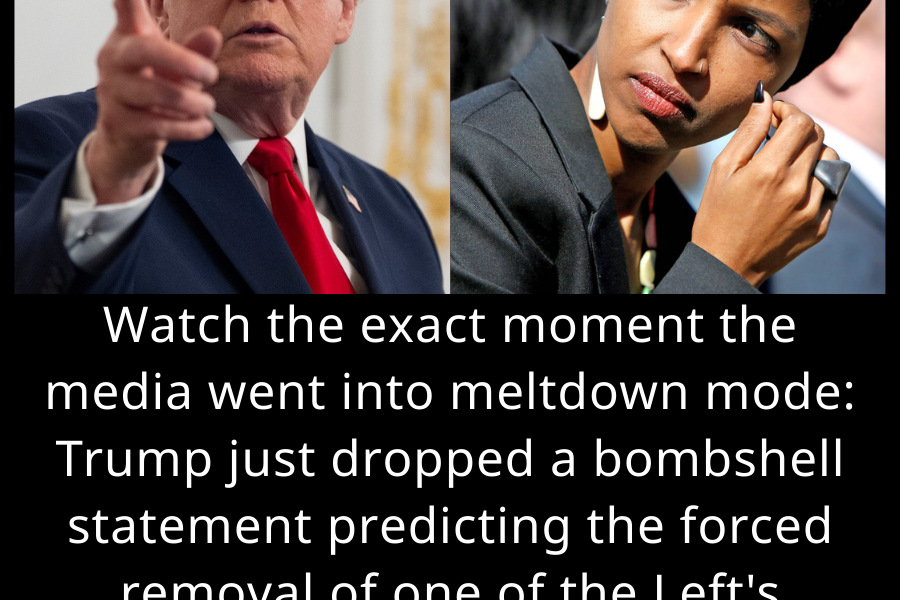
The catalyst was horrific—the alleged murder of National Guardsmen and a foiled terror plot, both linked to Afghan nationals admitted under the Biden administration. The response, however, transcended policy. It became an identity manifesto, a declaration of cultural and civilizational war. And at its center were two names: Ilhan Omar and Somalia.
Let’s dissect the blast pattern.
1. From “Immigration Policy” to “Remigration”: The Birth of a New Doctrine
Trump didn’t just propose a pause or a stricter vetting process. He introduced a radical, new-old concept into the mainstream American lexicon: “Remigration.”
“He’s going to consider potentially remigration which is a huge deal of populations that clearly don’t love America and are incompatible with our culture.”
This is a paradigm shift. It’s no longer about who gets in. It’s about who gets to stay. The argument moves from border security to national character. The logic, as laid out by the supportive commentator “Benny,” is stark: Why should America host populations that create “mini Somalia[s]” within its cities, that are “incompatible with the west,” and that are, in Trump’s words, “not good” and “shouldn’t be in our country”?
The targeting of Rep. Ilhan Omar is the perfect, combustible symbol of this. She is framed not as a political opponent, but as the embodiment of the “incompatible” immigrant: accused of fraud (the “married her brother” smear, a long-debunked conspiracy), shrouded in religious dress (“swaddling hijab”), and criticizing the nation she “supposedly” joined. Her denaturalization and deportation isn’t a legal proposal; it’s a purge of a symbol.
2. The Dehumanizing Calculus: “Countries That Don’t Do a Good Job”
The language is intentionally de-civilizing. It dismisses entire nations and, by extension, their people.
“Countries like Somalia that have virtually no government, no military, no police. All they do is go around killing each other. Then they come into our country and tell us how to run our country.”
This isn’t geopolitics. It’s anthropological dismissal. It reduces complex nations with rich histories to “failed states” and “terrorist hotbeds,” their citizens to a monolith of violence and dysfunction. The conclusion is simple: products of a “failed nation” cannot be a “net addition” to a successful one.
The emotional pull is powerful. It speaks to a deep-seated fear of chaos and a visceral desire for order. It frames immigration not as individual human aspiration, but as a civilizational threat.
3. The Performance of Unapologetic Power: “Trump Standing on Business”
The supporting commentary revels not in the substance, but in the style. This is seen as “Trump unlocked,” “the emperor’s got his groove back.” The use of the slur “r*tard” against Governor Tim Walz isn’t condemned; it’s celebrated as refusing to be “politically correct,” as “standing on business.”
This reveals the core transaction. For a significant segment of the audience, the content is secondary to the defiance. The policy is the posture. The unapologetic rejection of “those people” is, to them, the ultimate proof of strength, of a leader who will protect “us” from “them,” no matter how brutally he has to say it.
It’s a feedback loop of provocation and adulation. The more shocked the media, the more “thermonuclear” the post, the more it validates the core promise: I am not them. I will not speak their language. I will fight their world.
The Verdict: The New American Fault Line
This moment crystallizes the coming election into a single, brutal question:
Is America a proposition—an idea built on immigration, pluralism, and the constant reinvention of “we the people”?
Or is America a patrimony—an inheritance to be protected, defined by a dominant culture, where belonging is conditional on assimilation and compatibility, and where “we” have the right to remove “those” who threaten it?
Trump has chosen his answer in the starkest terms possible. He is no longer just campaigning on a border wall. He is campaigning on a cultural moat. The promise is no longer just to stop future immigration from “shithole countries,” but to begin a process of reversal—”remigration”—for those already here who are deemed incompatible.
The legal and moral chaos of such a concept is apocalyptic. But its political power, as a pure, distilled expression of fear and identity, is undeniable.
They called it a “mic drop.” It was louder than that. It was a declaration of war on the very idea of a multicultural America.
The battle lines aren’t just drawn. They’ve been scorched into the earth. ⚔️