The 3 A.M. Phone Call Generation: When Politics Becomes a Psychological Thriller
Washington, 3:17 a.m. — This is not how political scandals used to begin. There’s no slow-burn Woodward and Bernstein source meet-up in a parking garage. No carefully lawyered subpoena. No primetime special report with gravitas. The new crisis drops in the dead of night, dressed in a wrinkled hoodie, lit by the cold glow of a smartphone screen, and delivered with the raw, unscripted adrenaline of a live-stream.
Sean Duffy’s 3 a.m. “emergency monologue” wasn’t just news. It was a genre-bending performance piece—part political defiance, part psychological warfare, part reality TV cliffhanger. In six minutes, he dismantled the entire theater of modern political discourse and replaced it with something far more visceral, far more Gen Z in its execution: a public, high-stakes call-out, framed not as debate, but as personal survival.
The Aesthetic of Authenticity (Or Its Masterful Simulation)
Let’s deconstruct the stagecraft, because in the year of our Lord 2024, the medium is the ultimate message.
Duffy didn’t just give a speech. He curated an aesthetic. The jeans and hoodie against the sterile news desk? A direct rejection of institutional authority. It screams, “I was roused from my bed by this; I haven’t had time to put on the costume.” The phone, clutched like a holy relic or a piece of damning evidence, is the central prop. It’s not a teleprompter; it’s a tactile, personal device. It contains the “receipts.” By holding it up, he transforms a digital message into a physical exhibit A.
This is the visual language of a generation raised on Instagram Stories and Twitter Spaces—the more “raw” and unproduced, the more “true” it feels. He bypassed the producers, the legal team, the primetime slot. He went live. The subtext? “This is too urgent for your corporate protocols. This is real.”
The one-minute of dead air at the end, the phone lighting up silently on the desk—that’s pure cinema. It’s a mic drop in the form of anxious silence. He didn’t just tell us he was under pressure; he made us sit in the discomfort of it with him.
“We’ve moved from the ‘Fireside Chat’ to the ‘Phone-Glow-in-the-Dark Chat,’” observes Dr. Anya Petrova, a media theorist at Columbia who studies digital-era rhetoric. “The power has shifted from the institutionally polished to the personally vulnerable—or at least, the convincingly performed version of it. The audience is no longer a passive listener; they are a witness to what feels like an unfolding, risky event in real-time.”
The Message: A Masterclass in Modern Intimidation (Allegedly)
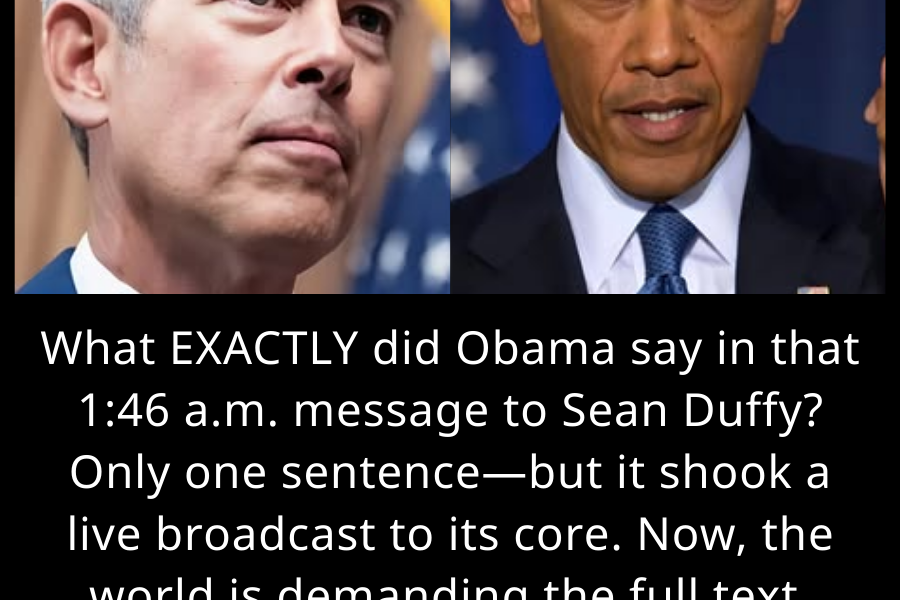
The alleged content of Obama’s message is a Rorschach test for the political psyche.
“Stop pushing this narrative, Sean. You’re playing a dangerous game. Ask others what happens when lines get crossed.”
Duffy’s genius—or his provocation—lies in his interpretation. He immediately frames it not as “political disagreement,” but as “intimidation dressed up in polished language.” He’s translating D.C. insidership into street-level stakes. He’s taking the subtext and making it text.
By naming “offshore foundations,” “sealed memos,” and “foreign intermediaries,” he does two things:
-
He gives the vague threat a tangible, investigative spine.
-
He positions himself not as a pundit, but as a journalist-whistleblower hybrid, getting “close to things that were never supposed to surface.”
The most powerful line? “If anything happens to me, my job, or this show—you’ll know exactly where the pressure came from.” This is the ultimate pre-emptive strike. It turns any future professional consequence—cancellation, demotion, show cancellation—into immediate proof of his narrative. It weaponizes consequence as confirmation.
The Digital Aftermath: A Firestorm of Speculation
Before the screen even faded to black, the infrastructure of modern commentary was already metabolizing the event.
-
#ObamaMessage trended worldwide, a mix of outrage, mockery, support, and deepfake speculation.
-
Memeification began instantly: Screenshots of Duffy’s intense gaze, the phone, overlaid with captions like “When you get a ‘u up?’ text from the 44th President” or “Main Character Energy vs. The Establishment.”
-
The political split was predictable: One side saw a brave truth-teller facing down the machine; the other saw a desperate ratings stunt by a provocateur cornered by his own lack of evidence.
But beyond the partisan noise, a more profound question hums: What is the playbook here? Is this the new template for political accusation—a late-night, emotionally charged, evidentiary-adjacent broadcast that creates an unstoppable narrative wave by morning?
Duffy’s sign-off was a final piece of narrative jujitsu:
“See you tomorrow, Mr. President. Or maybe not. Your move.”
It’s a challenge thrown into the void. It makes the former President an active character in Duffy’s story. It forces a response—silence becomes suspicious, a denial becomes engagement, legal action becomes vindication.
The Aftermath, Unfolding…
As dawn breaks over Washington, the studios are scrambling. News division heads are on emergency calls. Obama’s communications team is undoubtedly drafting a response—one that must navigate the Scylla of dignitary silence and the Charybdis of viral accusation.
Sean Duffy, whether a courageous iconoclast or a brilliant performance artist, has successfully rewritten the rules of engagement for a single night. He turned a television studio into a coliseum, a smartphone into a shield, and a late-night broadcast into a nerve-jangling season premiere of… whatever this is now.
He didn’t just break into the nightly reruns. He broke into the predictable rhythm of political scandal itself. And he left the entire ecosystem—viewers, rivals, and the alleged subject of his story—waiting for the next notification to light up the dark.
The only certainty? Tomorrow’ discourse will be conducted entirely on the battlefield he just created.