The Bipartisan Guillotine: How the Epstein Probe Forced a Reckoning Within the Democratic Party
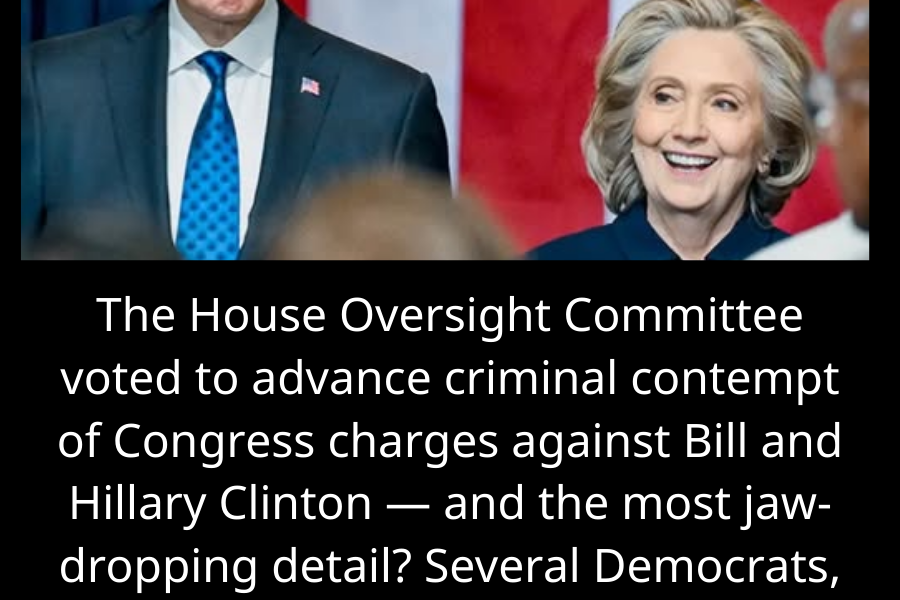
WASHINGTON — The political theater of a Republican-led committee targeting the Clintons was a predictable script. The twist came in the casting: nine Democrats, including stars of the progressive “Squad,” raised their hands to advance criminal contempt charges against their own party’s former standard-bearers.
This was not a procedural vote. It was a political exorcism. The House Oversight Committee’s decision to refer Bill and Hillary Clinton for full House contempt votes—with crucial Democratic defections—signals a profound shift. The unspoken pact to shield party elites from the most perilous investigations has been broken, not by the right, but from within the left’s own ranks.
The issue is no longer Jeffrey Epstein. The issue is now what a political party owes to its principles when those principles collide with its own mythology.
The Calculus of Defection: Why the Squad Crossed the Aisle
The votes of Representatives Summer Lee (D-PA), Rashida Tlaib (D-MI), and Ayanna Pressley (D-MA) were not gestures of bipartisanship. They were acts of ideological consistency. For the Squad, whose brand is built on confronting power without fear or favor, protecting the Clintons from a subpoena—regardless of the source—would have been a catastrophic betrayal of their core message.
Their logic is brutal and transparent:
-
Subpoena Power is Sacred: Eroding Congress’s ability to compel testimony, even in a flawed process, weakens a tool they themselves may need to investigate corporate CEOs, oil executives, or a future Republican administration.
-
No One is Above the Law: This mantra cannot have a Clinton exemption. To argue otherwise surrenders the moral high ground on every future accountability fight.
-
The Epstein Victims: To be seen as obstructing any investigation, however politicized, into a child sex trafficking ring that serviced the global elite is an untenable political and moral position for politicians who style themselves as champions of the vulnerable.
“This is the accountability dividend in action,” explains Dr. Amara Singh, a scholar of political ethics. “The Squad has invested years of capital in building a reputation as unbending reformers. That reputation is their primary currency. Spending that currency to defend the Clintons—figures who represent the pre-Squad, donor-friendly, scandal-tinged era of the Democratic Party—would have been poor politics and poorer principle. They are trading short-term intra-party discord for long-term credibility. They are proving their brand is not for sale, even to their own party’s ghosts.”
The other Democrats who voted ‘yes’—like Rep. Maxwell Frost (D-FL) and Rep. Stephen Lynch (D-MA)—represent a different, more institutional calculation: a belief that defying a congressional subpoena is a direct attack on the legislative branch itself, an institution they are sworn to protect.
The Clinton Gambit: A Miscalculation of the New Politics
The Clintons’ strategy—to dismiss the subpoenas as “invalid” and offer an informal, off-the-record interview—was a relic of a bygone political era. It assumed that unified party loyalty would create a protective shield. It was a bet that the old rules still applied.
They misjudged the landscape. The Democratic Party of 2025 is not the party of the 1990s. A significant faction, empowered by social media and grassroots funding, is deeply skeptical of dynastic power and establishment self-protection. The Clintons’ refusal to appear wasn’t seen as savvy lawyering; to these members, it looked like elite impunity.
By forcing Democrats to choose between protecting party icons and upholding institutional authority, the Clintons handed their opponents within the party a perfect test of values. The Squad, and others, chose the institution.
The Constitutional Cliff’s Edge: A DOJ Dilemma of Historic Proportions
The contempt referral now rolls toward a full House vote and, if passed, lands on the desk of the U.S. Attorney General. This creates a constitutional and political paradox of historic proportions.
The Department of Justice, under Attorney General Merrick Garland or a successor, would be asked to consider prosecuting:
-
A former President of the United States.
-
A former Secretary of State and presidential nominee.
-
On a criminal referral from a political opponent’s Congress.
The likelihood of prosecution is virtually zero. To prosecute would ignite a firestorm, signaling that sitting administrations can criminalize the opposition’s leadership. It would set a precedent with terrifying future implications.
But to decline prosecution is also fraught. It would validate the argument that the Clintons were above the law, and that congressional contempt power is meaningless against the highest echelons of power. It would embolden future witnesses from any administration to defy subpoenas.
The DOJ would be caught in a no-win scenario, forced to choose between escalating a political war or gutting congressional authority.
The New Precedent: Subpoena Power in the Post-Trump, Post-Clinton Era
This episode fundamentally alters the ecosystem of congressional oversight.
-
The End of Unified Fronts: Future witnesses can no longer assume their party will automatically circle the wagons. Factions within parties now have veto power over protectionism.
-
Weaponization Begets Weaponization: If Democrats can vote to hold Clinton in contempt, Republicans will face even greater pressure to hold Biden officials in contempt. The standard has been reciprocally lowered—or raised, depending on your view.
-
The Victim: Congress itself. As both parties use the contempt power more freely against the other side’s icons, its gravity is diminished. It becomes another commonplace weapon in the endless war, rather than a rarely used tool of last resort.
The Final Verdict
The Oversight Committee did more than advance a contempt charge. It administered a stress test to the modern Democratic Party, and the party fractured under the weight of its own contradictions.
The vote revealed that for a growing segment of the left, the myth of the Clintons is less valuable than the principle of accountability. It proved that in today’s politics, the most dangerous threat to a legacy is not an opponent’s attack, but an ally’s conviction.
The Clintons aimed to float above the fray. Instead, they provided the anvil upon which a new, more ruthless politics of principle was forged. The subpoena was the spark. The Democratic defections were the explosion. And the aftershocks will redefine accountability for generations to come.