(The temperature drops. The story shifts from the heat of political rhetoric to the literal, life-and-death cold of a city street. The conflict is no longer about ideology, but about a quiet, chilling calculus.)
The Warmth That Was Refused: A Story of Japanese Ingenuity and American Paradox
Here is a technology that feels like a revelation, a moral no-brainer, a fragment of grace in a brutal world.
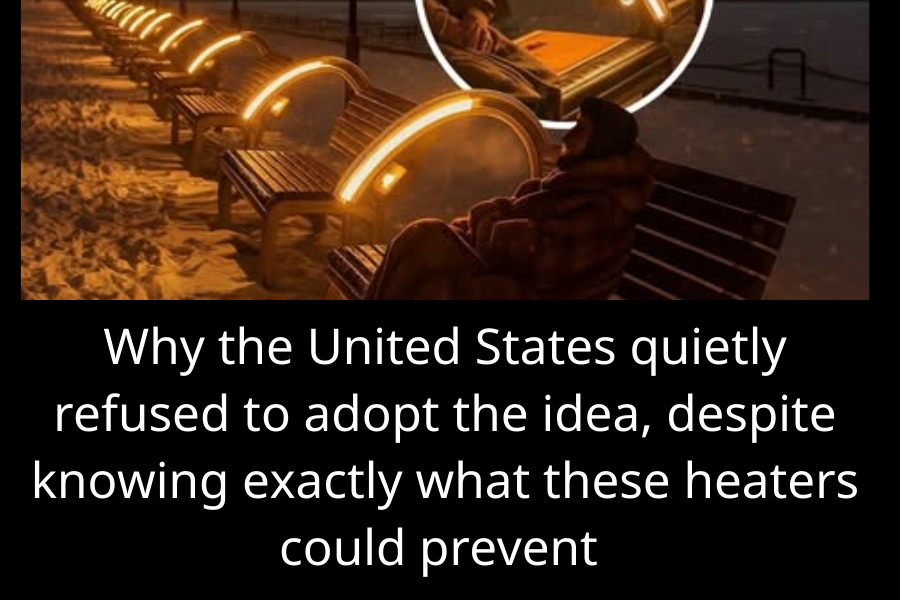
In Japan, where winters bite with a particular, damp ferocity, engineers didn’t look up at the cosmos for a breakthrough. They looked down at the pavement. They saw a problem as old as civilization—the homeless freezing to death in the wealthiest of societies—and they applied a stunningly simple, elegant fix: a solar heater for the human body.
The device is a triumph of appropriate technology. It’s not a complex, grid-tied panel. It’s a small, portable mat or pad, often using a phase-change material. It soaks up solar energy all day. Then, as the night plunges into sub-zero darkness, it slowly releases that stored heat for 6-8 hours, creating a personal, portable oasis of survivable warmth. It is cheap, durable, and requires no infrastructure. It is, quite literally, bottled sunlight for those the night has forgotten.
The most shocking part of this story is not that Japan built it. It is that the United States, fully aware of its existence and its potential, quietly, systematically, refused it.
This isn’t a tale of ignorance. It’s a tale of a deliberate, cultural “no.”
Part 1: The Japanese Calculus – Engineering Dignity
To understand the Japanese embrace, you must understand a cultural framework where public order, social harmony, and collective responsibility are woven into policy. The sight of people freezing to death is not just a tragedy; it is a stain on the social fabric, a visible failure of the system.
The solar heater is a low-touch, high-impact intervention. It doesn’t solve homelessness (a complex, intractable problem everywhere). It solves death by exposure (a simple, solvable problem). It is an engineering solution to a humanitarian crisis. It prioritizes immediate life over the ideological debate about how that life became so vulnerable. It says: Whatever the reason you are on the street, you will not die tonight from the cold. We, as a society, will not allow that.
It is a stopgap measure imbued with a profound, pragmatic dignity.
Part 2: The American Refusal – The Architecture of “Tough Love”
Now, cross the Pacific. In the United States, the approach to homelessness is not merely different; it is philosophically opposed to the logic of the solar heater.
The refusal is not about cost or efficacy. The technology is trivial to replicate. It’s about a pervasive, often unspoken, policy doctrine we might call “Deterrence through Suffering.”
Adopting a technology that specifically and effectively alleviates the mortal danger of street homelessness runs counter to a core tenet of many American municipal policies. The reasoning, as articulated by officials, advocates of “clean sweeps,” and a segment of the public, goes like this:
-
“Compassionate” Aid is a “Magnet”: If you make street life less lethal, you are encouraging it. Providing direct, no-strings-attached survival tools like heat is seen as removing a “natural” disincentive to seeking shelter or services.
-
Shelter or Nothing: The official pathway is the shelter system. Resources and policy are funneled toward getting people into that system. Any aid given outside of it is viewed as undermining that goal, enabling people to “choose” the streets. The suffering of the cold is an unspoken enforcement mechanism.
-
The Moral Hazard of Comfort: There is a deep-seated, almost Puritanical belief that alleviating suffering without demanding “accountability” (entering a program, accepting services, demonstrating “worthiness”) is morally corrosive. It creates “dependency” on the streets. A solar heater, in this view, is not a life-saving device; it is a “crutch” that perpetuates the “problem.”
To provide these heaters would be, in this framework, an act of enabling. It would be to sanction street living. It would be to say, “Your survival is our concern, even if you remain outside our systems.” And that is a bridge much of the American policy apparatus is built not to cross.
Part 3: The Shocking Twist – What We Choose to Prevent
This is the chilling core of the story. Japan looked at the cold and saw a physiological event to be mitigated. America looks at the cold and sees a behavioral incentive to be leveraged.
Both nations see the same frozen body. One sees a failure of engineering. The other sees a failure of will.
The U.S. refusal reveals a brutal prioritization: the sanctity of systemic pathways over immediate, unconditional human preservation. It privileges the abstract, long-term goal of “ending homelessness” (a goal perpetually out of reach) over the concrete, immediate goal of “preventing homeless deaths tonight.”
We have the technical knowledge to erase death by exposure from our cities. We have had it for years. We choose not to use it. Because in that choice, we believe we are pursuing a tougher, more “realistic” love. We are trying to force a square peg into a round hole through the application of lethal cold.
The Japanese heater asks a simple, devastating question: If you can prevent a death for $50, with zero downside, and you choose not to, what are you actually trying to achieve?
The Verdict: Two Visions of a Civil Society
This is not just a policy divergence. It is a philosophical chasm.
-
Japan’s approach is pragmatically humanitarian: Your life has value, and we will protect it here and now, regardless of your circumstances or choices.
-
America’s prevailing approach is moralistically transactional: Your safety is a product of your compliance with the systems we have designated for you.
The solar heater is more than a piece of tech. It is a litmus test for empathy. It forces us to declare what we believe: Is the preservation of a life in the moment an absolute good? Or is it a bargaining chip in a larger, more austere negotiation about behavior and “deservingness”?
The warmth exists. It has been invented. The sun stores it for free. The only thing left to engineer is our own conscience.
The real cold isn’t in the night air. It’s in the calculation that lets the night do its work. ❄️☀️