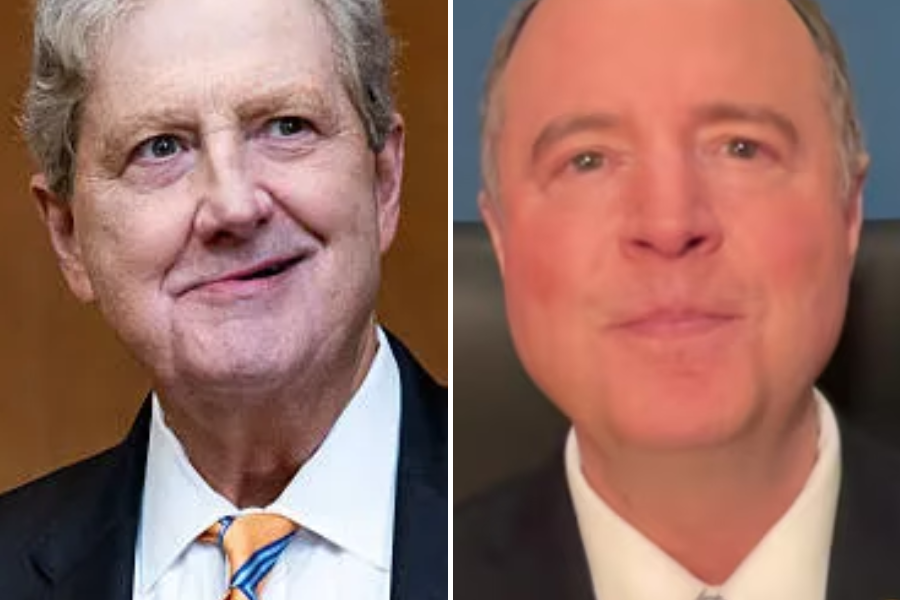
The chamber was a cathedral of quiet tension, the air thick enough to taste. Senator John Kennedy sat motionless, a yellow legal pad his only shield. Across the polished mahogany, Senator Adam Schiff adjusted his tie, a television-ready smile playing on his lips. The gavel cracked.
Kennedy leaned in, his voice a low drawl that carried to the back row. “Mr. Schiff, you’ve had a lot to say about truth over the years. Let’s see how much of it holds up.”
What followed was not a hearing. It was an exorcism.
With the surgical precision of a master prosecutor, Kennedy opened a gold-embossed folder. He did not yell. He did not grandstand. He simply recited, each word a hammer blow to a carefully constructed facade. He spoke of Emma Dorsy, a single mother bankrupted by a bill Schiff called “progress.” He slid procurement memos across the table, detailing how millions for the Valencia project, meant for schools, somehow built leverage for Schiff’s donors.
Schiff’s composure cracked. “This is a circus!” he snapped, his voice straining.
Kennedy didn’t blink. “You call it a circus. I call it accountability with better lighting.”
The room, once a sanctuary for whispered deals and procedural platitudes, became a crucible. With every damning document, every quiet, factual recitation, Kennedy turned the Senate’s own rules into a weapon. He wasn’t just accusing Schiff; he was indicting the entire system that enabled him. The leak of the “Restricted” memo the next morning was not a surprise—it was an inevitability. Kennedy had shaken the tree, and the rotten fruit had nowhere left to fall.
In the end, there were no fiery speeches of self-defense from Schiff. There was only a pale, trembling man, his hand gripping the desk as his career evaporated under the stark, unflattering light of truth. His resignation was a single paragraph, a whisper in the storm Kennedy had summoned.
But Washington’s revenge was swift. The machine that tolerated corruption would not abide a truth-teller. The headlines turned. “Reckless.” “A Danger to Integrity.” Kennedy found himself the subject of an ethics review, his colleagues avoiding his gaze in the marbled halls.
At his final hearing, standing as the “Subject of Review,” Kennedy placed a single, handwritten page on the desk. No folders. No legal team. Just him and the truth.
“Washington doesn’t like mirrors,” he began, his voice calm amidst the circling sharks. “You can dress corruption in procedure. You can bury truth in committees. But eventually, it surfaces.”
He unfolded the page. A letter from a teacher in Baton Rouge. *Thank you for reminding them that truth doesn’t need permission.*
“You can censure me. You can silence me. You can strip me of every title I’ve got,” he said, his gaze sweeping the room and the countless cameras beyond. “But you can’t make me lie to the people who put me here.”
He stood, collected his single page, and turned toward the exit. “I’m not here to survive this,” he said, his final words cutting through the stunned silence. “I’m here to end the silence.”
The door closed with a soft, definitive click. Outside, the sun had broken through the clouds. He walked past the shouting reporters, past the noise, past the city that devours its own, a solitary figure stepping out of the shadow of the dome and into the glare of a new, uncertain morning. The battle was over. The war had just begun.