The Gladiators of the Feed: How Two Instagram Politicians Are Building a Senate Race for the Algorithm Age
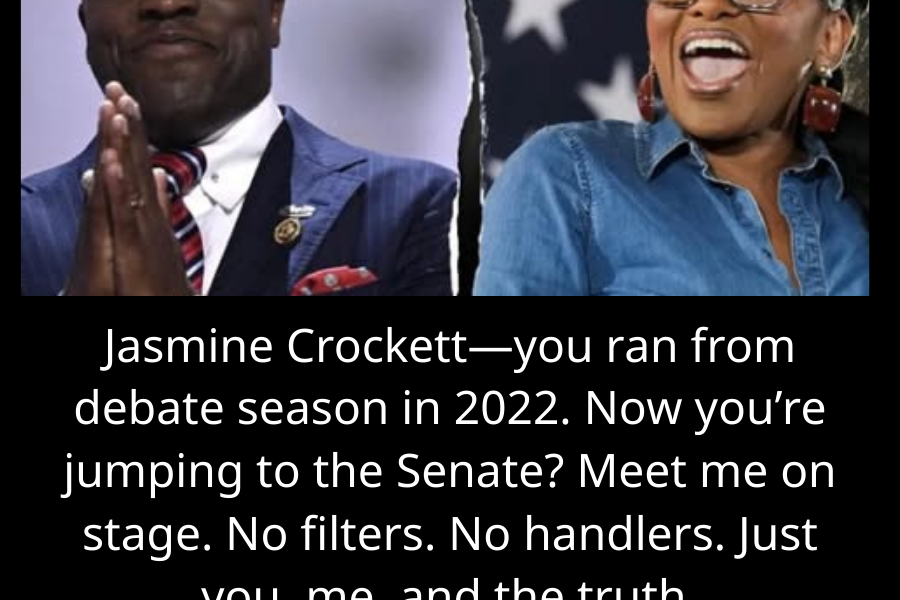
AUSTIN, Texas — The challenge wasn’t issued in a press release. It was crafted for the quote tweet. The venue wasn’t a town hall; it was the infinitely replicable space of a social media graphic. When Republican Congressman Wesley Hunt looked across the aisle—and the digital divide—to challenge Democratic Congresswoman Jasmine Crockett to a debate, he didn’t call it a civic duty.
He called it “must-see TV.”
He’s not wrong. But the TV he’s talking about isn’t on a network. It’s on the phone in your hand. This newly ignited Texas Senate race isn’t just a political contest; it’s a clash of meta-narratives, personally branded and algorithmically optimized. It’s a battle between two Black politicians with massive digital footprints, each offering a radically different origin story for America, packaged for a state that has never sent a Black person to statewide office.
Forget red vs. blue. The first draft of this war is being written in likes, shares, and follower counts.
The Challenge: A Premade Viral Moment
Let’s dissect Hunt’s move. Challenging Crockett the day she enters the race isn’t just aggressive; it’s content strategy. It seizes the news cycle, frames the contest as a binary showdown (bypassing his brutal primary against Cornyn and Paxton), and paints Crockett as needing to prove herself.
His language is precision-engineered for resonance:
-
“She defines this country by victimhood. I define it by hard work, grit, and determination.” This isn’t policy. It’s identity mythology. It pits two competing American dreams against each other: one focused on systemic barriers, the other on individual triumph.
-
“I’m proud to be Black, but I’m prouder to be an American.” A direct counter to what the right frames as “identity politics.” It attempts to reclaim patriotism and universalism as conservative virtues.
-
“Plantation to West Point.” The ultimate American redemption arc, condensed into three words. It’s unimpeachable, visceral, and designed to short-circuit accusations of racial insensitivity.
The “must-see TV” graphic his campaign provided to Fox isn’t an afterthought; it’s the core product. It’s a meme-ready asset, begging to be screenshotted and debated. This isn’t about informing voters. It’s about activating tribes.
“We’ve moved from the ‘spin room’ to the ‘asset drop,’” explains Kendra Lee, a digital strategist for progressive campaigns. “The debate challenge isn’t to have a debate. It’s to create a digital rallying cry. The graphic is the bumper sticker. The quote is the soundbite. The entire exchange is designed to be consumed and weaponized in the 15 seconds between scrolling. Policy is a subfolder you might click on later.”
The Algorithms: 4.1 Million vs. 2.5 Million
The Fox article casually drops the most telling metric of modern politics: the follower count. Hunt’s team boasts 4.1 million across platforms; Crockett has 2.5 million on Instagram alone. This isn’t vanity. This is infrastructure.
These are not just audiences; they are digitally enlisted armies. They are fundraisers, signal-boosters, and defenders. They provide a direct, unmediated channel that bypasses traditional—and often hostile—Texas media. Crockett’s “youthful energy and large social media presence” and Hunt’s “influencer-style approach” are their superpowers. They speak the native language of a generation that gets its news from vertical video and commentary from podcasters.
But this also creates their greatest vulnerability, as hinted by the James Carville quote Fox chose to highlight: the risk of being perceived as self-branding over public service. When your platform is built on personal narrative and viral clapbacks, the line between champion and celebrity blurs. The “quiet GOP ‘astroturf’ campaign” leak is a direct shot at this, attempting to frame Crockett’s entry as an inauthentic, Instagram-fueled gambit rather than an organic movement.
The Historic Stakes & The Texas-Sized Reality
Beneath the digital fireworks lies a seismic historic possibility: Texas could elect its first-ever Black statewide official. The fact that both leading contenders are Black rewrites the state’s political script entirely. It forces a conversation about representation that transcends the old binary.
Hunt immediately reframes this historic angle into his narrative: It’s not about race; it’s about American values. He seeks to universalize his Blackness as proof of the American dream, while Crockett’s platform, focused on voting rights, criminal justice reform, and equity, centers the ongoing struggle against systemic inequality. It’s Martin Luther King Jr.’s “content of their character” versus his “fierce urgency of now,” performed on a statewide stage.
Yet, the mountain is Everest-high for Crockett. Texas remains a lean-red state at the federal level. Tim Scott’s quote in the article lays down the national GOP framing: Crockett’s candidacy is proof the Democratic Party has been “overrun” by the “radical left.” They will work to make her a national progressive bogeywoman, hoping to galvanize the conservative base in a state where turnout is everything.
Hunt, meanwhile, has his own hellscape primary to survive against Cornyn’s establishment machinery and Paxton’s populist, Trump-aligned fury. Challenging Crockett is a clever way to look strong and pivot the conversation to the general election before he’s even won the nomination.
The “Must-See TV” Debate: What Would It Actually Be?
If this debate happens, don’t expect a sober discussion of water rights or military procurement. It would be a cultural and rhetorical cage match. Picture it:
-
Crockett would wield viral moments from the House Oversight Committee, sharp critiques of Texas’s power grid and abortion laws, and a direct appeal to the state’s growing, disillusioned suburban and youth vote.
-
Hunt would counter with his military service, the “plantation to West Point” narrative, and a relentless focus on border security, inflation, and framing Democrats as agents of decline.
It would be less Lincoln-Douglas and more high-stakes podcast episode—a battle of stories, zingers, and frames, each line written for the 60-second clip that will dominate the feeds the next day.
The bottom line: The Hunt vs. Crockett challenge is the opening act of a new political era. It’s a race where the candidates are their own media empires, where narratives are launched like digital special operations, and where the path to the Senate may very well run through a perfectly timed tweet and a flawlessly filtered Instagram story.
Texas isn’t just picking a senator. It’s beta-testing the future of political combat. And the whole country will be watching—not on TV, but on the tiny screens where this war is already being won and lost, one follower at a time.