The Midnight Envelope: How One Delivery Shattered Washington’s Consensus
The Kind of Silence That Only Comes Before the Storm
It wasn’t a vote. It wasn’t a leaked memo. It wasn’t even a press conference.
It was an envelope.
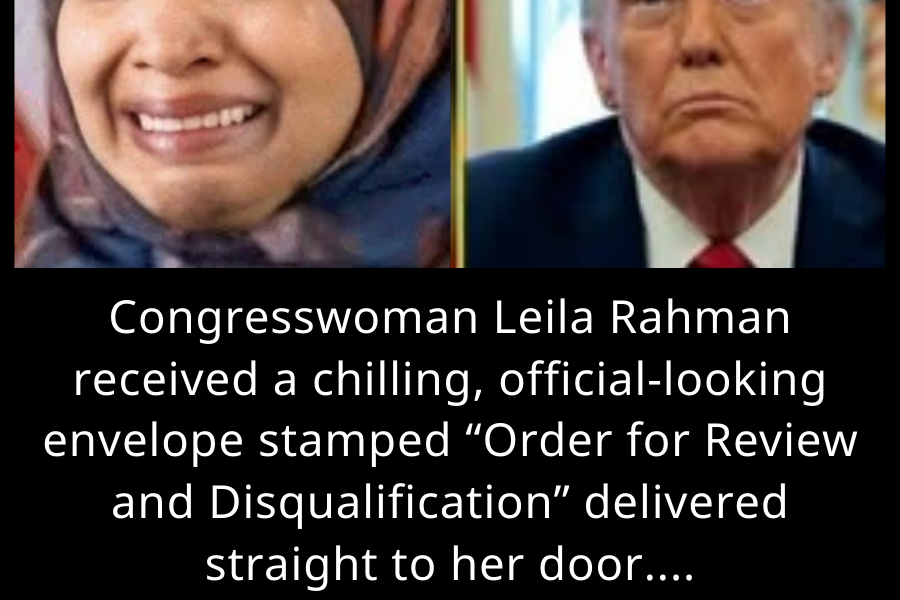
Delivered by a uniformed courier with the blank-faced urgency of a state secret, arriving not in the buzz of a committee hearing, but in the hollow, fluorescent quiet of a Capitol Hill office after midnight. The address was precise: The Honorable Leila Rahman, U.S. House of Representatives. The marking on the front wasn’t a logo. It was a directive: “Order for Review and Disqualification.” The kind of phrase bureaucrats use to make earthquakes sound like procedure.
And for a few, breathless minutes, in that hushed office, it was just a piece of paper. Then a staffer, maybe an over-caffeinated Legislative Assistant, scanned past the formal WHEREAS clauses and the case file number. The silence didn’t just break. It shattered.
What followed was pure, uncut political adrenaline: the frantic sprint of aides down marble hallways, the sudden constellation of phone screens igniting in the darkness of member offices, the muffled shouts swallowed by Persian rugs. And at the center, Congresswoman Leila Rahman—progressive firebrand, former ACLU litigator, and now, a woman reportedly barricaded in her own office as the whispers congealed into a single, thunderous question:
Who was named in the file?
The Anatomy of a Political Detonation
The genius of the crisis wasn’t the $250 million fraud probe. In a town that measures corruption in trillions, a quarter-billion is a rounding error, a Thursday. The fuse was lit by the delivery itself—the “urgent classification protocols.” This wasn’t a document you could FOIA. It was a legal IED, wrapped in secrecy and hand-delivered to ensure maximum psychological impact. It screamed one thing: This is not political. This is judicial. This is real.
But the true explosive core, the thing that turned a scandal into a systemic crisis, was the withheld name.
Washington runs on certainty. On known quantities, mapped alliances, and predictable conflicts. This envelope introduced a radical variable: a void. A blank space where a name should be, around which every fear, every rivalry, every conspiracy could crystallize.
In the 43 minutes between the delivery and the first cable news alert, the capital became a theater of mass speculation:
-
Was it a member of leadership? A name from the Speaker’s inner circle, implicating the very engine of the majority?
-
Was it a Committee Chair? Someone with the gavel overseeing the very agencies now investigating them?
-
Was it a freshmen darling or a venerable lion? The potential ranged from a career-ending tremor to a political extinction-level event.
-
Or was the true target not the named, but the recipient? Was this a weaponization of process aimed at Rahman herself, a figure of intense partisan controversy, delivered in a way meant to break her publicly?
The “partial unsealing” was a diabolical touch. It offered just enough to confirm the document’s terrifying legitimacy—the case number, the staggering sum, the authority of the issuing court—while withholding the one piece of information that would allow the city to react, to triangulate, to manage the story.
The Ripple in the Digital Pond That Became a Tsunami
Chaos is a vector. It needs a carrier. The first wave was human: staffers texting spouses, reporters calling unlisted numbers, cloakroom aides trading hushed, panicked hypotheses. The second wave was digital, and it moved at light speed.
Hashtags didn’t trend; they multiplied like viruses. #WhoIsIt? #MidnightEnvelope #RahmanLockdown. Parody accounts of the courier were created within the hour. Memes of empty name tags and blurred-out faces flooded feeds. The lack of facts didn’t slow the discourse; it accelerated it. Narrative vacuums abhor nature; they are instantly filled with the most combustible available material—partisan rage, deep-seated distrust, and raw, unmediated fear.
Analysts on air, with nothing concrete to analyze, were instead forced to analyze the silence itself. They dissected procedural law, the history of disqualification orders, the rare instances of midnight judicial actions. The speculation became the story. The anticipation of the reveal became a national event.
The Unspoken Question: What Has Been Broken?
Beyond the “who,” a more profound question began to pulse through the corridors of power: What institution just broke faith?
-
The Judiciary? Had a judge, or a secret panel, decided to intervene in the political process in a breathtakingly direct, public, and brutal way?
-
The Department of Justice? Was this the endgame of a silent, sealed investigation, now bursting into the political arena with calculated force?
-
A Political Opponent? Had someone within the system weaponized a legal mechanism as the ultimate October Surprise, a move so nuclear it risked destroying the very building it was meant to capture?
The envelope wasn’t just an accusation. It was a symptom of a terminal breakdown in the immune system of democracy—the norms, unwritten rules, and gradualist processes that keep political conflict from becoming political warfare.
The Verdict: The Weapon Is Uncertainty
As dawn bleached the sky over the Capitol, the city held its breath. Reporters stood in clumps, phones pressed to their ears. Lawmakers avoided eye contact. Committee hearings for the day were quietly postponed.
Leila Rahman remained behind her locked door. The name remained a secret. The document sat, a silent arbiter of futures not yet written.
In the end, the “Midnight Envelope” achieved something far more damaging than exposing a single act of corruption. It exposed the fragility of the entire system. It proved that a single piece of paper, delivered in the dark, could reduce the most powerful city on earth to a state of collective, trembling paralysis.
It wasn’t the crime. It was the credible threat of revelation. It was the demonstration that in today’s Washington, the most powerful force isn’t money, or votes, or even rhetoric.
It’s the controlled leak. The sealed indictment. The partially redacted report. The envelope with a name missing.
The firestorm had begun. And Washington, for once, had no idea where the flames would spread, or who they would consume next. All they knew for certain was that someone, somewhere, had just thrown a match into the archives. And the only thing left to do was watch it all burn.