The “Restoration” Narrative: Dissecting the Trumpian Revival Story
The Allure of the Strongman Script
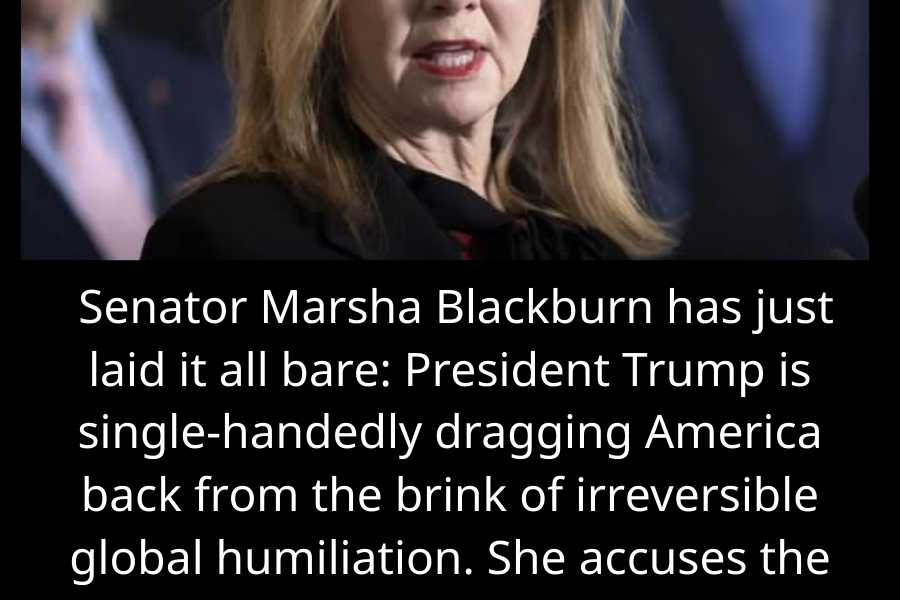
Let’s be clear from the jump: we are not here to debate policy. We are here to deconstruct a narrative. A powerful, potent, and profoundly effective story being sold to the American psyche. Senator Marsha Blackburn didn’t just issue a statement; she performed a piece of political mythology. She tapped into a specific, resonant frequency of American emotion: the longing for a lost golden age, the catharsis of a promised restoration.
The script, as she delivered it, is clean, binary, and emotionally satisfying:
-
Act I (The Fall): The “Obama-Biden era.” The descriptors are intentionally visceral: “weakened,” “failed deals,” “ignored threats,” “retreating leadership.” The visual is of an America on its back foot, apologetic, its strength leaching away. The disastrous Afghanistan withdrawal serves as the perfect, chaotic climax to this arc—the indelible video proof of “decline.”
-
Act II (The Crisis): “Conflicts spread, adversaries advanced, allies questioned.” At home, “Americans paid the price.” It’s a world in freefall, a direct consequence of weak leadership. The “Biden energy policies” become a metaphor: a nation voluntarily shutting off its own power.
-
Act III (The Restoration): Enter Trump, not as a politician, but as a corrective force. His tools are not bureaucracy, but willpower and deal-making. The “Board of Peace,” the Russia-Ukraine-U.S. trilateral talks—these are framed not as diplomacy, but as corporate-style, strength-backed conflict resolution. The Abraham Accords and a “war-free presidency” are the receipts. The result? “Confident, respected, leading.”
It’s a hell of a story. For a significant portion of the electorate, it doesn’t just feel political; it feels true. It explains their anxiety, names their enemies, and offers a redemptive hero.
The Professor’s Pause: A Narrative Under the Microscope
But let’s put on the gloves and place this narrative on the examination table. As a storytelling device, it’s brilliant. As unassailable fact, it’s… complicated.
1. The “Global Decline” Starting Point. This is the foundational axiom. It requires viewing the post-Cold War, pre-2016 world—a period of expanding NATO, relative great-power peace, and building global institutions—as one of American humiliation. It re-frames multilateralism as weakness, and diplomatic nuance as cowardice. This isn’t a fact; it’s an ideological lens. One that exchanges the messy, rule-based order for a transactional, power-based one.
2. The “War-Free Presidency” & The “Board of Peace.” Here’s where the narrative gets slick. Yes, no new formal wars were declared. But to sell a term as one of “peace” requires ignoring the escalation of drone strikes (with revised, looser rules of engagement), the abandonment of Kurdish allies in Syria, the peak of tensions with Iran that culminated in the assassination of Qasem Soleimani—an act many experts saw as brushing perilously close to war. The “Board of Peace” is a classic Trumpian branding maneuver: a name that declares an outcome, irrespective of the complex, ongoing reality of a brutal land war in Europe. The proposed Russia-Ukraine-U.S. talks are less a detailed plan and more a theatrical gesture of deal-making prowess, one that unnerves Kyiv and delights Moscow.
3. The Abraham Accords: The Crown Jewel. This is the undeniable diplomatic achievement. It normalized relations between Israel and several Arab states. The narrative rightly celebrates it. But a fuller analysis asks: at what cost, and for whom? The deals bypassed the Palestinian issue entirely, essentially taking it off the regional agenda. They were also heavily facilitated by massive arms sales to the signatory nations. It was a realignment based on shared antipathy toward Iran and mutual economic/security benefit, brokered by an America that offered weapons, not necessarily a lasting peace for all parties. It’s a deal, yes. Whether it’s the singular model for “peace” is a deeper question.
The Emotional Engine: Why It Resonates Beyond Fact-Checks
Blackburn’s statement works because it speaks to a feeling, not a spreadsheet. It addresses:
-
Credibility as Swagger: When she says “America’s credibility was shaken,” in this narrative, “credibility” means the fear of our adversaries. It’s restored not by predictable adherence to treaties, but by unpredictable, unilateral action.
-
Leadership as Dominance: “Leading on the world stage” is redefined. It’s not about being the primus inter pares (first among equals) in an alliance. It’s about being the undisputed center of attention, the deal-maker who commands the room, whose resolve is measured by his tweets, not his treaties.
-
The Price Paid at Home: This is the masterstroke. It links a diffuse sense of economic grievance and cultural displacement to foreign policy. High gas prices? Weak leadership abroad. A sense of disrespect? Global decline. The narrative offers a cohesive worldview where every domestic discomfort has a foreign policy cause, and thus, a strongman solution.
The Counter-Narrative: What Gets Edited Out
No restoration story is complete without the selective editing. This one quietly shelves:
-
The systemic damage to diplomatic corps and traditional alliances (famously, “the Germans are bad, very bad”).
-
The embrace of autocrats like Putin and Kim Jong Un, not as adversaries to be managed, but as strong leaders to be admired—a direct subversion of the post-WWII ideal of democratic leadership.
-
The concept of “soft power”—the appeal of American culture, ideals, and education—which was often openly derided as irrelevant.
The Verdict: A Story of Power, Not Proof
Senator Blackburn has articulated the core foreign policy faith of Trumpism. It is a faith that values will over wonks, momentum over multilateralism, and perceived strength over painstaking statecraft.
It is not, and does not seek to be, a balanced assessment. It is a campaign manifesto wrapped in a redemption epic. Its power lies in its simplicity, its emotional resonance, and its offer of clear, forceful answers in a terrifyingly complex world.
Whether you view it as a blueprint for national renewal or a dangerous oversimplification depends entirely on whether you believe the world is a boardroom to be dominated, or a fragile, interconnected system to be carefully stewarded. That, more than any individual policy, is the chasm that defines our age.
The restoration is not a fact. It is a story being told. And in politics, as any Gen Z professor knows, the best story often wins.