The Anne Frank Analogy: When a Governor’s Rhetoric Crosses the Historical Rubicon
The Soundbite That Silenced a Room
Let’s not bury the lede. It’s too explosive, too visceral, too loaded with historical ghosts.
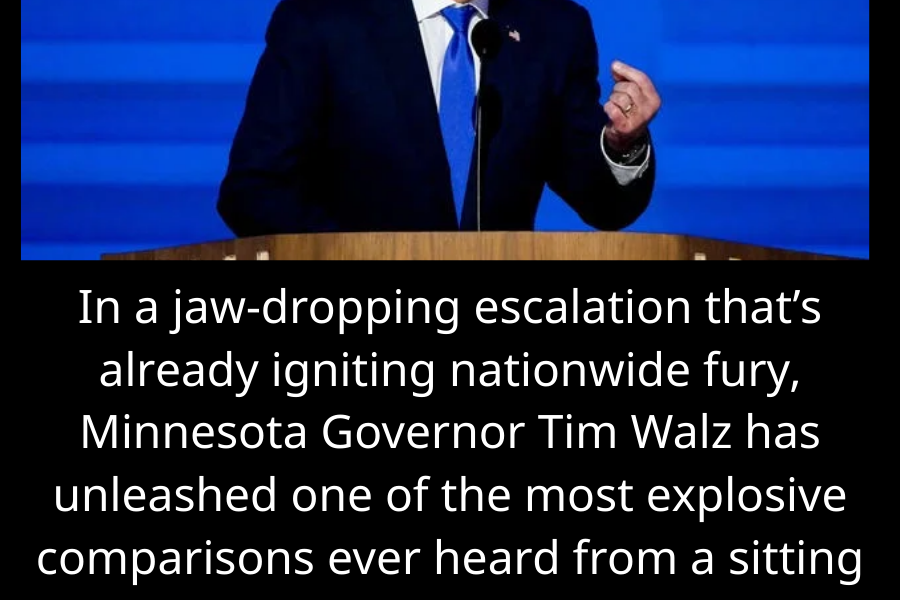
In the wake of a second fatal shooting involving federal immigration officers in Minneapolis, Minnesota Governor Tim Walz stood before microphones. The air was thick with tension, grief, and outrage—a familiar recipe for political rhetoric that aims to match the moment’s temperature. Then, he reached into the darkest cupboard of 20th-century history and pulled out a reference meant to shock the system into understanding.
“We have got children in Minnesota hiding in their houses, afraid to go outside. Many of us grew up reading that story of Anne Frank. Somebody’s gonna write that children’s story about Minnesota.”
Cue the record scratch. The digital silence. Then, the explosion.
In one sentence, Governor Walz—a former high school teacher, a man who presumably understands the weight of analogy—drew a direct narrative line from the secret annex in Amsterdam, where a Jewish girl hid from Nazi genocide, to the homes of immigrant families in the American Midwest, hiding from ICE. He didn’t just invoke fear; he invoked The Holocaust. The ultimate benchmark of human evil. The event that has spent decades under the solemn, academic warning: “Never Again,” and more recently, “Never Compare.”
This isn’t just a headline. It’s a rhetorical event horizon. Once you cross it, there’s no coming back to normal discourse.
Deconstructing the Calculus of Comparison
Why do it? As a professor of narrative, you have to ask: what’s the strategic play here? Let’s put on the analytical glasses, even as our moral compass spins.
1. The Amplification Gambit. In a media landscape numb to statistics—“X number of deportations, Y number of raids”—how do you make people feel the urgency? You attach it to the most universally recognized symbol of persecution in modern memory. You’re not just saying “this is bad.” You’re saying, “This is historically catastrophic bad.” It’s the nuclear option of empathy-generation. The goal: to shortcut the debate over policy and land directly in the realm of sacred moral imperative.
2. The Teacher’s Instinct, Gone Rogue. Walz was a teacher. He knows the power of a story to shape young minds. The Diary of Anne Frank is a foundational text of empathy in Western curricula. By invoking it, he’s attempting to frame the current situation not as a political dispute, but as a foundational moral failure students will read about in 50 years. He’s trying to write the first line of that future textbook, today.
3. The Localization of Trauma. He’s not talking about abstract “immigrants.” He’s saying the story is about Minnesota. Your streets. Your neighbors. The snow-blown neighborhoods you drive through. He’s taking a global historical trauma and planting its terrifying seed in the frozen soil of the Upper Midwest. It’s a brutal act of psychological transference.
The Backlash: When a Bridge to Empathy Burns Its Own Supports
But here’s where the strategy, however passionately felt, collides with the third rail of historical discourse.
The Holocaust is not an analogy. For scholars, for survivors, for the Jewish community, it is a singular, industrialized, ideologically-driven campaign of annihilation. To wield it as a rhetorical tool, even for a cause deemed just, risks commodifying its unique horror. It turns the six million into a metaphor, and metaphors can be diluted, debated, and dismissed.
The immediate counter-argument is potent and predictable: “This is insulting to the memory of the Holocaust. ICE agents are not SS officers. Deportation, however tragic, is not genocide.” The conversation instantly pivots from the plight of frightened children in Minneapolis to a seminar on comparative atrocity. The original intent—to amplify a local crisis—gets lost in a firestorm about historical propriety.
Walz, in his attempt to sound the loudest possible alarm, may have inadvertently handed his opponents the perfect deflection. They no longer have to defend the actions of federal agents; they can simply, and with moral outrage, defend the sanctity of Holocaust memory.
The Unignorable Core of Truth in the Hyperbole
Yet. And this is a crucial yet.
Strip away the incendiary comparison. Ignore the historical parallel. What’s left at the core of Governor Walz’s statement?
“We have got children in Minnesota hiding in their houses, afraid to go outside.”
That is not a metaphor. That is, by all journalistic accounts from immigrant communities in the Twin Cities, a reportable fact. The fear is real. The trauma of children who have seen neighbors taken, who hear a knock on the door and freeze, is real and measurable. The two fatal shootings by federal officers (regardless of the full, complex circumstances of each) have poured gasoline on that fear.
Walz’s fatal error might not have been in identifying the climate of terror, but in reaching for the wrong historical dictionary to describe it. America has its own lexicon of state-inflicted fear on communities: the Trail of Tears, the Fugitive Slave Act, the internment of Japanese Americans. These are indigenous American horrors that provide a fraught, but perhaps more structurally relevant, framework.
The Aftermath: What Happens When the Dust Settles?
So where does this leave us?
For immigrant advocates, it’s a mixed blessing. The comment dominates the news cycle, shining a brutal, unforgiving light on their cause. But it also risks alienating moderates who flinch at the comparison.
For political discourse, it’s another descent into the battlefield of superlatives, where every conflict becomes a “war,” every opponent a “fascist,” and every policy a potential “genocide.” When everything is the worst thing ever, language itself becomes bankrupt.
For the children hiding in their houses, the debate over rhetorical appropriateness is a distant noise. Their reality is the pounding heart, the drawn curtain, the whispered instruction. Governor Walz heard that reality and reached for the biggest megaphone he could find, forged in the fires of history.
Whether that megaphone amplifies their cry or drowns it out in a chorus of historical debate is the unanswered question hanging over Minnesota tonight. The story he fears may indeed be written. But its first draft, it turns out, is a raging controversy.