The Truth Tribunal: Hillary Clinton and the Case for Criminalizing “Disinformation”
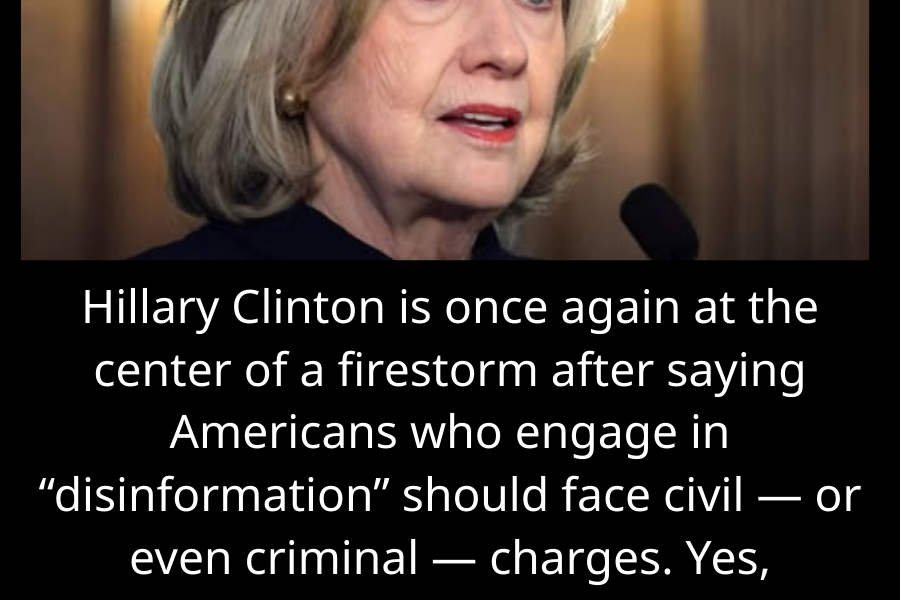
NEW YORK — The proposal emerges not from a legal scholar’s journal, but from a political figure for whom “disinformation” is not an abstract threat, but a visceral, career-defining scar. Hillary Clinton’s call to subject domestic purveyors of “propaganda and misinformation” to civil or criminal liability is more than a policy suggestion. It is a philosophical declaration of war on the current American information ecosystem, born from her direct experience as its most prominent victim.
She is not merely pointing out a problem. She is proposing a new legal frontier, where the weaponization of falsehoods moves from a social media ToS violation to a potential courtroom offense. Her framing—juxtaposing foreign interference (Russian ops) with domestic “propaganda”—blurs the line between geopolitical adversary and domestic political opponent, raising a profound and dangerous question: In the war for truth, who becomes the enemy within?
The Core Proposition: From Platform Moderation to State Prosecution
Clinton’s argument rests on a premise that is both widely accepted and terrifyingly subjective: the current system of algorithmic amplification and platform self-policing is catastrophically “broken.” AI deepfens, hyper-partisan media ecosystems, and incentive structures that reward engagement over accuracy have created a “firehose of falsehood” that she believes drowns out democratic discourse.
Her solution is a radical escalation: move beyond content moderation (deplatforming, demonetization) and into the realm of state-enforced consequences. This implies creating legal definitions and standards for “domestic propaganda” and “misinformation” that are actionable in court.
“This is the juridification of truth,” explains Dr. Evelyn Park, a constitutional law scholar. “Clinton is proposing that the state take on a role historically reserved for debate, journalism, and counterspeech: determining punishable falsehoods. The immediate, insurmountable problem is the definitional trap. Who decides what is ‘misinformation’ versus vehement disagreement, satire, speculation, or error? A statement about vaccine efficacy, election integrity, or a politician’s past could be deemed ‘criminal misinformation’ by one administration and ‘protected speech’ by the next. It creates a heckler’s veto powered by the prosecutorial state, where the threat of lawsuits or charges chills not just lies, but robust, messy political speech.”
The reference to “complementing efforts to counter foreign interference” is the most legally and rhetorically charged aspect. It implicitly frames certain domestic speech as akin to a hostile foreign intelligence operation—a form of intellectual sedition. This is the logic that could be used to justify extraordinary measures.
The Political Subtext: A Personal Reckoning and a Partisan Minefield
Clinton’s stance cannot be divorced from her history. She views herself as the primary casualty of a disinformation campaign that blended foreign hacking (WikiLeaks), domestic media manipulation, and viral conspiracy theories (Pizzagate). For her, this is not academic; it is personal and vindicative.
Politically, this proposal is a gift to her opponents. It allows them to frame her as the avatar of a “liberal elite” seeking to criminalize dissent and deploy the legal system against critics. The soundbite writes itself: “Hillary Clinton wants to jail her political opponents for ‘misinformation.'” It plays directly into the conservative narrative of a “weaponized DOJ” and “cancel culture” gone criminally punitive.
For many on the left, weary of conspiracy theories and hate speech, the appeal is visceral. It promises accountability and a cleaner information space. But it requires a staggering faith in the state’s ability—and right—to arbitrate political truth.
The Constitutional Abyss: The First Amendment as the Final Boss
Any such law would face an immediate, likely successful, First Amendment challenge. U.S. jurisprudence has consistently protected false statements, with extremely narrow exceptions (defamation, fraud, incitement to imminent lawless action, perjury). The Supreme Court, in cases like United States v. Alvarez (2012), has ruled that “false statements of fact” are protected unless they cause a legally cognizable harm under one of those established exceptions.
Creating a new category of criminal “political misinformation” would require the Court to overturn decades of precedent establishing that the remedy for false speech is more speech—truth, not incarceration. The “chilling effect” on journalism, activism, and everyday political argument would be profound.
The Practical (and Orwellian) Nightmare
Even if constitutional hurdles were overcome, the implementation is a dystopian puzzle:
-
The Arbiter: Would a new federal “Truth Commission” be established? Would the DOJ set up a “Disinformation Task Force”?
-
The Standard: Is it “knowing” falsehood? “Reckless disregard” for truth? How is intent proven?
-
The Scale: Does this apply to a Twitter user with 50 followers? A talk radio host? A major cable news network? The former president?
The potential for abusive, partisan enforcement is not a risk; it is the inevitable outcome.
The Bottom Line
Hillary Clinton’s proposal is a sign of profound democratic despair. It is the conclusion that the marketplace of ideas is not just inefficient, but poisoned beyond repair, and that survival requires the heavy hand of the state to seize control of the narrative.
It is a vision that swaps one existential threat for another. It trades the chaos of a “broken” information system for the authoritarian clarity of state-defined truth. The road from combating foreign interference to prosecuting domestic “propaganda” is short, and it leads directly to the politicization of justice and the end of open debate.
She is correct about the disease: the ecosystem is broken, and lies can have devastating real-world consequences. But her proposed cure is arguably more fatal. In seeking to jail the liars, she risks building the legal architecture that a future authoritarian could use to jail the truth-tellers. The line between protecting democracy and preemptively dismantling its core freedom is the line she is now asking America to cross.