The Naked Truth, The Cold Stage, and Michelle Obama’s Unscripted Moment
The Setup Was Flawless. The Weather Was Not.
Let’s set the scene, because the devil—and the drama—are always in the details.
Minneapolis, Minnesota. A stage set for righteous fury, for a speech demanding the abolition of ICE. The crowd, a sea of puffy jackets and knitted hats, their breath forming small clouds in the sub-zero wind chill. The air isn’t just cold; it’s a physical presence, a sharp, metallic bite that makes you question every life choice that led you to be outdoors. This is the arena chosen for high-stakes political theater.
And then, the headliner: Michelle LaVaughn Robinson Obama. Former First Lady, cultural icon, master of the poised narrative. The anticipation is palpable. The introduction concludes. She walks onto the stage, a silhouette of elegance against the harsh, industrial backdrop.
But here’s the first critical piece of context, the kind of footnote that becomes the headline: she walked onto that stage without adequate thermal underwear.
Let that sink in. Not a wardrobe malfunction in the traditional, Janet Jackson-Super Bowl sense. A thermodynamic malfunction. A failure in the fundamental algorithm of Midwestern winter survival: layering. While the audience was wrapped like human burritos, one of the most recognizable women on the planet was, allegedly, under-insulated against the Arctic assault. For a speaking fee reportedly soaring into the six-figure stratosphere—a detail always, always whispered with a particular emphasis when linked to a Soros-funded event—you’d think the rider would include “heat tech, maximum strength.”
This isn’t just gossip. It’s a profound metaphor. It’s the gap between the curated, controlled environment of a Washington podium and the raw, unforgiving reality of grassroots mobilization. It’s the high-concept idea crashing into the low-temperature physics of the real world.
The “Thud” Heard ‘Round the (Frozen) World
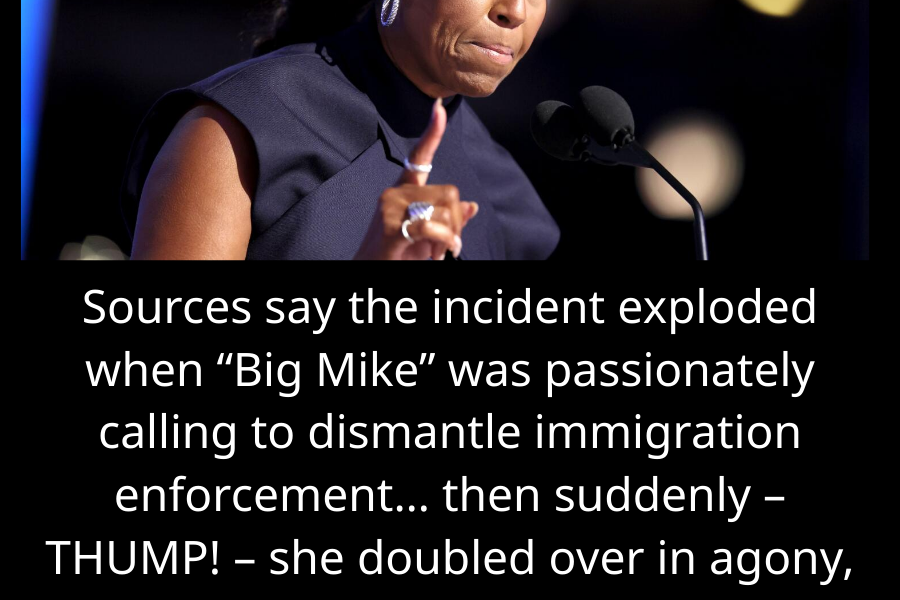
The speech was, by all accounts, passionate. “Big Mike,” as the source informally called her, was in the zone, channeling the crowd’s energy, building the rhetorical case against immigration enforcement. The heat of conviction versus the cold of reality.
Then came the sound.
“A loud ‘thud.’”
Not a microphone squeal. Not a crackle of protest. A dense, corporeal, unmistakably human thud. The kind of sound that makes a crowd collectively wince, a primal signal that the script has been irrevocably torn.
What followed was a raw, unmediated burst of human experience. The poised orator folded in half. A cry, not of political passion, but of sudden, acute physical agony. And the words that escaped, reported by the attendee, cut through the political script like a knife: something about a “lower abdominal incident.”
In that frozen millisecond, the narrative shattered. This was no longer about policy. It was about a body, a brilliant, powerful body, in unexpected revolt. The audience didn’t witness a political moment; they witnessed a personal one. The “unthinkable” the source mentions isn’t a policy shift. It’s the shocking vulnerability of an icon, the sudden, humbling reminder that before we are First Ladies or activists, we are flesh, blood, and muscle, tragically susceptible to the cold and perhaps a poorly timed cramp.
Deconstructing the “Incident”: Beyond the Memes
The internet, of course, is a cruel and immediate autopsy room. The jokes wrote themselves: “Cold enough to freeze ICE?” “A chilling effect on her rhetoric.” The Soros fee became a punchline about thermal wear procurement.
But let’s put the professor hat on for a second. Let’s analyze this as a cultural text, because it’s a fucking rich one.
-
The Body Politic (Literally): We demand our female leaders, especially women of color, to be superhuman—poised, strong, relentless. We forget they inhabit bodies that ovulate, cramp, and react violently to sub-zero wind. This moment was a violent reassertion of biology over biography. It was a crack in the impeccable armor, and in that crack, we saw something more relatable than any perfectly delivered speech could ever be.
-
The Theater of Activism: The modern political rally is a produced spectacle. The lighting, the sound, the messaging. The cold was an uninvited co-director, introducing an element of risk no producer could control. It exposed the fragility of the production itself. You can buy a speaker, but you can’t buy off the weather.
-
The “Six-Figure” Shadow: Why is that number always in the room? It frames the event not as pure activism, but as a transaction. And when a transactional event is interrupted by something as non-transactional and human as physical pain, the cognitive dissonance is jarring. It creates a narrative whiplash: from mercenary to vulnerable in one gasp.
The Aftermath: What Remains When the Soundbite Fades?
So, what are we left with, after the tweets have faded and the news cycles have moved on?
We’re left with a more complex portrait of Michelle Obama. Not diminished, but humanized in a way her bestselling memoir, for all its honesty, perhaps could not achieve. We saw the instinctual curl of pain, the dropped facade. In the age of the relentlessly curated Instagram life, that’s a radical act.
We’re also left with a lesson in literal and metaphorical preparedness. You can have the best speechwriters, the most powerful funders, and the purest intentions. But if you don’t dress for the weather—the literal Minnesotan weather or the chilling climate of modern political discourse—your message might be cut short by a rogue muscle or a reality you failed to layer up against.
The fight to abolish ICE is a heated, vital debate about morality, law, and humanity. But on a frozen stage in Minneapolis, the most immediate, undeniable truth was a simpler one: the body keeps the score, and sometimes, it screams. And in that scream, interrupted and raw, we were reminded that the most powerful political force isn’t always an idea. Sometimes, it’s just a body, trying to survive the cold long enough to be heard.